The next Bitcoin halving is projected to occur in April 2028, when the network reaches block height 1,050,000. At that point, the block reward will drop from 3.125 BTC to 1.5625 BTC per block. Roughly 99,000 blocks remain as of May 2026, which translates to approximately 694 days at the current average block time.
Four halvings have already taken place, in 2012, 2016, 2020, and 2024. Each one cut the rate of new Bitcoin entering circulation by half. Each one was followed, eventually, by a significant rise in price. The 2028 event will be the fifth halving, and it arrives in a market that looks structurally different from any previous cycle, with spot Bitcoin ETFs established, institutional holdings at record levels, and the network hashrate at all-time highs.
This guide covers the expected date, why different tracking platforms show different dates, the full history of past halvings, what happened to price after each one, what makes 2028 different, and what miners should prepare for.
What Is the Bitcoin Halving
The Bitcoin halving is a pre-programmed reduction in the reward that miners receive for adding a new block to the blockchain. It happens automatically every 210,000 blocks, which works out to roughly every four years based on Bitcoin’s target block time of 10 minutes. The halving is hardcoded into Bitcoin’s protocol and cannot be changed by any individual, company, or government.

When a miner successfully validates a block of transactions and adds it to the chain, the protocol issues a fixed number of new bitcoins as the block reward. This reward is the only mechanism through which new Bitcoin enters circulation. Halving that reward every 210,000 blocks means the rate of new supply is cut in half repeatedly over time, making Bitcoin progressively scarcer.
How the Halving Mechanism Works
Bitcoin’s mining algorithm targets one new block every 10 minutes on average. In practice, actual block times vary. Some blocks are found in under a minute, others take 20 minutes or more. To keep the average close to 10 minutes, the protocol runs a difficulty adjustment every 2,016 blocks, which is approximately every two weeks. If blocks are coming in faster than the target, difficulty increases. If slower, it decreases.
The halving itself is not triggered by time but by block count. When the cumulative number of mined blocks hits a multiple of 210,000, the reward drops. This means the exact calendar date of any halving cannot be known in advance with precision. The closer the network gets to the target block, the more accurate the date estimate becomes.
For a detailed breakdown of how block rewards are structured and what they mean for the network, the guide on Bitcoin block rewards covers the full mechanics.
Why the Halving Was Built Into Bitcoin
Satoshi Nakamoto designed Bitcoin as a deflationary asset. Unlike fiat currencies, where central banks can increase supply at will, Bitcoin has a hard cap of 21 million coins. The halving schedule is the mechanism that enforces that cap over time. By reducing the rate of new issuance every four years, Bitcoin’s total supply approaches 21 million asymptotically, with the last bitcoin expected to be mined around 2140.
The intent was to create digital scarcity. As new supply slows and demand grows or holds steady, basic supply and demand economics create upward pressure on price. This is the theoretical foundation behind the “halving as bullish event” narrative that the market has repeated across four cycles.
Bitcoin Halving 2028 Date: When Will It Happen
The bitcoin halving 2028 date is projected to fall in April 2028, specifically in the April 17-19 range based on current block time averages. The network needs to reach block 1,050,000 to trigger the halving. As of May 25, 2026, approximately 99,000 blocks remain.

At the current average block time of roughly 10 minutes and 6 seconds per block, those remaining blocks translate to about 694 days. That places the halving in mid-April 2028. However, if the network mines blocks slightly faster on average, the date shifts earlier. If slower, it shifts later.
Why Different Platforms Show Different Dates
If you check multiple tracking sites, you will find different projected dates for the 2028 halving. CoinWarz projects April 18, 2028. Swan Bitcoin shows March 26, 2028. Crypto.com lists March 26 as well, while BeinCrypto and Bitcoin.com News point to April 17-19. The range spans nearly a month.
The reason is that each platform uses a different method for calculating the average block time. CoinWarz bases its calculation on the average of the last 20,160 blocks, which is the most recent two weeks of data. Swan Bitcoin may use a longer historical average. When the network has been mining slightly faster than 10 minutes on average, shorter time windows catch that speed and project an earlier date. Longer windows smooth it out and project later.
Neither approach is wrong. Both are estimates. As the network approaches block 1,050,000, the estimates from all platforms will converge. The safe working assumption is sometime between late March and late April 2028, with April being the current consensus among data-heavy sources.
What Happens at Block 1,050,000
The moment the Bitcoin network mines block 1,050,000, the block reward drops from 3.125 BTC to 1.5625 BTC. Every block after that pays miners 1.5625 BTC until block 1,260,000 triggers the sixth halving in approximately 2032.
The 2028 halving carries one distinction that no future halving will share: it is the last halving where the reward includes a number that, while fractional, still reads as a recognizable denomination. After 2028, rewards will fall below 1 BTC per block for the first time. The 2032 reward drops to 0.78125 BTC. From that point forward, rewards will be sub-1 BTC fractions indefinitely.
Currently, Bitcoin miners collectively produce approximately 450 BTC per day. After the 2028 halving, daily issuance drops to roughly 225 BTC per day. With more than 19.7 million of the 21 million total supply already mined, the remaining issuance over all future halvings is less than 1.3 million BTC.
Bitcoin Halving History: All Four Cycles
Every halving cycle has produced a different set of market conditions, a different starting price, and a different outcome.

The table below shows the confirmed data for all four completed halvings.
| Halving | Date | Block Height | Reward Reduction | BTC Price on Halving Day |
|---|---|---|---|---|
| First | November 28, 2012 | 210,000 | 50 BTC to 25 BTC | $12.40 |
| Second | July 9, 2016 | 420,000 | 25 BTC to 12.5 BTC | $680 |
| Third | May 11, 2020 | 630,000 | 12.5 BTC to 6.25 BTC | $8,590 |
| Fourth | April 20, 2024 | 840,000 | 6.25 BTC to 3.125 BTC | $64,025 |
The price at each successive halving has been significantly higher than at the previous one, by a factor of roughly 55x from 2012 to 2016, 12x from 2016 to 2020, and 7.5x from 2020 to 2024. The percentage gain between halvings is shrinking, which reflects a maturing market, larger capital base, and reduced volatility compared to the early years.
2012: The First Halving and What Followed
The first halving on November 28, 2012 cut the reward from 50 BTC to 25 BTC. Bitcoin was trading at $12.40 on that day. The event passed with little mainstream attention. Over the following 12 months, Bitcoin’s price climbed to $1,170, a gain of more than 9,000%. The primary driver was growing awareness of Bitcoin via dark web markets and the first wave of retail speculation. The halving reduced daily issuance, but demand growth was the dominant force.
2016: The Second Halving and the Bull Run
The second halving on July 9, 2016 reduced the reward from 25 BTC to 12.5 BTC. Bitcoin was at $680. The price remained relatively flat for several months before beginning a sustained rally in late 2016 that carried through 2017, eventually reaching $19,400 in December of that year. The 2017 bull market coincided with the ICO boom on Ethereum, which pulled broad attention and capital into crypto for the first time at scale. Bitcoin led the initial move, then altcoins took over.
To understand why Bitcoin holds its position as the reference asset through every cycle, the comparison of Bitcoin versus other cryptocurrencies explains the structural differences that drive capital back to BTC.
2020: The Third Halving and the Institutional Entry
The third halving on May 11, 2020 cut the reward from 12.5 BTC to 6.25 BTC. Bitcoin was trading at $8,590. What followed was the largest bull run in Bitcoin’s history in absolute dollar terms. By November 2021, Bitcoin hit $69,000, a gain of roughly 700% from the halving price. Two factors drove this beyond the supply reduction: pandemic-era stimulus flooding into risk assets, and the first wave of institutional adoption from companies like MicroStrategy and Square adding Bitcoin to their balance sheets.
2024: The Fourth Halving and the Broken Pattern
The fourth halving on April 20, 2024 reduced the reward from 6.25 BTC to 3.125 BTC. Bitcoin was already at $64,025, having already reached a new all-time high of $73,628 in March 2024, one month before the halving. This broke the historical pattern. In all three prior cycles, Bitcoin reached its all-time high many months after the halving, not before it.
The reason was the approval of spot Bitcoin ETFs in the United States in January 2024. ETF inflows brought institutional capital into Bitcoin through a regulated vehicle for the first time, pulling the demand surge forward. The bull cycle peak came in January 2025, when Bitcoin reached $109,078. The post-halving rally happened, but from a much higher base than any previous cycle, and it started earlier.
This shift in timing matters significantly for how investors should think about 2028. The idea that price always lags the halving by 6-12 months was based on three data points. The fourth data point broke it.
How Bitcoin Price Has Moved After Each Halving
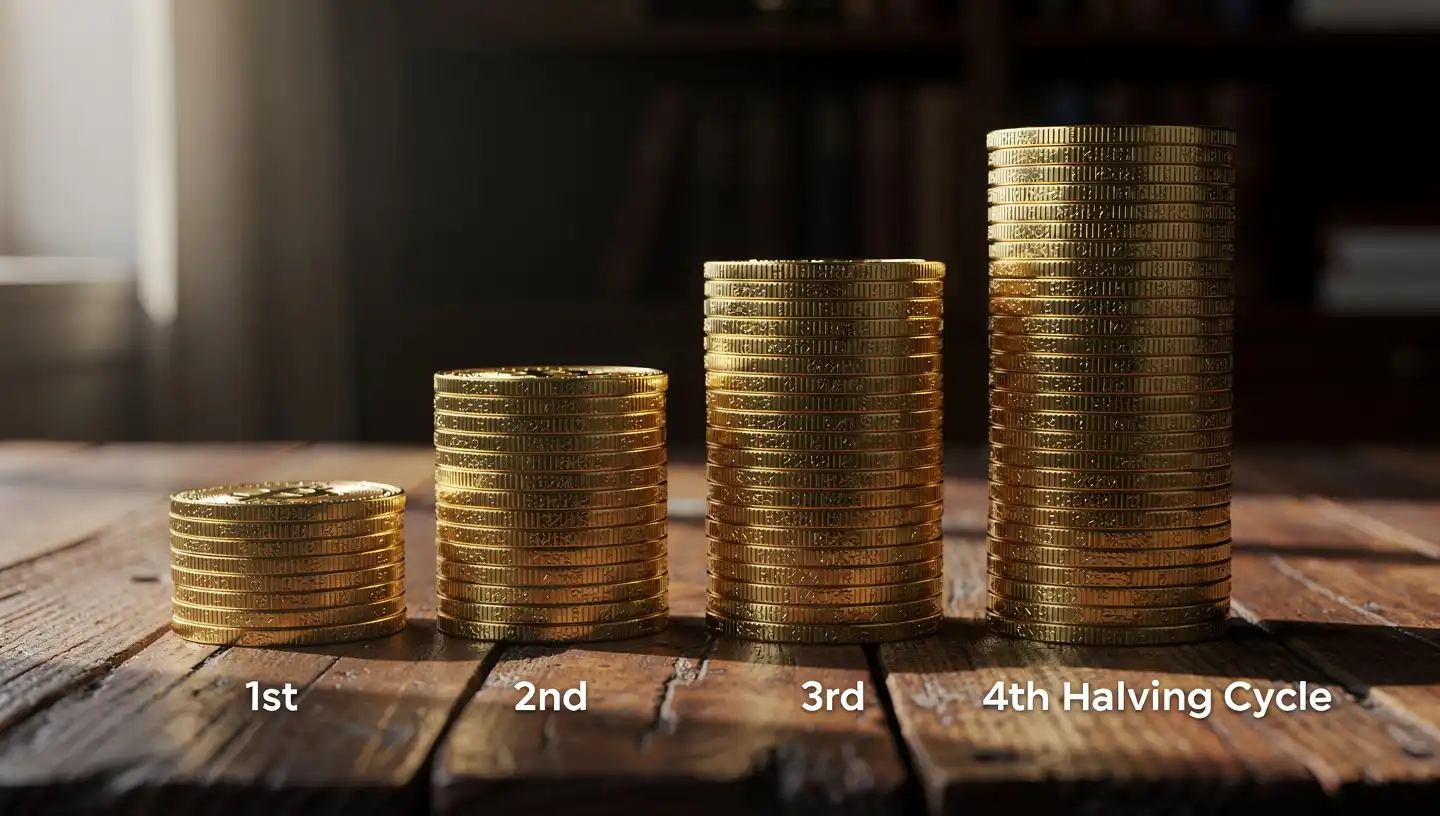
The table below shows the price range across each complete halving cycle, from the halving date to the next halving.
| Cycle | Halving Price | Cycle High | Gain from Halving | Months to Cycle High |
|---|---|---|---|---|
| 1st cycle (2012-2016) | $12.40 | $1,170 | +9,335% | ~12 months |
| 2nd cycle (2016-2020) | $680 | $19,400 | +2,753% | ~17 months |
| 3rd cycle (2020-2024) | $8,590 | $73,628 | +757% | ~18 months |
| 4th cycle (2024-2028) | $64,025 | $109,078 (Jan 2025) | +70% (so far) | ~9 months post-halving |
Two clear trends emerge from the data. First, the percentage gain after each halving shrinks as the market matures and the capital required to move price grows. Second, the absolute dollar gain increases with each cycle even as the percentage return falls. The third trend, that cycle highs come 12-18 months after the halving, held for three cycles and then shifted forward in 2024 due to ETF-driven demand.
The Pattern: Accumulation, Rally, Peak
Across the first three cycles, Bitcoin followed a recognizable sequence. In the months leading up to the halving, price would gradually climb as anticipation built. After the halving, there was often a flat or consolidation period lasting several months. Then a sustained post-halving rally began, typically peaking 12-18 months after the event, followed by a sharp drawdown that erased 70-85% of the gain.
The accumulation phase before the halving is when long-term holders typically increase positions based on the expectation of reduced supply. Whether this front-running of the event reduces the post-halving upside is one of the central debates heading into 2028.
Why 2024 Was Different from All Previous Cycles
The launch of spot Bitcoin ETF products in January 2024 fundamentally changed the demand side of the equation. Products from BlackRock, Fidelity, and others gave institutional investors, pension funds, and retail investors a familiar, regulated way to gain Bitcoin exposure without holding the asset directly. Inflows were immediate and substantial, pulling the demand surge that previous cycles saw after the halving into the pre-halving window instead.
By the time the fourth halving actually occurred in April 2024, much of the market had already priced in the supply reduction. Bitcoin hit its pre-halving all-time high a full month before the event. The subsequent rally to $109,078 in January 2025 still happened, but it was more compressed and started from a higher base than any previous cycle peak.
This context is important for anyone studying how Bitcoin halvings work and how the market has historically responded to each one.
What Makes the 2028 Halving Different from All Previous Ones
The 2028 Bitcoin halving will occur in a market that did not exist during any prior halving. Spot ETFs are now established products with years of inflow history. Institutional holdings are at unprecedented levels. The network hashrate is at all-time highs. And the remaining supply of unmined Bitcoin is smaller than it has ever been.
Institutional Holdings Going Into 2028
Previous halvings in 2012, 2016, 2020, and 2024 all occurred before spot Bitcoin ETFs existed at scale in the United States. The 2028 halving is the first to take place with institutional accumulation not just present but historically large. As of mid-2026, Strategy holds approximately 843,738 BTC and BlackRock holds approximately 817,138 BTC. Together those two entities alone hold over 1.66 million BTC, representing roughly 7.9% of the total 21 million coin supply cap.
This level of institutional concentration means a meaningful share of Bitcoin’s circulating supply is held by entities with long time horizons and no urgent pressure to sell. When the 2028 halving cuts daily issuance to 225 BTC per day, the combination of reduced new supply and large, sticky institutional holdings creates a supply picture that has no historical precedent.
The growing role of Bitcoin dominance in measuring capital flows across the entire crypto market reflects how central Bitcoin has become as the primary institutional entry point into digital assets.
The Last Halving Where the Reward Includes a Familiar Denomination
The 1.5625 BTC block reward after 2028 will be the last halving reward that reads as a number most people can visualize. After the 2032 halving, the reward drops to 0.78125 BTC. After 2036, it falls to 0.390625 BTC. From that point forward, block rewards become increasingly small fractions. While this has no direct impact on Bitcoin’s price or security, it marks a psychological milestone: for the first time since 2009, miners will receive less than 1 BTC per block.
Record Hashrate and What It Means for Miners
Bitcoin’s network hashrate has hit record highs repeatedly through 2025 and into 2026. More computational power is being directed at mining Bitcoin today than at any point in its history. This creates a paradox heading into 2028: the network is more secure than it has ever been, but the revenue per block is about to be cut in half for the fifth time.
Miners who entered the current cycle with efficient hardware and low electricity costs will be better positioned to absorb the reward cut. Those operating older equipment at higher costs will face margin compression regardless of where Bitcoin’s price trades after the halving. The current record hashrate means the mining difficulty is also near all-time highs, making it harder than ever to mine the same number of blocks. For a full picture of how this dynamic plays out, the analysis of Bitcoin mining difficulty explains the adjustment mechanism in detail.
What the 2028 Halving Means for Bitcoin Miners
For miners, the halving is the single most consequential scheduled event in their business calendar. The 2028 reward cut from 3.125 BTC to 1.5625 BTC per block means revenue per block drops by 50% overnight, while operating costs, electricity bills, and hardware depreciation do not.
The question every mining operation faces before each halving is the same: will the price of Bitcoin rise enough after the halving to compensate for the reduced reward, and if so, how long will that take? Operations that cannot survive the gap between the reward cut and any subsequent price increase face shut down or consolidation.
How Miners Stay Profitable After a Reward Cut
The primary levers for mining profitability after a halving are electricity cost and hardware efficiency. Miners with access to cheap or renewable power can operate at lower break-even prices per BTC. Miners running the latest generation of ASICs produce more hashes per watt, lowering the cost to mine each block.
After each previous halving, the market has seen a pattern of less-efficient miners shutting down in the months immediately following the reward cut. This reduces total network hashrate temporarily, which triggers a downward difficulty adjustment, which in turn makes it easier and more profitable for the remaining miners. Eventually price recovery restores profitability across the industry and hashrate climbs again.
The energy dimension of mining is one of the most debated aspects of Bitcoin’s long-term sustainability. The data on Bitcoin mining energy consumption covers both the scale of current usage and the shift toward renewable sources that many large operations are pursuing ahead of 2028.
Transaction Fees as the Long-Term Revenue Model
As block rewards shrink with each halving, transaction fees become an increasingly important component of miner revenue. Currently, fees represent a relatively small share of what miners earn per block compared to the subsidy. But with the block reward at 1.5625 BTC after 2028, and eventually heading toward zero by 2140, the long-term security of the Bitcoin network depends on fees being large enough to incentivize miners to keep validating transactions.
The 2028 halving will be the first in which this fee-versus-subsidy question begins to carry real weight. If Bitcoin’s transaction volume and average fee levels grow proportionally with adoption, the revenue model transitions gradually and without disruption. If they do not, the economics of mining compress further with each subsequent halving.
The full picture of how the Bitcoin network hashrate responds to these economic pressures shows how miners collectively signal confidence or stress in real time.
What to Expect from the 2028 Bitcoin Halving
Nobody can predict what Bitcoin’s price will do after the 2028 halving. The historical pattern is real but the sample size is four events, and the fourth one already broke the pattern in a meaningful way. What can be assessed is the structural setup heading into 2028 and the scenarios that history and market mechanics suggest.
If the Historical Pattern Holds
In the first three cycles, Bitcoin reached its cycle high approximately 12-18 months after the halving. If that pattern reasserts itself in 2028, the window for the cycle peak would fall somewhere between late 2029 and mid-2030. The accumulation phase in the run-up to the halving, from late 2027 through early 2028, would be the period when long-term holders historically increase positions.
The supply side of this scenario is straightforward. Daily issuance drops to 225 BTC. Institutional holders are not selling. Exchange reserves have been declining as more Bitcoin moves into self-custody and cold storage. If demand holds or grows, the reduction in new supply has historically been enough to tip the balance.
For anyone considering how to hold Bitcoin through a halving cycle, understanding the difference between cold wallet storage and exchange custody is a practical first step.
Why the 2028 Cycle May Behave Differently
The 2024 cycle established that ETF-driven institutional demand can pull the price rally forward, ahead of the halving rather than after it. If that dynamic repeats in 2028, price could peak before block 1,050,000 is reached, as it did in March 2024 ahead of the April halving.
Additionally, the percentage gains from each halving have declined with every cycle: 9,335%, 2,753%, 757%, and roughly 70% through mid-2025 in the current cycle. This compression reflects a maturing asset class. A market cap above $1 trillion requires more capital to move meaningfully than a market cap of $200 billion. The 2028 rally, if it follows historical precedent in direction but not magnitude, may be the most modest post-halving move yet in percentage terms.
There is also a counterargument. The combination of reduced supply, record institutional holdings, and a now-established ETF market means the demand side of the equation is larger and more durable than in any previous cycle. Whether that demand offsets the diminishing-returns pattern is the open question.
Strategies Investors Use Around Halving Events
Based on historical cycles, investors have taken three main approaches around halving events:
- Dollar cost averaging (DCA): Investing a fixed amount at regular intervals regardless of price. This approach removes the pressure of timing the market and builds a position gradually through the accumulation phase leading up to the halving. Given that the exact date of the peak in any cycle is unknowable in advance, DCA has historically been the approach that avoids the worst outcomes of trying to time perfectly.
- Pre-halving accumulation: Increasing Bitcoin exposure in the 12 months before the halving based on the historical pattern of price appreciation that has followed each event. This carries timing risk, particularly now that the 2024 cycle showed the rally can come before the halving rather than after.
- Long-term hold through the full cycle: Buying and holding through the halving, the post-halving rally, and the subsequent drawdown, targeting the next cycle’s higher base rather than selling at the cycle peak. This approach requires the conviction to hold through drawdowns of 70-85% that have followed each cycle high.
None of these are investment recommendations. Each involves different risk tolerance, time horizons, and assumptions about how the 2028 cycle will behave relative to prior ones. For those managing holdings across exchanges and wallets and thinking about how to eventually move or sell after a price run, the practical guide on how to sell crypto covers the mechanics step by step.
All Future Bitcoin Halving Dates
The halving schedule runs until approximately 2140, when the last fraction of Bitcoin will be mined and block rewards reach zero.

The table below shows the projected halvings from 2028 through 2040, when the reward drops below 0.2 BTC per block.
| Halving | Year | Block Height | Block Reward After |
|---|---|---|---|
| 5th | 2028 | 1,050,000 | 1.5625 BTC |
| 6th | 2032 | 1,260,000 | 0.78125 BTC |
| 7th | 2036 | 1,470,000 | 0.390625 BTC |
| 8th | 2040 | 1,680,000 | 0.195313 BTC |
After the 2028 halving, more than 98% of all Bitcoin that will ever exist will have already been mined. The remaining 1.3 million or so BTC will be issued over the next century-plus through progressively smaller block rewards. By 2032, the block reward will be below 1 BTC for the first time. By 2036, it will be below 0.5 BTC. The economics of mining after each subsequent halving will depend increasingly on transaction fees rather than the block subsidy.
Two external references used in preparing this guide:
- CoinWarz: Bitcoin Halving Countdown and All Halving Dates
- CoinCodex: Bitcoin Halving Dates and Price History
Frequently Asked Questions
When exactly is the bitcoin halving 2028 date?
The bitcoin halving 2028 date is projected to fall in mid-April 2028, with most data sources pointing to April 17-19 based on current block time averages of roughly 10 minutes and 6 seconds. Some platforms like Swan Bitcoin and Crypto.com project March 26, 2028, based on different block time calculation windows. The halving is triggered by block height 1,050,000, not a calendar date, so the exact day will only be known as the network approaches that block. The current consensus range is late March to late April 2028.
What will the block reward be after the 2028 halving?
After the 2028 halving, the block reward drops from 3.125 BTC to 1.5625 BTC per block. Miners currently earn 3.125 BTC for each block they successfully mine and add to the blockchain. Once block 1,050,000 is mined, that reward is cut in half automatically by the protocol. Daily Bitcoin issuance will fall from approximately 450 BTC to roughly 225 BTC.
How does the halving affect Bitcoin price?
The halving reduces the rate of new Bitcoin entering circulation, which decreases the selling pressure from miners who typically sell a portion of their rewards to cover operating costs. If demand remains constant or grows while supply slows, basic economics suggest upward price pressure. In practice, all four previous halvings were followed by significant price increases, though the timing and magnitude varied. The first three cycles saw peaks 12-18 months after the halving. The fourth cycle peaked about 9 months after, having already reached a pre-halving all-time high due to ETF inflows.
Should I buy Bitcoin before the 2028 halving?
This is a personal financial decision that depends on your risk tolerance, investment horizon, and how much you already understand about Bitcoin’s volatility. Historically, buying before a halving and holding through the subsequent cycle has produced positive returns in all four completed cycles. However, past performance does not guarantee future results, percentage gains have shrunk with each cycle, and the 2024 cycle showed that patterns can change. Anyone considering a position should factor in that Bitcoin has also experienced drawdowns of 70-85% after each cycle peak. A dollar cost averaging approach over an extended period has historically reduced timing risk compared to a single large purchase. This is not financial advice.
How many Bitcoin halvings are left?
There will be approximately 29 more halvings after the 2028 event, with the last one occurring around the year 2140 when the final fraction of Bitcoin is mined and the block reward reaches zero. The total supply is capped at 21 million BTC. More than 19.7 million have already been mined, meaning over 93% of all Bitcoin that will ever exist is already in circulation. The remaining supply will be issued over more than a century through progressively smaller rewards.
What happens to miners after the 2028 halving?
When the block reward drops to 1.5625 BTC, miners with high operating costs will face reduced or negative margins. Historically, halvings trigger a temporary drop in network hashrate as less-efficient operations shut down or pause. This causes the mining difficulty adjustment to decrease, making it easier and more profitable for remaining miners. Eventually, if Bitcoin’s price rises after the halving as it has in previous cycles, profitability recovers and new miners enter. Long-term, miners will increasingly depend on transaction fees rather than block subsidies as the reward continues to shrink every four years.
Is the 2028 halving already priced in?
This is one of the most debated questions in crypto ahead of any halving. The efficient market hypothesis suggests that if everyone knows the halving is coming, the market has already priced in its effect. The counterargument, supported by the data from all four previous cycles, is that knowing something will happen and fully pricing it in are different things. The 2024 cycle showed partial front-running via ETF inflows, but a meaningful rally still followed the halving. Whether 2028 sees similar dynamics, more front-running, or something different entirely depends on factors that cannot be predicted from current data.