Bitcoin mining difficulty is a number that measures how hard it is for miners to add a new block of transactions to the blockchain. It adjusts automatically every 2,016 blocks, roughly every two weeks, to keep the average time between blocks close to 10 minutes. When more computing power joins the network, difficulty rises. When computing power leaves, difficulty falls. This self-correcting mechanism is one of the core features that makes Bitcoin predictable and secure.
What is bitcoin mining difficulty?
Bitcoin mining is a competition. Miners around the world run specialized machines that repeatedly generate numbers, called hashes, in search of one that falls below a specific value set by the protocol. That value is called the target hash. The lower the target, the harder it is to find a valid hash. Bitcoin mining difficulty is the number that controls how low that target has to be.

Every block header contains a value called a nonce, short for number used once. Miners change the nonce and run it through the SHA-256 hashing algorithm over and over until the resulting hash falls below the current target. Because the algorithm produces outputs that look random, miners cannot calculate in advance which nonce will produce a winning hash. They have to keep trying until one works. The miner who finds a valid hash first adds the next block to the blockchain and collects the block reward.
The difficulty number does not appear in the hash itself. It controls the size of the target range. A higher difficulty means a smaller range of valid hashes, which means miners have to generate more hashes on average before finding one that qualifies. Think of it like a lottery where the protocol decides how many winning tickets exist. Difficulty controls how rare those winning tickets are.
At block height 946,560, the current difficulty stands at approximately 135.6 trillion, written as 135,594,876,535,256. That number is the result of more than 15 years of continuous difficulty adjustments since Satoshi Nakamoto launched the network in January 2009 with a difficulty of 1. A full explanation of what Bitcoin is and how it works at a foundational level is in the guide to what is Bitcoin.
Why does bitcoin need a difficulty adjustment?
Without a difficulty adjustment, the block time would drift as mining conditions changed. If a large number of miners joined the network, blocks would be found faster than every 10 minutes. If miners left, blocks would slow down. Either outcome breaks the assumptions that Bitcoin’s design depends on.
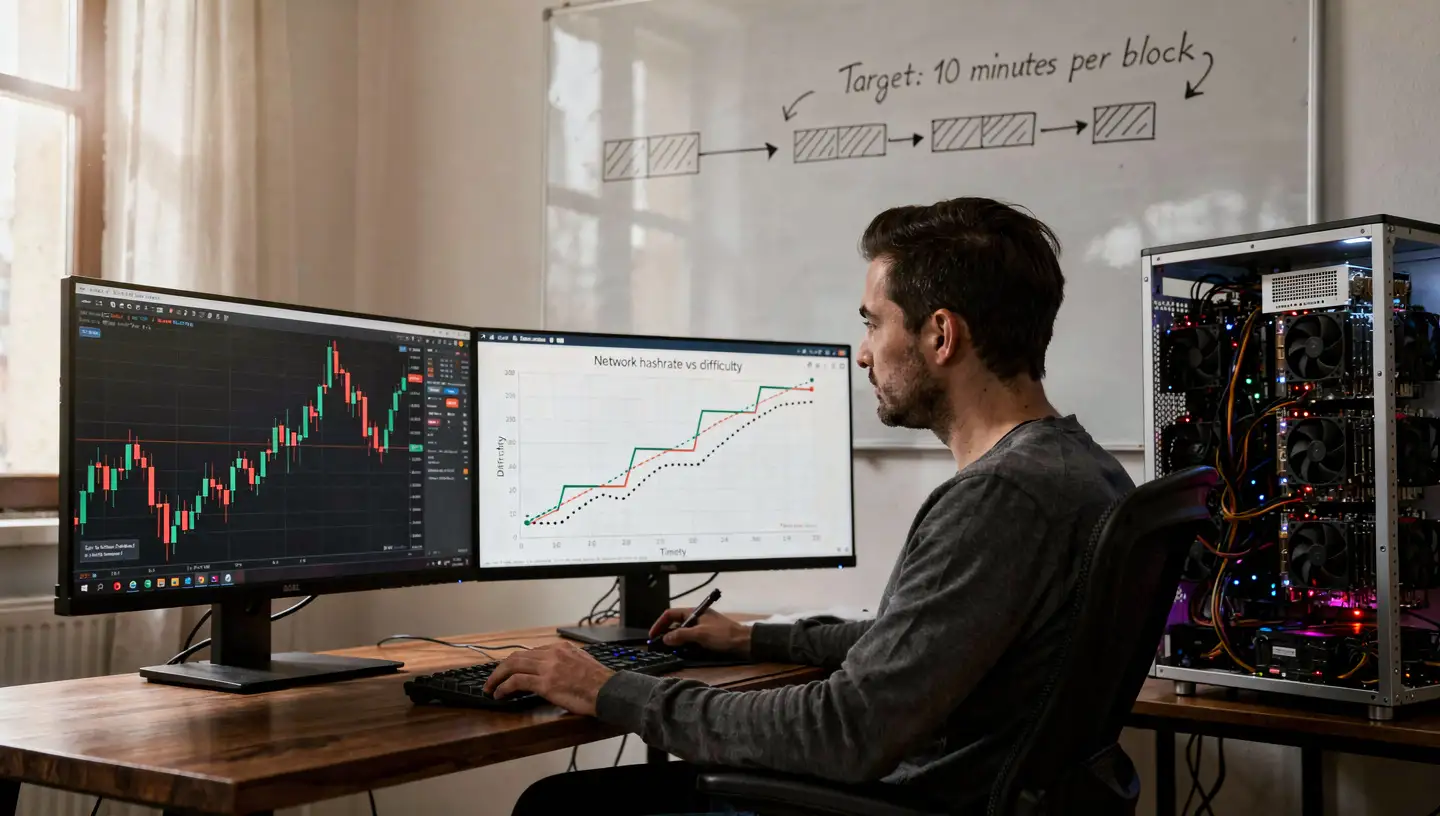
The 10-minute target is not arbitrary. It gives nodes across the world enough time to receive and validate each new block before the next one is found, which reduces the rate of orphaned blocks and keeps the chain consistent. It also determines how quickly new bitcoin enters circulation through the block reward. If blocks came every 5 minutes instead of 10, new supply would enter the market twice as fast, disrupting the fixed issuance schedule that leads to the 21 million coin cap around the year 2140.
The difficulty adjustment is what enforces that schedule regardless of how many miners are participating at any given time. Whether the network has 10 miners or 10 million, the protocol keeps new blocks arriving at roughly the same pace. That predictability is what allows anyone to calculate how much new BTC enters circulation each day and how the supply approaches its ceiling. How Bitcoin’s supply schedule and issuance work in practice is explained in the guide to how crypto works.
How is bitcoin mining difficulty calculated?
The calculation happens at the end of every epoch, which is the name for each 2,016-block period. At that point, every node on the network independently runs the same calculation and arrives at the same new difficulty. No central authority sets it. The protocol enforces it.
The 2016-block epoch
An epoch is the standard measurement period for difficulty. At 10 minutes per block, 2,016 blocks should take exactly 20,160 minutes, or 14 days. The network compares that expected figure against the actual time it took to mine the last 2,016 blocks. The difference between the two determines whether difficulty goes up, down, or stays roughly the same.
The formula: expected time divided by actual time
The adjustment formula is straightforward. Take the expected time (20,160 minutes) and divide it by the actual time it took to mine the last 2,016 blocks. Multiply the result by the current difficulty to get the new difficulty.
Here is a concrete example. If the last 2,016 blocks were mined in an average of 9 minutes each instead of 10, the actual time was 18,144 minutes. The calculation is: 20,160 divided by 18,144 equals 1.11. Multiply the current difficulty by 1.11 and you get the new difficulty, an increase of approximately 11%. Blocks were found too fast, so the protocol makes the target harder to hit.
The reverse applies when blocks are slow. If the average was 11 minutes per block, the actual time was 22,176 minutes. Dividing 20,160 by 22,176 gives 0.91. The new difficulty is 9% lower. The target widens, making it easier for miners to find valid hashes and bringing the block time back toward 10 minutes.
The 4x cap on difficulty changes
The protocol includes a safety limit: difficulty can only change by a factor of 4 in a single adjustment. It cannot increase by more than 4x or decrease by more than 75% in one epoch. This cap prevents a catastrophic adjustment in cases where hash rate changes dramatically over a short period. Without it, an extreme event like a sudden loss of most of the network’s computing power could send difficulty so low that the network becomes trivially easy to attack before miners have a chance to react. The 4x cap has never been hit in Bitcoin’s history, but the protection is written into the code.
What causes bitcoin difficulty to rise or fall?
The primary driver of difficulty changes is the total hash rate of the network, which is the combined computing power of all miners running at any given time. Hash rate and difficulty move together because the protocol is designed to keep block times constant regardless of how much power is on the network.
When hash rate rises: more miners, harder puzzles
When new miners join the network or existing miners upgrade to faster machines, the total hash rate increases. More hashes are being generated per second across the network, which means valid hashes are found more quickly. Blocks start arriving faster than 10 minutes. At the next difficulty adjustment, the protocol raises difficulty to push block times back up.
The main drivers of rising hash rate are a higher bitcoin price, which makes mining more profitable and attracts more participants, and improvements in ASIC hardware, which allow the same number of machines to produce significantly more hashes per second than older models. Both forces have pushed Bitcoin’s hash rate to all-time highs multiple times in its history. The role of Bitcoin as an asset and why its price matters for the broader network is explained in the guide to Bitcoin vs crypto.
When hash rate falls: fewer miners, easier blocks
When miners shut down machines, whether because the bitcoin price has fallen below their production costs or because of regulatory pressure, the total hash rate drops. Blocks start arriving slower than 10 minutes. At the next difficulty adjustment, the protocol lowers difficulty to make it easier for remaining miners to find valid hashes.
The largest single difficulty drop in Bitcoin’s history happened in July 2021, when China banned Bitcoin mining. Within weeks, roughly half of the global hash rate went offline as Chinese mining operations shut down or relocated. The difficulty fell by approximately 28% in a single adjustment, the biggest negative adjustment the network had seen. Within months, miners relocated to other countries and hash rate recovered. Difficulty then began climbing again. The episode demonstrated exactly what the adjustment mechanism was designed to handle: a sudden, large-scale shock absorbed without any disruption to the network itself.
What does mining difficulty mean for miners?
For miners, difficulty is one of three variables that determine whether their operation is profitable. The other two are the bitcoin price and energy costs per kilowatt-hour. Difficulty by itself does not make mining profitable or unprofitable. The relationship between all three determines the outcome.
Profitability: the difficulty-price-energy equation
A rising difficulty means each miner must generate more hashes to find a valid block. If the bitcoin price stays the same, higher difficulty means the same number of blocks are shared among more competing miners, reducing each miner’s expected earnings per day. If the bitcoin price rises fast enough to offset the difficulty increase, miners can remain profitable even as difficulty climbs.
Energy cost is the largest operational expense for most mining operations. A miner running machines that consume 3,000 watts in a region where electricity costs $0.05 per kilowatt-hour faces very different economics from one paying $0.12. The combination of difficulty, price, and energy costs determines whether a given machine is above or below its breakeven point at any given time. Machines that fall below breakeven are typically turned off until conditions improve, which reduces hash rate and eventually brings a difficulty decrease. This self-correcting cycle is one of Bitcoin’s most reliable design features. How the block reward fits into miner income is covered in the guide to Bitcoin block reward.
Hardware: the ASIC arms race
In Bitcoin’s early years, anyone could mine using a standard home computer. As difficulty climbed in response to growing hash rate, CPU mining became uncompetitive. Miners moved to GPU-based systems that could generate far more hashes per second. As difficulty climbed further, GPUs were replaced by ASICs, Application-Specific Integrated Circuits, purpose-built to run the SHA-256 algorithm as efficiently as possible. Modern ASICs produce trillions of hashes per second and consume electricity with a fraction of the waste heat that general-purpose chips generate.
Each new generation of ASIC hardware increases the total hash rate of the network, which drives a difficulty increase, which makes the previous generation of hardware less competitive. This cycle pushes older machines out of profitability and creates ongoing pressure on miners to upgrade or expand. The result is that Bitcoin mining has become a capital-intensive industrial operation dominated by large facilities with access to cheap electricity, though solo mining and smaller operations remain technically possible.
Mining difficulty and network security
Bitcoin’s security rests on the cost of attacking it. To rewrite blockchain history or execute a double spend, an attacker would need to control more than half of the network’s total hash rate, an attack known as a 51% attack. The higher the difficulty, the more computing power the network has behind it, and the more expensive that attack becomes.
At a difficulty of 135 trillion and a hash rate measured in hundreds of exahashes per second, acquiring enough computing power to attack Bitcoin would require spending billions of dollars on hardware and then consuming enormous amounts of electricity to run it. Even if an attacker assembled that hardware, the act of doing so would likely drive up the price of mining equipment and electricity faster than the attack could be profitable. The difficulty adjustment does not directly set this cost, but it reflects it. A rising difficulty is evidence that more computing power is protecting the chain, which makes the history of the blockchain more resistant to being altered.
This connection between proof of work, hash rate, and immutability is why Bitcoin’s security is described as being backed by actual energy expenditure. Transactions that have been confirmed by many subsequent blocks become exponentially more expensive to reverse as each new block is added. The longer a transaction sits in the chain, the more work it would take to undo it. How proof of work functions within the broader crypto context is covered in the guide to what is crypto.
A brief history of bitcoin mining difficulty
The history of Bitcoin’s mining difficulty is effectively a history of the network’s growth. Difficulty started at 1 in January 2009, when Satoshi Nakamoto mined the genesis block on a standard laptop. From there it has climbed, with occasional drops, to over 135 trillion today.
2009-2016: From CPUs to ASICs
In the early years, Bitcoin was mined by hobbyists using home computers. Difficulty rose gradually as more people joined, but remained low enough for CPU mining to produce results. By 2010, miners discovered that GPUs could generate hashes far faster than CPUs, and difficulty began climbing more steeply. The introduction of ASIC miners around 2013 triggered the sharpest sustained difficulty increases Bitcoin had seen up to that point. Within a year of ASICs becoming widely available, GPU mining was no longer competitive, and the difficulty had jumped by orders of magnitude. By 2016, the difficulty was in the billions and the mining industry had shifted from individual hobbyists to professional operations.
2017-2020: Bull markets and difficulty spikes
The 2017 bull run, which took Bitcoin from under $1,000 to nearly $20,000, attracted a wave of new miners. Hash rate climbed sharply throughout the year, and difficulty followed. When the market peaked and the bitcoin price dropped in 2018, mining became unprofitable for many operations and hash rate fell, producing difficulty decreases. The 2020 halving reduced the block reward from 12.5 BTC to 6.25 BTC, which immediately cut miner revenue in half. Despite that, hash rate recovered within months as the price rose, and difficulty climbed to new highs by the end of 2020.
2021: China’s mining ban and the biggest drop in history
In May and June 2021, the Chinese government ordered Bitcoin mining operations to shut down. China had been home to a significant portion of the global hash rate. As machines went offline, the network’s total computing power fell sharply over a matter of weeks. The difficulty adjustment that followed in July 2021 produced a drop of approximately 28% in a single epoch, the largest downward adjustment in Bitcoin’s history. The network continued producing blocks throughout, just more slowly than the 10-minute target until the difficulty adjusted. Within six months, miners had relocated to the United States, Kazakhstan, Canada, and other countries, and hash rate had recovered to pre-ban levels. The difficulty then resumed its upward trend. The broader context of Bitcoin halvings and how they interact with mining economics is in the guide to Bitcoin halving.
2024-present: Post-halving era and all-time highs
The April 2024 halving reduced the block reward from 6.25 BTC to 3.125 BTC. Despite that cut in miner revenue, hash rate and difficulty both continued climbing through 2024 and into 2025, reaching all-time highs multiple times. Institutional demand for Bitcoin, driven in part by the launch of spot Bitcoin ETFs in January 2024, kept the price high enough that mining remained profitable for well-positioned operations even with the reduced subsidy. By early 2025, the network’s difficulty had crossed 135 trillion, more than 135 trillion times harder than the difficulty Satoshi Nakamoto set when Bitcoin launched.
Where to track bitcoin mining difficulty
Several tools display the current bitcoin mining difficulty and its history as a live chart. The most commonly used are mempool.space, which shows the current difficulty alongside a countdown to the next expected adjustment and an estimate of whether the next adjustment will be up or down based on current block times; bitinfocharts.com, which provides a full historical difficulty chart alongside hash rate data; and CoinWarz, which combines a difficulty chart with a mining profitability calculator.
On mempool.space, the difficulty section shows the current epoch’s progress, the number of blocks remaining until the next adjustment, and the projected percentage change. If the current average block time is below 10 minutes, the projection will show a positive adjustment, meaning difficulty will increase. If block times are running above 10 minutes, it will show a negative adjustment. This gives miners and observers a real-time indication of where the next difficulty lands before it happens.
For those who hold bitcoin rather than mine it, understanding difficulty provides context for how the network’s security and supply issuance are functioning at any given point. When you store bitcoin in a cold wallet or on an exchange, the security of the underlying network is what the difficulty reflects. How cold storage works and why self-custody matters is covered in the guide to cold wallets for crypto.
Frequently asked questions
What is the current bitcoin mining difficulty?
As of block height 946,560, the current bitcoin mining difficulty is approximately 135.6 trillion (135,594,876,535,256). This figure changes every 2,016 blocks. For the most current reading, check mempool.space or bitinfocharts.com, both of which update in real time.
How often does bitcoin difficulty change?
Bitcoin difficulty changes every 2,016 blocks, which takes approximately two weeks at a 10-minute block time. This period is called an epoch. The adjustment can be up or down depending on whether the last 2,016 blocks were mined faster or slower than the 10-minute target. There is no fixed calendar date for adjustments because the timing depends on actual block production.
Does higher difficulty mean lower miner profits?
Not necessarily. Mining profitability depends on three factors: difficulty, the bitcoin price, and energy costs. Higher difficulty increases the computing power required to earn each block reward, but if the bitcoin price rises at the same pace, miners can maintain or improve their profit margins. Profitability falls when difficulty rises faster than the bitcoin price, or when energy costs increase.
What happens to difficulty when a large number of miners leave?
When hash rate drops significantly, blocks start arriving more slowly than 10 minutes. At the end of the current epoch, the protocol calculates a difficulty decrease to make it easier for remaining miners to find blocks. This is the self-correcting part of the design. The network does not stop or slow permanently. It adjusts and continues. The 2021 China ban, which caused a 28% drop, is the clearest historical example of this mechanism working at scale.
How does mining difficulty relate to the bitcoin halving?
The bitcoin halving cuts the block reward in half every 210,000 blocks. It does not directly change difficulty. However, if the price does not rise enough to offset the reduced revenue, some miners shut down unprofitable machines, which reduces hash rate and eventually triggers a difficulty decrease. In practice, each of the four halvings so far has been followed by rising prices and rising difficulty, though not always immediately. The interaction between halvings and mining economics is one of the most discussed topics in Bitcoin analysis.
Can bitcoin mining difficulty go down?
Yes. If the average block time over an epoch is longer than 10 minutes, the difficulty adjustment produces a negative adjustment, meaning difficulty decreases. This has happened many times in Bitcoin’s history. The largest single decrease was the 28% drop in July 2021 following the China mining ban. A falling difficulty is not a sign that Bitcoin is broken. It is the protocol responding correctly to a drop in hash rate and rebalancing block production to maintain the 10-minute target.
Sources
- Bitcoin: A Peer-to-Peer Electronic Cash System, Satoshi Nakamoto, 2008
- mempool.space, live Bitcoin difficulty and block data