The bitcoin network hash rate is the total combined computing power that miners around the world are contributing to the Bitcoin blockchain at any given moment. It measures how many hashes per second the entire network generates in its competition to find the next valid block. As of block height 946,745, the current reading sits at approximately 1.020 ZH/s, or one zetahash per second. That figure represents one sextillion cryptographic calculations every second, and it reflects more computing power than any other network in the history of computing.
What is bitcoin network hash rate?
Bitcoin runs on proof of work, a system where miners compete to solve a cryptographic puzzle to earn the right to add the next block of transactions to the blockchain. Each attempt to solve that puzzle is called a hash. The number of hashes the entire network generates per second is the hash rate. A higher hash rate means more machines are participating, more attempts are being made each second, and more computational power is securing the network.

The hash is produced by the SHA-256 algorithm, which takes any input and produces a fixed-length output. Miners feed slightly different inputs into SHA-256 billions of times per second, looking for an output that meets the current target. Because there is no shortcut to finding a valid output, the only way to increase your chances of winning the block reward is to run more hardware and generate more hashes. The total hash rate of the network is the sum of every miner doing this simultaneously across the world.
It is important to understand that the hash rate measures the activity of the entire network, not any single miner. One ASIC machine might produce 200 TH/s. The network currently produces over one million times that amount every second. The hash rate is the collective output of hundreds of thousands of machines running in mining facilities across multiple continents, all competing to find the next valid block. How Bitcoin works at a foundational level, including what mining is and why it exists, is covered in the guide to what is Bitcoin.
How is bitcoin hash rate measured? Units from H/s to ZH/s
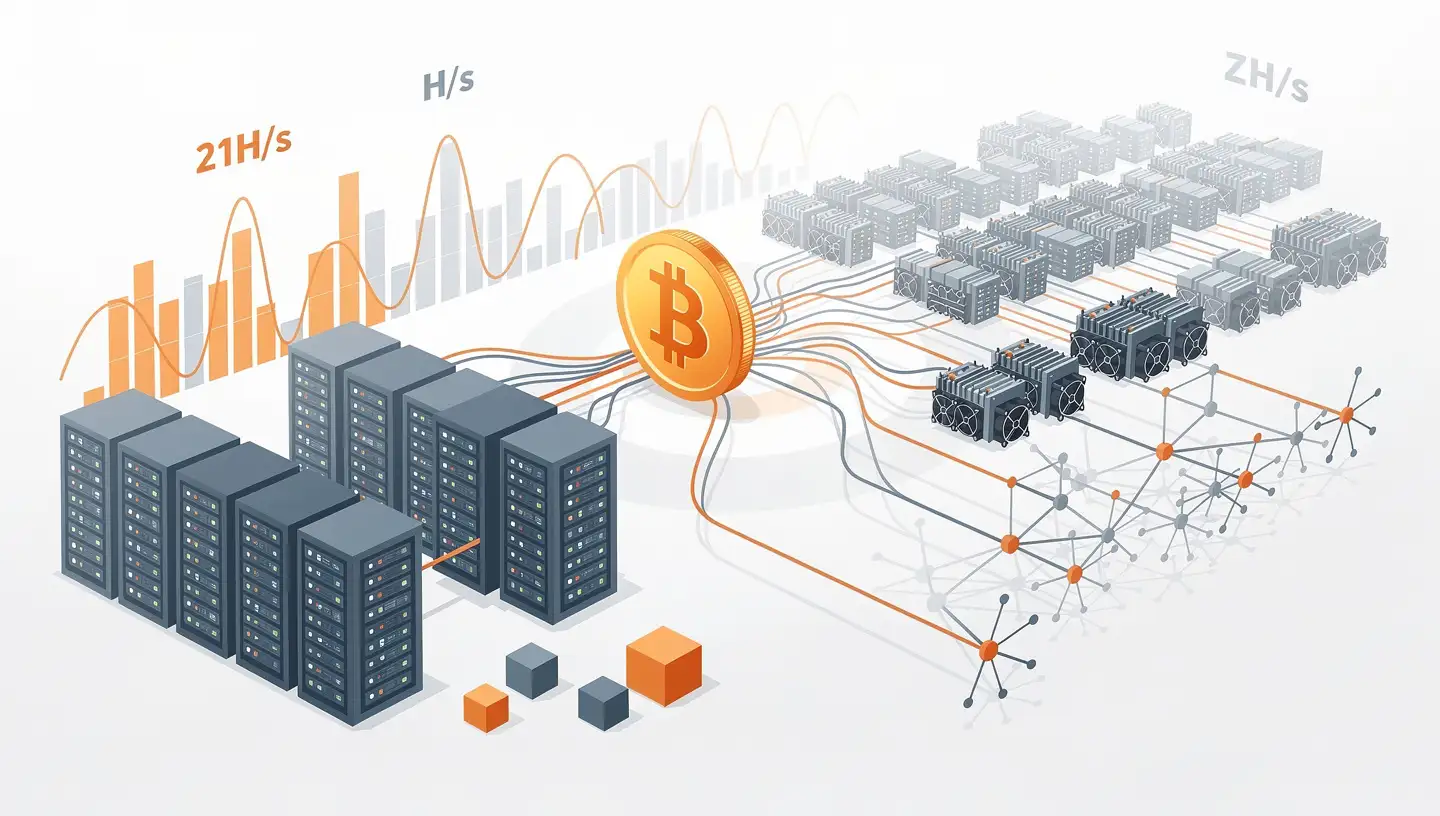
The numbers involved in Bitcoin’s hash rate are so large that standard notation becomes unreadable. The network uses SI-derived prefixes to keep figures manageable. In 2009, the hash rate was measured in kilohashes. Today it is measured in zetahashes. The table below shows every unit and what it represents.
| Unit | Abbreviation | Hashes per second |
|---|---|---|
| Hash | H/s | 1 |
| Kilohash | kH/s | 1,000 |
| Megahash | MH/s | 1,000,000 |
| Gigahash | GH/s | 1,000,000,000 |
| Terahash | TH/s | 1,000,000,000,000 |
| Petahash | PH/s | 1,000,000,000,000,000 |
| Exahash | EH/s | 1,000,000,000,000,000,000 |
| Zetahash | ZH/s | 1,000,000,000,000,000,000,000 |
When Satoshi Nakamoto mined the genesis block in January 2009, the hash rate was measured in thousands of hashes per second. Individual GPU miners in 2010 and 2011 operated in the megahash range. The introduction of ASIC miners in 2013 pushed the network past gigahashes and into terahashes within months. By 2016, the network had crossed into petahashes. The exahash era arrived around 2018 and lasted until late 2024, when the network crossed the threshold into the zetahash range for the first time. Today, a single modern ASIC machine such as the Bitmain Antminer S21 Pro produces around 234 TH/s. The network’s 1 ZH/s represents approximately four million machines of that class running simultaneously.
What is the current bitcoin network hash rate?
The current bitcoin network hash rate at block height 946,745 is approximately 1.020 ZH/s. The all-time high was recorded on September 20, 2025, at block height 915,533, when the network reached 1.442 ZH/s. That ATH represented a level of computing power dedicated to Bitcoin that no network in history had previously reached.

Why hash rate is an estimate, not an exact number
The hash rate you see on any tracking site is not a direct measurement. It is a calculated estimate. No central system records every hash being generated by every miner. Instead, the figure is derived from two known values: the current mining difficulty and the average time between recently mined blocks. If blocks are arriving slightly faster than the 10-minute target, the calculation produces a higher estimated hash rate. If blocks are arriving slightly slower, it produces a lower estimate.
This is why daily hash rate figures fluctuate, sometimes significantly, even when the actual computing power on the network has not changed. The randomness of block discovery means any single day can produce an unusually high or low number of blocks purely by chance. The 7-day average smooths out this noise and gives a more accurate picture of the underlying hash rate. When tracking tools display the current estimated hash rate, they are showing a calculation based on recent block data, not a live sensor reading from every mining machine in the world. How proof of work and blockchain confirmations function is covered in the guide to how crypto works.
Current reading and all-time high
The most reliable places to check the current bitcoin hash rate are mempool.space, which shows the estimated hash rate alongside block-by-block data and the current difficulty epoch; CoinWarz, which provides a live reading with historical chart options going back to 2009; and bitinfocharts.com, which overlays the hash rate chart against bitcoin price data. All three sites update their estimates in near real time as new blocks arrive. For the most stable reading, look at the 7-day or 14-day moving average rather than the daily figure.
Why does bitcoin hash rate matter?
The hash rate is one of the most important metrics for understanding the health and security of the Bitcoin network. Its significance operates on two levels: what it means for security against attacks, and what it signals about the economic health of mining.
Hash rate as a measure of network security
Bitcoin’s security against manipulation depends on the cost of attacking it. To rewrite blockchain history or execute a double spend, an attacker would need to control more than 50% of the total hash rate, which is called a 51% attack. At a network hash rate of 1 ZH/s, achieving that majority would require assembling and operating more computing power than the rest of the entire network combined. The hardware cost alone would run into tens of billions of dollars, and the electricity required to run it would consume industrial-scale power capacity that does not easily exist in one place.
This is why network security improves as hash rate grows. A higher hash rate raises the cost of attacking the network, which makes past transactions progressively harder to reverse. When you store bitcoin in a cold wallet and a transaction has accumulated many block confirmations, the rising hash rate is the foundation of the immutability of that transaction record. What cold wallets are and how they keep private keys protected is covered in the guide to cold wallets for crypto.
What a falling hash rate signals
When the hash rate drops significantly, it typically means miners are turning off unprofitable machines. This happens most often when the bitcoin price falls faster than miners can reduce their operating costs, or when a regulatory event forces operations offline. A large hash rate decline triggers the difficulty adjustment mechanism, which reduces mining difficulty to bring block times back toward 10 minutes. The remaining miners then find it easier to earn blocks, which stabilizes their revenue per machine and slows or stops the exit.
Some analysts track the hash ribbon indicator, which compares short-term and long-term hash rate moving averages to identify periods of miner stress. When the short-term average crosses below the long-term average, it signals miner capitulation, a period where unprofitable miners are shutting down. Historically, these periods of capitulation have appeared near bitcoin price bottoms. When the short-term average crosses back above the long-term average, it signals that miners are returning, which has sometimes preceded price recoveries. The indicator is not a reliable standalone signal, but it provides useful context for understanding where mining economics stand at any given point in the cycle.
What drives bitcoin hash rate up or down?
Three factors control the direction of the bitcoin network hash rate over time: the bitcoin price, the quality of available hardware, and the regulatory environment in major mining regions.
Bitcoin price as the primary driver
The bitcoin price is the most important driver of hash rate. When the price rises, mining becomes more profitable for a larger number of operations. Miners who were previously running at a loss become profitable again. New miners order hardware and enter the market. Existing miners expand capacity. All of this adds hash rate to the network. When the price falls, the process reverses. Miners with high electricity costs or older, less efficient machines shut down first. Hash rate falls until the difficulty adjustment compensates.
A key point that experienced miners emphasize is that the direction of causality runs from price to hash rate, not the other way around. Mining profitability depends on the bitcoin price, which miners cannot control. They can control their electricity costs and hardware efficiency, but they accept the price as given. When price rises, more hash rate joins. When price falls, hash rate leaves. The hash rate follows the price, not the other way around. How BTC functions as an asset and why price matters for the broader network is explained in the guide to what is BTC in crypto.
ASIC hardware generations and efficiency gains
Each new generation of ASIC hardware produces more TH/s per watt than the previous generation. When a new ASIC generation ships, miners upgrade their machines to stay competitive. The same number of miners, running newer hardware, produces a higher total hash rate than before. This means that even without adding new mining operations, the hash rate grows as the industry upgrades its equipment.
In Bitcoin’s early years, miners used standard home computers with CPUs. By 2010 and 2011, GPUs had become the standard because they produced far more hashes per watt. ASIC miners arrived around 2013 and rendered GPUs permanently uncompetitive. Modern ASICs are purpose-built for SHA-256 and nothing else, which allows them to achieve efficiency levels that general-purpose hardware cannot approach. The ongoing improvement in ASIC efficiency is one of the reasons Bitcoin’s hash rate has trended upward across every market cycle, even when the bitcoin price was falling.
Regulatory events and mining bans
Regulatory decisions can cause sudden, large shifts in hash rate. The most significant example is the China mining ban of 2021, which caused roughly half of the global hash rate to go offline within weeks. More recently, hash rate has concentrated in the United States, where publicly listed mining companies now account for approximately 30% of the global total. Favorable regulatory conditions, access to capital markets, and cheap energy in certain regions have made the US the dominant mining geography. Changes in energy policy, tax treatment of mining operations, or direct restrictions on mining activity in any major mining region can move the global hash rate significantly in a short period. How Bitcoin compares to other cryptocurrencies in terms of network design and adoption is covered in the guide to Bitcoin vs crypto.
Hash rate and mining profitability
For individual miners, the network hash rate is not just a security metric. It directly determines how much each miner earns relative to the total reward available.

Your share of the total hash rate determines your earnings
Every 10 minutes, one miner wins the right to add the next block and collects the block reward of 3.125 BTC, plus any transaction fees from that block. Your probability of winning any given block is equal to your hash rate divided by the total network hash rate. If you control 0.0001% of the network’s hash rate, you can expect to win approximately 0.0001% of all blocks mined. As the total network hash rate grows, your share of it shrinks unless you add hardware at the same pace the network is growing.
Mining profitability for any operation comes down to four variables: the bitcoin price, the current block reward, your electricity costs per kilowatt-hour, and your hardware’s efficiency in TH/s per watt. A rising hash rate by itself does not make mining less profitable if the bitcoin price has risen to compensate. What it does do is raise the breakeven threshold for less efficient machines and push them closer to being unprofitable. The economics of the block reward and how it changes over time are explained in the guide to Bitcoin block reward.
Mining pools: combining hash rate for regular payouts
At a network hash rate of 1 ZH/s, a solo miner with 200 TH/s controls roughly 0.00000002% of the network. The expected time to find a block solo would be measured in thousands of years. This is why almost all miners join a mining pool, which aggregates the hash rate of many participants and distributes rewards proportionally when any pool member finds a block.
Joining a pool trades the lottery model of solo mining for a bond model: smaller, more consistent payouts rather than a rare large one. Most pools charge a fee of 1% to 3% of earnings for this service. The hash rate contributed by large mining pools represents the majority of the total network hash rate at any given time. Pool concentration is one of the factors analysts watch when assessing the decentralization of the Bitcoin network. How the broader crypto mining economy works and what different types of wallets mean for storing your rewards is covered in the guide to what is crypto.
A brief history of bitcoin hash rate milestones
The history of Bitcoin’s hash rate is the history of an industry that grew from one person mining on a laptop to a global multi-billion dollar operation in 15 years. Each era brought new hardware, new participants, and new levels of competition.
2009-2016: From kilohashes to petahashes
Satoshi Nakamoto mined the genesis block in January 2009 on a standard computer. The hash rate of the entire network at that point was measured in kilohashes per second. As more people joined, CPU mining gave way to GPU mining around 2010, pushing the network into the megahash range. The real acceleration came in 2013, when the first ASIC miners arrived. Within 12 months of ASIC adoption, the network had moved through gigahashes and terahashes and into petahashes. GPU mining was no longer competitive. By 2016, the network was producing hundreds of petahashes per second, and the mining industry had shifted from individual hobbyists to professional facilities. How Bitcoin’s supply mechanics were designed during this period is covered in the guide to Bitcoin halving.
2017-2020: Exahashes and the first major bull cycle
The 2017 bull run drove the bitcoin price from under $1,000 to nearly $20,000, pulling a wave of new miners into the market. By the end of 2017, the network had crossed 10 EH/s. China dominated the global hash rate during this period, accounting for an estimated 65% to 75% of total network hash power at its peak. The 2018 bear market caused significant hash rate declines as unprofitable machines went offline. The 2020 halving cut the block reward from 12.5 to 6.25 BTC, but rising prices through late 2020 drove the network past 100 EH/s for the first time.
2021: China’s mining ban and the biggest hash rate drop
In May and June 2021, China ordered Bitcoin mining operations to shut down. The impact was immediate. Within weeks, the network lost approximately 50% of its hash rate as Chinese mining facilities went offline. This was the largest single decline in hash rate in Bitcoin’s history. The difficulty adjustment mechanism reduced mining difficulty significantly over two consecutive epochs, keeping block times close to 10 minutes even with half the network’s computing power gone.
Recovery was faster than many expected. Miners relocated equipment to the United States, Kazakhstan, and Canada over the following months. By early 2022, the hash rate had recovered to pre-ban levels and continued climbing. The episode is the clearest historical example of how the difficulty adjustment protects the network from sudden shocks, and how hash rate can recover quickly when miners have an economic reason to return. For those who hold bitcoin while monitoring these network events, understanding the difference between keeping funds on an exchange and in self-custody is covered in the guide to custodial vs non-custodial wallets.
2024-2025: Post-halving era and the 1 ZH/s milestone
The April 2024 halving reduced the block reward from 6.25 BTC to 3.125 BTC. Despite this cut in the per-block subsidy, the hash rate continued to climb through 2024 and into 2025. Bitcoin ETF approvals in January 2024 and the resulting rise in the bitcoin price kept mining profitable for well-positioned operations. By early 2025, the network crossed 800 EH/s. In September 2025, it crossed the 1 ZH/s milestone for the first time, reaching an ATH of 1.442 ZH/s on September 20, 2025. US publicly listed mining companies accounted for approximately 30% of the global hash rate by that point, reflecting the consolidation of mining into regulated, publicly accountable entities since the China ban.
Where to track bitcoin hash rate live
Three tools provide the most reliable access to live and historical bitcoin hash rate data. mempool.space shows the current estimated hash rate alongside block-by-block data, the current difficulty epoch, the number of blocks remaining until the next difficulty adjustment, and the projected percentage change in difficulty. It is the most commonly used tool for monitoring both hash rate and network conditions in real time.
CoinWarz at coinwarz.com/mining/bitcoin/hashrate-chart provides a dedicated hash rate chart with options to view daily, weekly, monthly, and all-time historical data going back to 2009. It also shows the current difficulty and links to a mining profitability calculator. bitinfocharts.com overlays the hash rate chart against the bitcoin price, making it useful for comparing hash rate trends to price movements over any time period.
When using any of these tools, look at the 7-day or 14-day moving average rather than the single-day figure. Daily hash rate readings fluctuate because block discovery is random. Some days produce more blocks than expected; some produce fewer. The 7-day average of the estimated hash rate gives a much cleaner signal of where the network’s actual computing power stands. For those who hold bitcoin rather than mine it, keeping funds in a self-custody wallet removes any dependency on exchange platform security. How to set up and use a hot wallet for day-to-day activity is covered in the guide to hot wallets for crypto.
Frequently asked questions
What is the current bitcoin network hash rate?
As of block height 946,745, the current bitcoin network hash rate is approximately 1.020 ZH/s, or one zetahash per second. This figure is an estimate based on recent block times and the current mining difficulty. For the latest reading, check mempool.space or CoinWarz, both of which update in near real time as new blocks are mined.
What does hash rate tell you about Bitcoin?
Hash rate tells you how much computing power is actively securing the Bitcoin network at any given moment. A rising hash rate means more miners are participating, competition for block rewards is increasing, and the cost of a 51% attack is growing. It is one of the most direct indicators of network security and of miner confidence in the profitability of the network. A sustained decline in hash rate signals that mining is becoming unprofitable for some participants and that machines are being turned off.
Why does bitcoin hash rate keep going up over the long term?
The long-term upward trend in hash rate reflects two forces. First, rising bitcoin price attracts new miners and makes it profitable for existing miners to expand. Second, each new generation of ASIC hardware produces more hashes per watt than the previous one, increasing total network hash rate even when the number of mining operations stays constant. As long as mining remains economically viable and hardware continues to improve, the long-term trend in hash rate is expected to continue upward.
Can hash rate predict bitcoin price?
The hash ribbon indicator compares two moving averages of hash rate to identify periods of miner capitulation, when unprofitable miners are shutting down machines. Historically, these periods have appeared near bitcoin price bottoms. When the indicator signals the end of capitulation and hash rate recovers, it has sometimes preceded price recoveries. However, the indicator is not a reliable standalone trading signal. Most experienced analysts treat it as one input among many rather than a standalone prediction tool.
What is the difference between hash rate and mining difficulty?
Hash rate is the total computing power the network is generating. Mining difficulty is the number that controls how hard it is to find a valid block hash. Every 2,016 blocks, the difficulty adjusts based on how fast the last 2,016 blocks were mined relative to the 10-minute target. When hash rate rises and blocks come faster than 10 minutes, difficulty increases to compensate. When hash rate falls and blocks slow down, difficulty decreases. Hash rate drives the change; difficulty responds to it.
What happened to bitcoin hash rate when China banned mining?
When China banned Bitcoin mining in 2021, the network lost approximately 50% of its hash rate within a matter of weeks as Chinese mining facilities went offline. The difficulty adjustment mechanism responded by reducing mining difficulty over two consecutive adjustment periods, keeping block production close to the 10-minute target despite the massive loss of computing power. Hash rate recovered to pre-ban levels within roughly six months as miners relocated equipment to other countries, with the United States becoming the largest single mining geography in the process.
Sources
- Bitcoin Hashrate Chart, CoinWarz – live hash rate data and historical charts
- mempool.space – live Bitcoin network data including hash rate and difficulty