Crypto staking lets you earn rewards on coins you already own by helping a blockchain network process transactions. Instead of buying expensive equipment or running power hungry machines the way traditional mining does, you simply lock up a certain amount of cryptocurrency and the network pays you for it. The idea sounds simple, but the mechanics behind it, along with the risks that come with it, are worth understanding before you commit any funds. This guide breaks down what crypto staking actually is, how the process works behind the scenes, the different ways you can take part, and what to weigh up before locking away your coins for a reward that is never fully guaranteed.
Key takeaways
- Crypto staking means locking up coins to help validate transactions on a proof of stake blockchain, in exchange for rewards.
- Rewards are usually paid in the same coin you staked, and the rate moves over time rather than staying fixed.
- Validators handle the technical side, while smaller holders can take part through delegated staking or a staking pool instead.
- Staking comes with real risks, including price drops, lock-up periods and slashing penalties for validators who misbehave or go offline.
What is crypto staking?
Crypto staking is the process of locking up cryptocurrency to support a blockchain network, in exchange for rewards. The coins you commit back the network’s proof of stake system, which checks that new transactions are valid before they get added to the chain. The more coins involved, the more weight that stake usually carries in the process.

Unlike leaving coins idle in a wallet, staked crypto is put to work. You are not lending it out, and you are not trading it. You are proving that you have a financial stake in the network running correctly, which is also where the term comes from. If you are still getting familiar with the basics, our guide on what cryptocurrency actually is covers the fundamentals before going further into staking.
How does crypto staking work?
Staking only works on blockchains that use a consensus mechanism called proof of stake. Instead of computers competing to solve puzzles, the network selects participants to confirm new blocks based on how many coins they have locked up. Those chosen participants are called validators, and they get paid in newly issued coins or transaction fees for doing the job correctly.
What is proof of stake (PoS)?
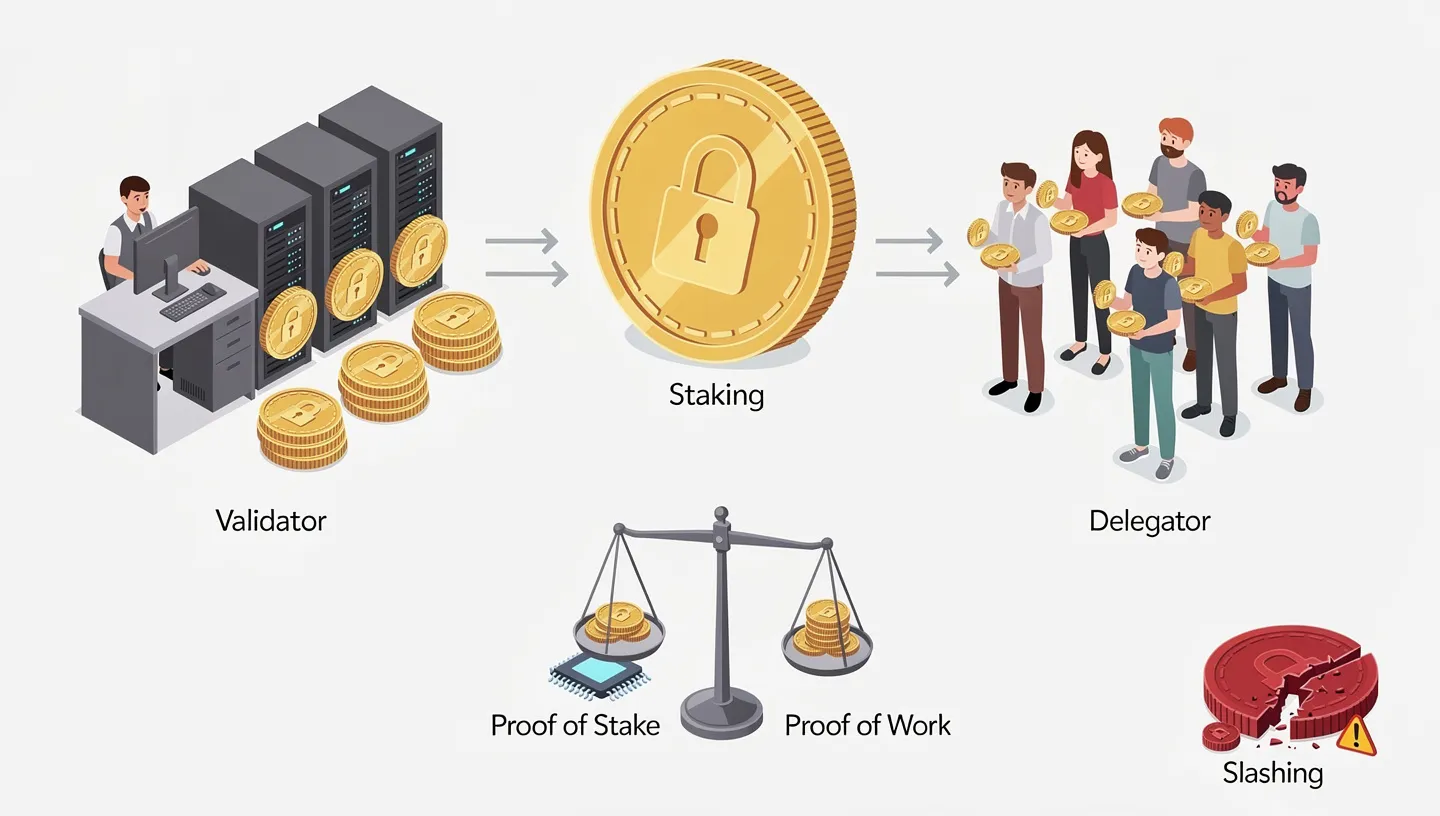
Proof of stake is a method blockchains use to agree on which transactions are valid, without needing miners or specialized hardware. Token holders lock up coins as collateral, and the network selects validators from that pool, usually giving better odds to whoever has staked more. A validator who does the job honestly earns a reward. One who tries to cheat or stays offline too often can lose part of their stake instead.
Proof of stake vs proof of work
Proof of work is the older model, and it is still the one Bitcoin runs on. Under proof of work, miners use specialized hardware to solve complex mathematical puzzles, and whoever solves it first adds the next block and collects the reward. This approach demands a large amount of electricity and computing power around the clock.
Proof of stake reaches the same goal of securing the network and confirming new blocks, but it does so through locked up coins instead of raw computing power. Validators are selected mathematically rather than through a race to solve a puzzle, which removes the need to keep thousands of energy hungry machines running non stop.
Validators and delegators explained
A validator is a participant who runs the software needed to check transactions and propose new blocks on a proof of stake network. To become one, you usually need to lock up a fairly large minimum amount of crypto and keep your equipment online almost all the time.
Not everyone wants to run a validator node, which is where delegators come in. A delegator hands their coins to an existing validator instead of running the infrastructure themselves. The validator does the technical work, and rewards are then split between the two, usually after the validator takes a small commission.
What is slashing?
Slashing is the penalty a validator faces for breaking the rules of the network, whether that means approving invalid transactions, attacking the chain, or simply staying offline too long. Depending on how serious the violation is, the network can take away part of the validator’s stake, or in severe cases, all of it. This is also why choosing a reliable validator matters if you plan to delegate your coins rather than run your own.
Types of crypto staking
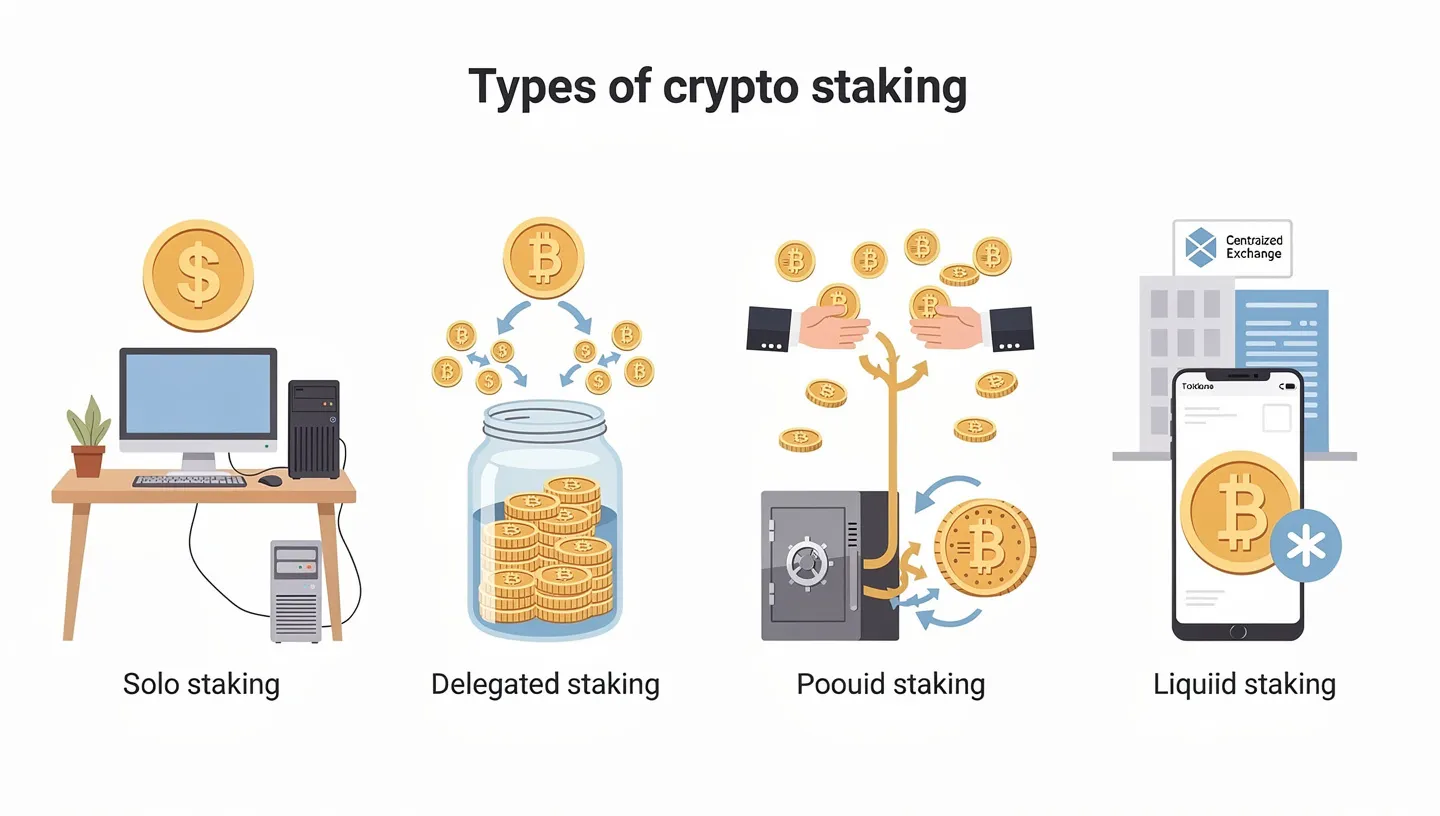
There is more than one way to put your coins to work. The method that suits you usually depends on how much technical knowledge you have, how much crypto you hold, and how hands-on you want to be.
- Solo staking: you run your own validator node and keep all the rewards, but this requires meeting a minimum stake, reliable hardware and a stable internet connection at all times.
- Delegated staking: you hand your coins to a validator you trust, and they handle the technical side while sharing the rewards with you, minus a small fee.
- Pooled staking: a group of holders combine their coins to meet a network’s minimum staking requirement, then split the rewards based on how much each person contributed.
- Liquid staking: you stake your coins but receive a separate token in return, which represents your staked balance and can still be traded or used elsewhere while your original coins stay locked.
- Exchange staking: a centralized platform stakes your crypto on your behalf, usually the simplest option for beginners, though it means trusting that platform with custody of your coins. The difference between this approach and keeping your own keys is explained in our breakdown of custodial versus non-custodial wallets.
Which cryptocurrencies can you stake?
Not every coin supports staking. Only cryptocurrencies built on proof of stake, or a variation of it, let holders lock up coins and earn rewards this way.
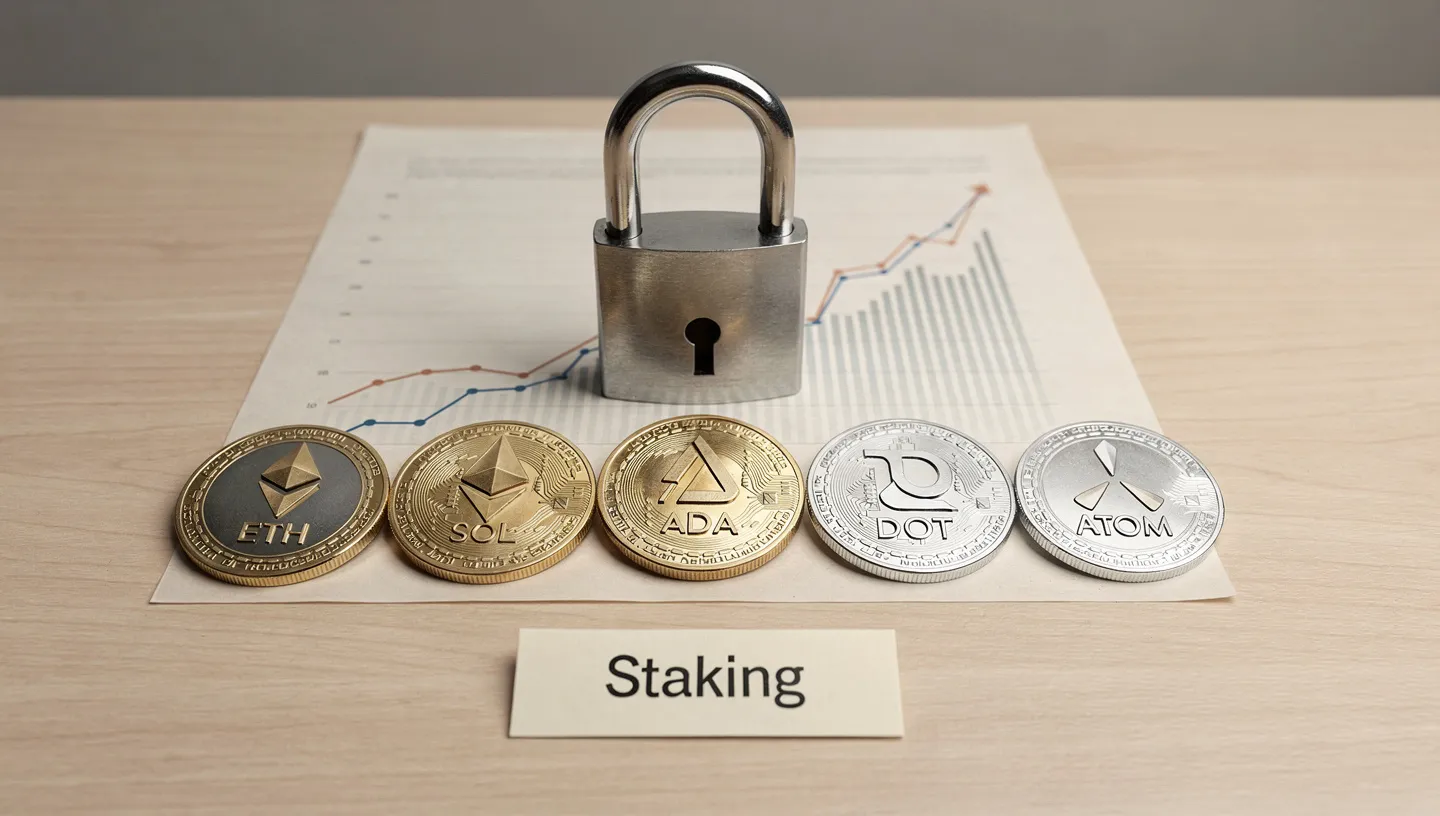
Some of the most commonly staked coins include the following.
| Ethereum (ETH) | Requires 32 ETH to run a solo validator, though pools and exchanges allow much smaller amounts. |
| Solana (SOL) | Known for fast transaction speeds and a large number of active validators. |
| Cardano (ADA) | Uses delegated staking with no minimum lock-up period in most cases. |
| Polkadot (DOT) | Uses nominated proof of stake, where holders nominate validators they trust. |
| Cosmos (ATOM) | Rewards can be claimed and restaked manually to compound returns over time. |
Ethereum’s 32 ETH requirement for solo staking is one of the highest minimums in the space, and it is exactly why pooled and exchange staking exist in the first place. The official network explains its proof of stake requirements directly on the Ethereum Foundation’s staking page.
Benefits of crypto staking
- Passive income: you can earn rewards on coins you already planned to hold, without needing to actively trade them.
- No expensive hardware: staking does not require the specialized machines or high electricity bills that mining does.
- Lower energy use: proof of stake networks use a small fraction of the power that Bitcoin mining consumes, since validators are selected rather than competing against one another.
- Network security: the more coins locked up across a network, the harder and more costly it becomes for anyone to attack it.
- Possible governance rights: some networks let stakers vote on proposals that shape how the protocol develops.
Risks of crypto staking
- Price volatility: the value of your staked coins can drop while they are locked, even if the reward rate itself stays steady.
- Lock-up periods: some networks hold your coins for days or weeks after you decide to unstake, during which you cannot sell or move them.
- Slashing risk: if you delegate to a validator who misbehaves or goes offline too often, you can lose part of your stake along with them.
- Regulatory uncertainty: rules around staking differ from country to country and keep changing. Regions such as the UAE and Dubai have taken a clearer stance than most, but plenty of jurisdictions still have not settled the question.
- Tax obligations: in many countries, staking rewards count as taxable income the moment you receive them, separate from any tax owed later if you sell. The IRS digital asset guidance is a useful starting point for United States residents trying to understand their obligations.
How to start staking crypto
Getting started does not require deep technical knowledge if you choose a beginner friendly route such as an exchange or a staking pool. Here is the general process most people follow, step by step, from picking a coin through to watching the first reward land in your account.
- Choose a coin that supports staking. Popular options include Ethereum, Solana and Cardano, but always check the specific terms and minimum amounts for that particular network first.
- Get a wallet to hold your crypto. If you plan to stake through a pool or directly on a protocol rather than an exchange, keeping your coins in a cold wallet between staking periods adds an extra layer of security.
- Move your coins to where you plan to stake them. If your crypto is already sitting on an exchange, you may only need to opt into that platform’s staking program from your account settings.
- Confirm your stake and start earning. Some networks pay rewards almost immediately, while others require a short bonding period before anything starts to accumulate.
Is crypto staking worth it?
Whether staking makes sense for you depends on what kind of holder you are. If you already plan to hold a coin for the long term and are comfortable with its price moving up and down, staking lets you put that holding period to work instead of leaving it idle. The rewards can outpace what a typical savings account offers, though they arrive in a volatile asset rather than stable currency.
If you need quick access to your funds, or you are not confident in the long-term value of the coin you would be staking, the lock-up periods and price risk may outweigh the reward. Staking works best as one part of a wider strategy, not as a guaranteed way to grow your money.
Frequently asked questions
Is crypto staking safe?
Staking carries fewer technical risks than running a mining operation, but it is not risk free. Price drops, lock-up periods and slashing penalties can all affect how much you end up with compared to what you started with.
Can I unstake and sell my crypto at any time?
It depends on the network. Some protocols allow you to unstake almost instantly, while others hold your coins for a set waiting period first. Once your coins are unlocked, you can sell your crypto the same way you would any other holding.
Do I need a minimum amount to start staking?
Running your own validator usually requires a meaningful minimum, such as the 32 ETH needed on Ethereum. Staking through a pool or an exchange normally has a much lower entry point, sometimes just a few dollars worth of coins.
Are staking rewards guaranteed?
No. Reward rates move with network conditions, the total number of coins staked, and how the protocol is designed. A rate advertised today can be lower or higher a few months from now.
Is Bitcoin available for staking?
No, not in the traditional sense. Bitcoin runs on proof of work rather than proof of stake, so there is no validator role to fill. Holders looking for a similar mechanism usually look toward other proof of stake coins instead.
The bottom line
Crypto staking turns idle coins into an active part of a blockchain network and rewards you for it along the way. It is more accessible than mining, easier on electricity bills, and open to almost anyone willing to lock up a coin for a period of time. That said, the rewards are never free of risk. Price swings, lock-up periods and the occasional slashing penalty are all part of the deal, so it pays to understand exactly what you are committing to before your coins go to work.