Robinhood Crypto is a commission-free trading platform that lets US investors buy Bitcoin, Ethereum, Solana, and more than 40 other cryptocurrencies starting from $1, with no explicit trading fee. Instead of charging a commission, Robinhood earns revenue through the bid-ask spread, the difference between the price you pay and the current market price.
As of 2026, the platform serves more than 27 million funded customers and has expanded well beyond its stock-trading roots into crypto staking, a self-custody wallet, IRA accounts with contribution matches, and a growing suite of banking and investment tools. Crypto on Robinhood is best suited to US-based beginners and investors who want stocks and crypto in one app. Dedicated crypto traders who need a broad coin selection, direct trading pairs, or advanced order types will find it limiting.
Quick summary:
- $0 commission on crypto trades, but revenue comes from the bid-ask spread
- 40+ cryptocurrencies including BTC, ETH, SOL, DOGE, XRP, SHIB, and ADA
- ETH and SOL staking available in 2026
- Separate self-custody Robinhood Wallet app supporting 7 networks
- US-only brokerage with a limited UK launch in 2024
- Robinhood Gold: $5/month, 3% IRA match, 4% APY on uninvested cash
- SIPC member, FINRA regulated, FinCEN registered
- Trustpilot score: 1.3/5 – customer support is a consistent complaint
Robinhood Crypto at a glance
| Feature | Details |
|---|---|
| Supported cryptos | 40+ (BTC, ETH, SOL, DOGE, XRP, SHIB, ADA, LTC, ETC, BCH and more) |
| Trading fee | $0 commission (spread-based) |
| Minimum investment | $1 |
| Staking | ETH and SOL available in 2026 |
| Self-custody wallet | Yes (separate Robinhood Wallet app) |
| IRA match | 1% standard, 3% Gold members |
| Robinhood Gold | $5/month or $50/year |
| SIPC coverage | Up to $500,000 (incl. $250,000 cash) |
| Crypto FDIC/SIPC coverage | No – crime insurance only |
| Cold storage | Yes (percentage not disclosed) |
| Available in | US (plus partial UK since 2024) |
| Founded | 2013 |
| Funded customers | 27 million+ |
What cryptocurrencies can you trade on Robinhood?
As of 2026, Robinhood supports trading in 40 to 50 cryptocurrencies, a more modest number than dedicated exchanges but covering the assets that most retail investors actually use. The full list of tradeable coins includes major assets such as Bitcoin (BTC), which is the most traded asset on the platform and what most users mean when they search for robinhood bitcoin, plus Ethereum (ETH), Solana (SOL), Dogecoin (DOGE), XRP, Shiba Inu, Cardano, Polkadot, Avalanche, Chainlink, Uniswap, Litecoin, Ethereum Classic, Bitcoin Cash, Bitcoin SV, Compound, and Aave, among others. Robinhood also provides real-time market data for around 60 additional coins that cannot be traded on the platform, letting you track prices without buying.
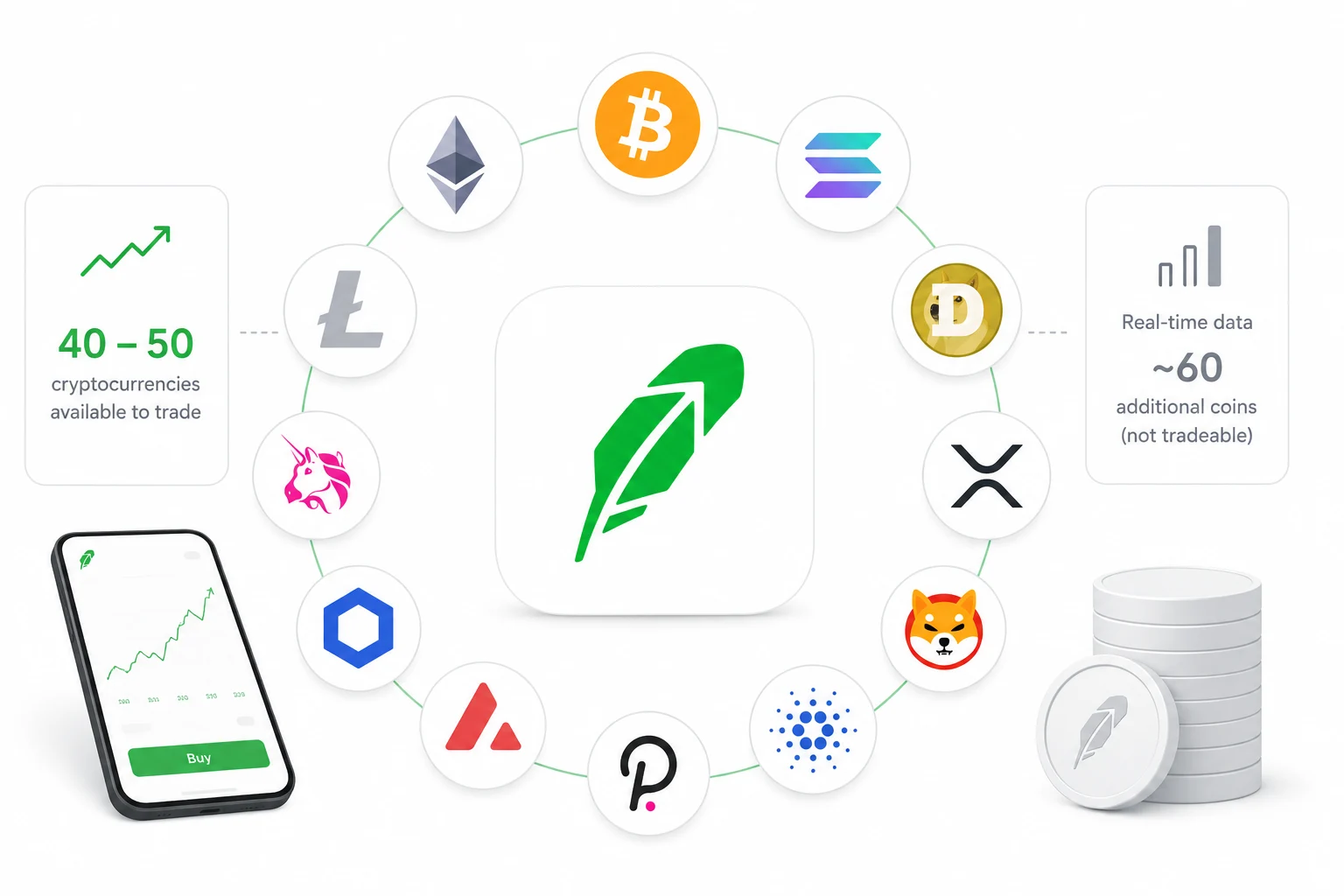
The coin selection is one of Robinhood’s clearest limitations compared to dedicated exchanges. Coinbase lists more than 200 assets. Kraken lists more than 200. Binance exceeds 350. Robinhood’s list covers every asset that mainstream US retail investors actively buy, but it excludes the long tail of altcoins that crypto traders seek. If your portfolio consists of Bitcoin, Ethereum, and a handful of other major tokens, the selection is sufficient. If you want access to newer DeFi tokens, layer-2 assets, or speculative small-caps, you will need a different platform alongside Robinhood. What Bitcoin is and why it holds a distinct position in any crypto portfolio is explained in the guide to what is Bitcoin.
Robinhood crypto fees: zero commissions or a hidden spread?
Robinhood’s headline is $0 commission on crypto trades. No explicit fee appears when you execute a trade. This is technically accurate and distinguishes Robinhood from platforms like Coinbase, which shows a clear fee line on every transaction. However, $0 commission does not mean free.
How the spread works: what Robinhood actually charges
Robinhood earns revenue on crypto through the bid-ask spread. When you buy Bitcoin on Robinhood, you pay slightly above the current market price. When you sell, you receive slightly below it. The difference goes to Robinhood. This spread is built into the price you see at execution, not displayed as a separate line item, which is why many users describe it as a hidden cost. In calm market conditions the spread is typically small. In volatile conditions it can widen, increasing the effective cost of the trade without any notification on screen.
The fee table below shows the full structure of Robinhood charges across account activity:
| Fee type | Amount |
|---|---|
| Crypto trading commission | $0 |
| Spread (built into execution price) | Variable, not disclosed per trade |
| Crypto deposits | $0 |
| Crypto withdrawals | $0 |
| Debit card purchases | 1.5% |
| Options trading | $0.04 per contract |
| Futures (standard) | $0.75 per contract |
| Futures (Gold members) | $0.50 per contract |
| Outbound ACAT transfer | $100 |
Real test: Robinhood vs Coinbase on a $500 Bitcoin purchase
Wall Street Survivor ran a direct comparison in November 2024, buying $500 of Bitcoin on Robinhood and Coinbase at the exact same moment. On Robinhood, the buyer received 0.00509186 BTC. On Coinbase, they received 0.0049752 BTC for the same $500, after Coinbase charged an explicit $9.20 fee. The difference of 0.00011666 BTC was worth approximately $11.46, meaning Robinhood delivered roughly 2.3% more Bitcoin per dollar spent than Coinbase on that specific trade.
This test illustrates the practical reality: Robinhood’s spread-based model can be cheaper than exchanges that charge explicit percentage fees, particularly for smaller trades. Robinhood’s own marketing claims users get up to 2.6% more crypto than on competing platforms. The spread varies with market conditions, so no single test determines the outcome in every scenario, but the structure is genuinely competitive against platforms with stated commission rates of 0.5% to 1.5%. How crypto transactions work at a protocol level, including what happens when assets move between platforms, is covered in the guide to how crypto works.
Robinhood Crypto features
Robinhood has grown from a simple stock trading app into a platform with a range of features relevant to crypto investors. The crypto-specific tools below are available in the main app and the separate Robinhood Wallet.
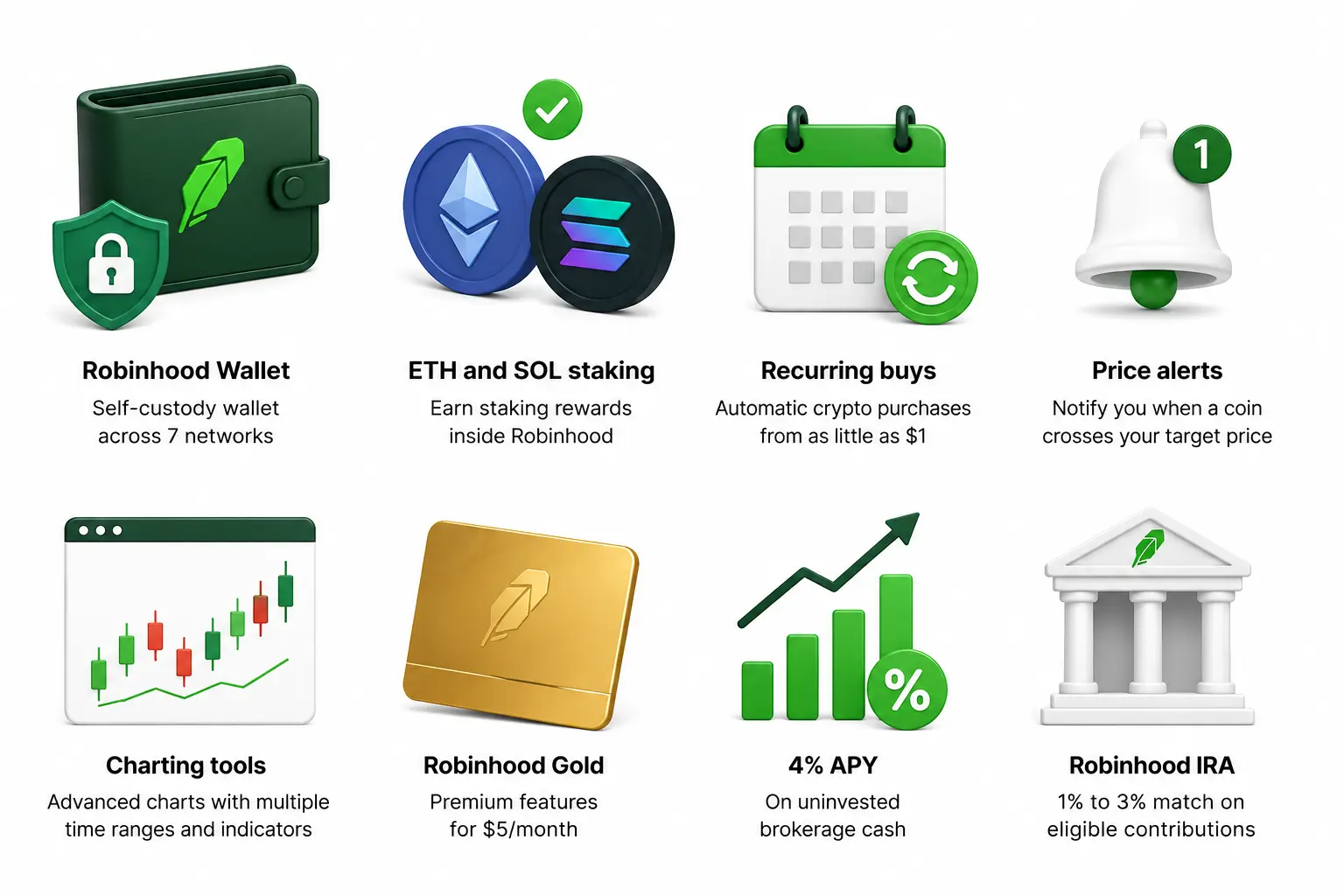
Robinhood Wallet: self-custody across 7 networks
The Robinhood Wallet is a separate application from the main Robinhood brokerage app, operated by Robinhood Non-Custodial, Ltd. It is a non-custodial, self-custody wallet, meaning you hold the private keys to your assets rather than trusting Robinhood to hold them on your behalf. The wallet supports seven networks: Ethereum, Bitcoin, Dogecoin, Arbitrum, Polygon, Optimism, and Base. It charges no fees and is available on iOS and Android as a standalone download.
The distinction between the robinhood crypto wallet and the main app matters for understanding custody risk. When you buy crypto in the main Robinhood app, Robinhood holds the keys. When you move those assets to the Robinhood Wallet, you hold the keys. Position limits on the main platform apply per asset: BTC, ETH, and DOGE have a maximum position limit of $16 million, while BCH, LTC, and ETC are capped at $5 million. These limits do not apply to assets held in the self-custody wallet. The two products look related but operate under entirely different custody models. For users who want to combine Robinhood’s commission-free trading with genuine asset ownership, the process is: buy in the main app, transfer to the Robinhood Wallet, and hold there under self-custody. The broader distinction between custodial and non-custodial arrangements is explained in the guide to custodial vs non-custodial wallets.
ETH and SOL staking: earning rewards inside Robinhood
Robinhood added ETH and SOL staking to its platform, and both are available in 2026. Users who hold Ethereum or Solana in their Robinhood account can earn staking rewards directly within the app without transferring assets to a separate staking service. Robinhood handles the delegation process automatically and credits rewards to your account. There is no mandatory lock-up period beyond what the underlying network requires for unstaking.
This is worth clarifying because some older reviews, including Arristor’s 2026 piece, state that Robinhood does not offer staking. That was accurate for an earlier period but is no longer the case. Staking on Robinhood is limited to ETH and SOL; it does not extend to the broader range of proof-of-stake assets available for staking on dedicated platforms like Kraken or Coinbase.
Recurring buys, price alerts, and charting tools
Recurring buys let you set up automatic crypto purchases from as little as $1 on a daily, weekly, biweekly, or monthly schedule, applying a dollar-cost averaging strategy without manual trades. Price alerts notify you when a coin crosses a price threshold you specify. Charting tools include line and candlestick views with time ranges from one hour to five years. The Robinhood Legend browser platform expands these tools with up to eight simultaneous charts, Bollinger Bands, moving averages, and customizable layouts built for active traders who prefer a larger screen.
Robinhood Gold: what crypto traders get for $5 a month
Robinhood Gold costs $5 per month or $50 per year and adds a range of perks across the platform. For cash: 4% APY on uninvested brokerage cash through the sweep program. For research: professional reports from Morningstar and Level II market data from Nasdaq. For deposits: larger instant deposit limits. For margin: the first $1,000 of borrowed funds is interest-free. For crypto specifically, Gold’s most relevant benefit is the enhanced IRA match described below. The base plan without Gold still gives full access to crypto trading, staking, and the wallet.
Robinhood IRA: 1% to 3% match on contributions
Robinhood offers Traditional and Roth IRA accounts with a contribution match that is unique among retail brokers. Standard accounts receive a 1% match on eligible IRA contributions. Gold members receive a 3% match. You can hold crypto, stocks, and ETFs within the IRA, and rollovers from 401(k)s and other IRAs are accepted with no cap on the transfer amount. The match comes with a five-year holding requirement: withdrawing matched funds before five years means forfeiting the bonus. For Bitcoin investors using an IRA structure for long-term tax-advantaged holding, this match is a material benefit that dedicated crypto exchanges do not offer. The broader landscape of Bitcoin IRA options and how they work is covered in the guide to Bitcoin IRA.
Is Robinhood crypto safe?
Robinhood is a regulated, publicly traded company with institutional security infrastructure. For US investors, the platform presents a reasonable level of safety for the crypto assets they are likely to trade. The honest answer to “is Robinhood crypto safe” requires separating several distinct questions: how secure is the platform against hacking, how safe are your assets if Robinhood itself fails, and how has Robinhood performed on safety in practice.
Cold storage and crime insurance: what Robinhood discloses
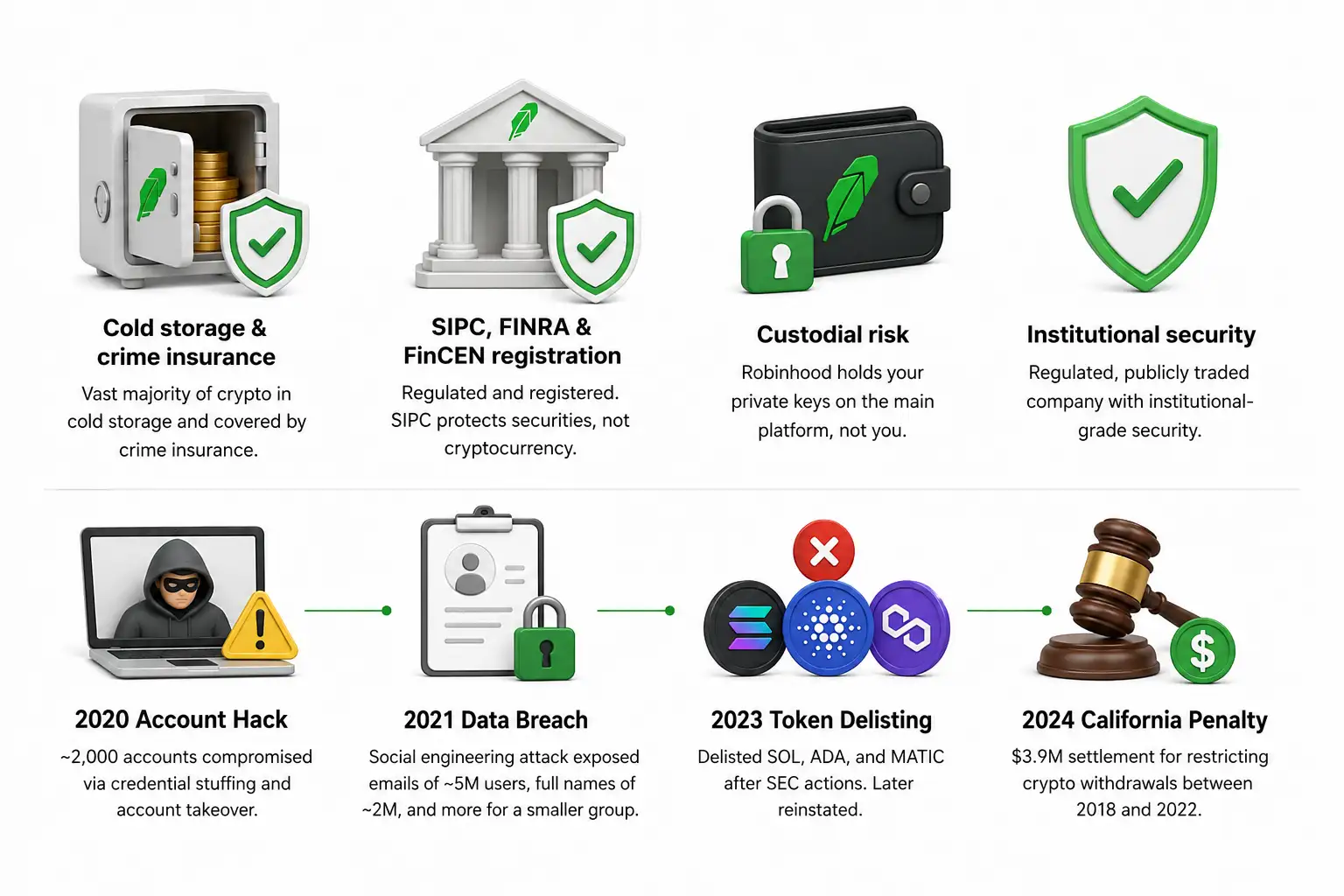
Robinhood stores customer crypto in a mix of cold storage and hot storage. The company says the “vast majority” of coins are kept offline in cold storage. The specific percentage is not publicly disclosed. For comparison, Coinbase publishes that approximately 98% of customer assets are held in cold storage. Robinhood’s language, “vast majority” and “a portion,” leaves the exact protection level undefined. Robinhood also carries a crime insurance policy that covers crypto held by Robinhood against losses from theft and cybersecurity breaches. The coverage amount is not publicly disclosed. These two undisclosed figures, the cold storage percentage and the insurance amount, are the clearest informational gaps in Robinhood’s published security documentation.
SIPC, FINRA, and FinCEN registration
Robinhood Financial LLC is registered with the SEC, is a FINRA member, and holds SIPC membership. SIPC coverage protects brokerage customers for up to $500,000, including up to $250,000 in cash, in the event of Robinhood’s insolvency. Uninvested cash enrolled in the cash sweep program is covered by FDIC insurance up to $2 million through partner banks. Robinhood Crypto LLC is separately registered with FinCEN as a money services business. The important caveat is that none of these protections cover cryptocurrency. SIPC protects securities; FDIC protects bank deposits. Crypto held on Robinhood is covered only by the crime insurance policy, not by any government-backed guarantee. The nature of cold storage and what it means for asset protection is covered in the guide to cold wallets for crypto.
Custodial risk: you do not own your private keys on the main platform
When you buy Bitcoin on the main Robinhood app, Robinhood holds the private keys to your crypto, not you. Your balance appears in your account, but the actual keys that control the coins belong to Robinhood. This is the standard custodial model used by most exchanges. It is convenient, but it creates counterparty risk: if Robinhood were to become insolvent, freeze withdrawals, or be compromised, your ability to access your crypto would depend on how the situation was resolved. Robinhood states that customer crypto is held separately from company assets and would not be available to creditors in a bankruptcy, but the legal recovery process in such a scenario for cryptocurrency on a US broker-dealer platform remains untested. The FTX collapse in 2022 illustrated what can happen when exchange-held customer assets are not properly segregated. Moving crypto to the Robinhood Wallet or another non-custodial wallet eliminates this specific risk by placing the private keys in your own hands.
Security incidents and regulatory actions
Robinhood has faced four notable security and regulatory events that any potential user should know about:
- 2020 account hack: Approximately 2,000 customer accounts were compromised by attackers who gained access through credential stuffing and account takeover methods.
- 2021 data breach: A hacker used social engineering to gain access to customer support systems. The breach exposed email addresses of approximately 5 million users, full names of around 2 million, and additional personal data of a smaller group. Robinhood notified affected users and reported the incident publicly.
- 2023 token delisting: Following SEC enforcement actions against crypto exchanges for offering unregistered securities, Robinhood delisted Solana, Cardano, and Polygon tokens in June 2023. Users holding those assets could sell but could not buy. The tokens were later reinstated after regulatory clarity improved.
- 2024 California penalty: The California Attorney General secured a $3.9 million settlement from Robinhood for failing to allow customers to withdraw their cryptocurrency between 2018 and 2022. Robinhood had restricted withdrawals for various operational and compliance reasons during that period.
Robinhood Crypto limitations
Robinhood is built primarily as a stock and ETF brokerage that added crypto as an additional asset class. That origin shapes what the crypto experience can and cannot do.
Coin selection: 40-50 coins vs hundreds elsewhere
Robinhood’s 40 to 50 tradeable coins is a deliberate, conservative approach to coin selection. The platform does not list new or speculative tokens until they have established regulatory and liquidity profiles. This protects users from some pump-and-dump dynamics common on platforms with wider listings but leaves out the altcoins that active crypto traders want access to. Dedicated exchanges such as Coinbase (200+), Kraken (200+), and Binance (350+) offer far more options. For Bitcoin and Ethereum investors, the limitation is mostly irrelevant. For anyone building a diversified crypto portfolio beyond the major assets, it is a genuine constraint. The full picture of how Bitcoin’s position compares to the rest of the crypto market is covered in the guide to Bitcoin vs crypto.
No crypto-to-crypto trading pairs
Robinhood does not support direct crypto-to-crypto trading. If you want to convert Bitcoin to Ethereum, you must sell Bitcoin for US dollars first, then use those dollars to buy Ethereum. Each step involves a separate spread cost, and the process adds friction and potential slippage compared to direct trading pairs on a dedicated exchange. On Coinbase, Kraken, or Binance, BTC/ETH is a direct pair with a single transaction and a single spread. On Robinhood, the same conversion requires two transactions and two spread costs. For investors who rarely swap between coins, this is a minor issue. For active traders who rotate between assets frequently, it is a meaningful disadvantage.
US-only platform with limited international access
Robinhood is primarily a US-only platform, and this restriction applies to crypto just as it does to equities. The platform launched in the UK in March 2024 with access to US-listed stocks and commission-free trading, but UK users cannot trade UK-listed assets, open ISAs or SIPPs, or access the full crypto feature set available to US users. The EU sees limited availability through a separate subsidiary registered in Lithuania. The platform does not accept users from Cuba, North Korea, Russia, or Myanmar. For anyone outside the US, Robinhood is at best a partial solution.
Is Robinhood Crypto good for beginners?
For most beginners, Robinhood is one of the more accessible starting points for crypto investing in the US. The $1 minimum removes the intimidation of needing to buy a full coin. The mobile app is designed for clarity rather than complexity, showing prices, basic charts, and a simple buy/sell interface without the order-type menus and fee structures that intimidate new users on professional exchanges. The ability to hold stocks and crypto in one account means beginners do not need to manage multiple platforms to build a basic portfolio across asset classes.
The limitations for beginners are fewer coin options and a thinner educational layer specifically for crypto compared to platforms like Coinbase, which has its own Learn-and-Earn program. Robinhood Learn provides general investing content but less crypto-specific depth. For a beginner whose goal is to buy Bitcoin and Ethereum and hold them alongside a small stock portfolio, Robinhood is a practical starting point. For a beginner who wants to explore DeFi, NFTs, or altcoin speculation, it falls short quickly.
Robinhood online reputation and customer support
Robinhood’s technical platform receives generally positive feedback for its design and ease of use. Its customer support receives the opposite. On Trustpilot, Robinhood holds a score of 1.3 out of 5, with approximately 95% of reviewers giving it one star. The dominant complaints across Trustpilot, Reddit, and Google Play reviews are slow response times, inability to reach a human agent, and unresolved account and withdrawal issues. One widely cited case involved a user who sent more than 27 emails over a week and eventually had to contact the state attorney general to resolve an account dispute.
Google Play reviews are somewhat more favorable, with users praising the app interface and speed of execution while still criticizing support responsiveness. The gap between platform quality and support quality is Robinhood’s most consistent weakness across user reviews. For traders who never need support, this may be irrelevant. For anyone who encounters a withdrawal problem, account access issue, or disputed transaction, the poor support infrastructure is a real operational risk.
Regulation and compliance
Robinhood Financial LLC is registered with the SEC, holds FINRA membership, and carries SIPC coverage. Robinhood Crypto LLC is separately registered with FinCEN as a money services business, which subjects it to the Bank Secrecy Act, PATRIOT Act AML obligations, and state-level money transmitter regulations. In Europe, Robinhood operates a subsidiary registered in Lithuania as a virtual currency exchange operator and virtual currency depository wallet operator. Italian operations are supervised by the Financial Intelligence Unit of the Bank of Italy.
Robinhood’s regulatory history includes the 2024 California settlement and a 2021 FINRA fine of $70 million for systems outages and misleading customers on options, the largest FINRA fine at the time. The company has since improved its infrastructure and compliance posture. Being a publicly traded company on Nasdaq since 2021 adds a layer of financial reporting and governance transparency that private crypto exchanges do not have. How crypto regulation compares across major jurisdictions is covered in the guide to Japan crypto regulation.
How Robinhood Crypto compares to Coinbase and Kraken
| Feature | Robinhood | Coinbase | Kraken |
|---|---|---|---|
| Trading fee | Spread only | 0.5-1.5% + spread | 0.16-0.26% |
| Coins available | 40-50 | 200+ | 200+ |
| Staking | ETH, SOL | Many assets | Many assets |
| Self-custody wallet | Separate app | Separate app | No |
| Stocks and ETFs in same app | Yes | No | No |
| IRA with contribution match | Yes (1-3%) | No | No |
| Minimum investment | $1 | $2 | $1 |
| Crypto-to-crypto pairs | No | Yes | Yes |
| US available | Yes | Yes | Yes |
| Trustpilot score | 1.3/5 | 1.6/5 | 3.9/5 |
Robinhood wins on stocks-plus-crypto convenience and IRA matching but loses on coin selection, trading pairs, and international reach. Kraken’s 3.9 Trustpilot score stands out as the clearest differentiation on customer experience. For users whose primary goal is to buy and hold Bitcoin in a US brokerage alongside stocks, Robinhood’s combination of $0 commission and IRA matching is hard to match. For users who treat crypto as their primary investment vehicle, the limitations become significant quickly. How to move crypto between platforms when switching is covered in the guide to how to move crypto from Coinbase.
Who Robinhood Crypto is right for and who should look elsewhere
Robinhood Crypto is a good fit if you:
- Are a US investor who wants Bitcoin, Ethereum, and other major cryptos alongside stocks in one app
- Are a beginner who wants the lowest possible minimum ($1) and zero visible commissions
- Want a Traditional or Roth IRA with a 1-3% contribution match that includes crypto
- Plan to hold Bitcoin or Ethereum long term and do not need advanced trading tools
- Want recurring buys and price alerts without learning a complex interface
Robinhood Crypto is not a good fit if you:
- Need access to more than 50 cryptocurrencies including newer altcoins
- Want to trade directly between crypto pairs without converting to USD first
- Are outside the US (Robinhood’s international availability is limited)
- Depend on responsive customer support for account or withdrawal issues
- Need advanced order types like stop-limit or trailing stop on crypto positions
- Want the highest level of transparency on cold storage percentages and insurance amounts
Robinhood 2026 updates: what is new
Bitstamp acquisition and what it means for users
Robinhood acquired Bitstamp in June 2024, one of the oldest operating cryptocurrency exchanges in the world. The acquisition gives Robinhood access to Bitstamp’s existing regulatory licenses across Europe and its established crypto trading infrastructure. For Robinhood users, the practical implications are a stronger foundation for European expansion, improved back-end crypto systems, and a broader base for adding new cryptocurrencies over time. The acquisition is the clearest signal that Robinhood is treating crypto as a long-term core business rather than a secondary feature. How Bitcoin’s price and market dynamics interact with these platform developments is tracked in the guide to Bitcoin price.
New features: Cortex AI, Futures, Banking, and Custodial accounts
Several significant features launched or expanded in 2025 and 2026. Futures trading launched in January 2025 through a CME Group partnership, giving access to more than 40 contracts. Robinhood Banking, a high-yield savings and checking offering exclusive to Gold members, began rolling out in late 2025. Cortex AI, an AI-powered market insights tool, was expanded with deeper analysis capabilities in December 2025. Custodial accounts for minors and trust accounts were announced in March 2026. Early Dividends, a feature that credits eligible US stock dividends up to one month before the official payment date, also launched in March 2026. Robinhood was added to the S&P 500 index in 2025, a milestone that reflects its growth from startup to mainstream financial institution.
How to set up a Robinhood Crypto account

- Download the app or visit robinhood.com. The app is available on iOS and Android. The browser platform works on Chrome, Safari, Firefox, and Edge.
- Enter your email address and create a password. Provide your full legal name and phone number, then verify your number with the SMS code sent to you.
- Submit identity information. Enter your date of birth, residential address, citizenship details, and Social Security Number. Robinhood encrypts SSN using Transport Layer Security and accesses it only for verification.
- Complete investing experience and employment questions. Review and agree to the brokerage agreement.
- Link your bank account and fund. Connect via ACH transfer or debit card. Debit card transfers are faster but carry a 1.5% fee. ACH is free but takes longer to clear.
How to transfer crypto out of Robinhood
- Open the Robinhood app and go to the crypto detail page for the asset you want to send.
- Select the cryptocurrency and tap Send or Transfer.
- Enter the amount you want to withdraw.
- Enter the receiving wallet address and confirm the network matches the asset being sent.
- Review the network fees Robinhood shows before confirming. Network fees are paid by the sender and vary with blockchain congestion.
- Confirm with your 2FA authenticator code to authorize the withdrawal.
To enable crypto withdrawals on Robinhood, you must have verified your identity and enabled two-factor authentication on the account. First-time withdrawals can take up to five business days for Robinhood to review and approve. Withdrawal limits vary by account and verification level. Crypto withdrawal fees charged by Robinhood are $0; only the network fee applies. Managing seed phrases for the wallets you transfer to is covered in the guide to crypto seed phrase storage.
Robinhood Crypto pros
- $0 commission on all crypto trades
- $1 minimum investment, one of the lowest available
- Stocks, ETFs, options, futures, and crypto in a single app
- Separate self-custody Robinhood Wallet supporting 7 networks with no fees
- ETH and SOL staking available in 2026
- Traditional and Roth IRA with 1% (3% Gold) contribution match, unique among retail platforms
- Robinhood Legend desktop platform with advanced charting tools
- SIPC member, FINRA regulated, FinCEN registered
- Crime insurance on crypto holdings
- Recurring buys from $1 for dollar-cost averaging
- FDIC coverage up to $2 million on uninvested cash through sweep program
Robinhood Crypto cons
- Spread is a cost built into execution price, not shown as a separate fee
- Only 40-50 cryptocurrencies available for trading
- No crypto-to-crypto trading pairs; must convert through USD
- Cold storage percentage not publicly disclosed
- Crime insurance amount not publicly disclosed
- Trustpilot 1.3/5 with widespread customer support complaints
- US-only brokerage with limited UK availability and no full EU rollout
- Crypto is not covered by SIPC or FDIC insurance
- 2021 data breach exposed 5 million user email addresses
- $3.9 million California penalty for withdrawal restrictions between 2018 and 2022
- No advanced crypto order types beyond market and limit orders
Frequently asked questions
Is Robinhood safe for crypto?
Robinhood is a regulated, publicly traded company with cold storage, crime insurance, and FinCEN registration. It is reasonably safe for crypto investors who understand its limitations. The key risks are that the cold storage percentage is not disclosed, the crime insurance amount is not disclosed, and crypto is not covered by SIPC or FDIC. The custodial model means you do not hold your private keys in the main app. Transferring crypto to the Robinhood Wallet after purchase gives you self-custody and removes platform risk for those assets.
Does Robinhood charge fees for crypto trading?
Robinhood charges $0 commission on crypto trades. It earns revenue through the bid-ask spread, a difference between the market price and the price you receive on execution. This spread is not shown as a separate line item. In practice, Robinhood’s effective cost per trade has been shown to be lower than Coinbase’s stated commission on the same trade amount, as demonstrated in direct comparison tests. Crypto deposits and withdrawals are also free; only network fees apply on crypto transfers out.
Can I transfer crypto from Robinhood to another wallet?
Yes. Robinhood supports crypto withdrawals to any compatible external wallet. To withdraw, you need a verified identity and two-factor authentication enabled on your account. First-time withdrawals may take up to five business days for approval. You pay no Robinhood withdrawal fee; only the blockchain network fee applies. Withdrawal limits vary by account. The process works for any of the cryptocurrencies supported by Robinhood’s platform.
Does Robinhood have a crypto wallet?
Yes. The Robinhood Wallet is a self-custody, non-custodial wallet available as a separate app on iOS and Android. It supports Ethereum, Bitcoin, Dogecoin, Arbitrum, Polygon, Optimism, and Base networks. The wallet charges no fees and is operated by Robinhood Non-Custodial, Ltd., a separate entity from Robinhood Crypto LLC. It is distinct from your Robinhood brokerage account: assets in the wallet are held under your own private keys, not Robinhood’s.
Is Robinhood good for beginners?
Yes, for most US beginners with straightforward goals. The $1 minimum, zero visible commissions, clean mobile interface, and ability to hold stocks and crypto together make it one of the more approachable starting points. Beginners who want Bitcoin and Ethereum without managing multiple platforms will find it sufficient. Beginners who want to explore altcoins, DeFi, or more than 50 cryptocurrencies will outgrow it quickly and need a dedicated exchange.
What happened with Robinhood and crypto in 2024?
Two significant events: the California Attorney General secured a $3.9 million settlement over Robinhood’s practice of restricting crypto withdrawals between 2018 and 2022, and Robinhood acquired Bitstamp in June 2024 to strengthen its European crypto infrastructure and licensing. Bitstamp is one of the oldest operating crypto exchanges in the world. The acquisition is the clearest indicator of Robinhood’s ambition to become a serious crypto platform beyond the US market.
Sources
- Robinhood Review 2026: Pros, Cons and How It Compares, 99Bitcoins
- Is Robinhood Safe for Crypto Trading?, Wall Street Survivor