Kraken is one of the oldest and most established crypto exchanges in the world, founded in 2011 and still running without a single confirmed customer-fund theft in its history. It supports over 500 cryptocurrencies, commission-free trading on 11,000 US stocks and ETFs, and a Pro platform with maker fees starting at 0.25%. The SEC’s case against Kraken was dismissed with prejudice in March 2025, clearing its regulatory position in the United States.
This review covers everything you need to make a decision: the actual fee structure across both the standard app and Kraken Pro, how Kraken’s security and Proof of Reserves work, the staking options available to US clients, the details on funding holds that most reviews skip, and how it compares to Coinbase, Binance.US, and others.
Kraken at a Glance
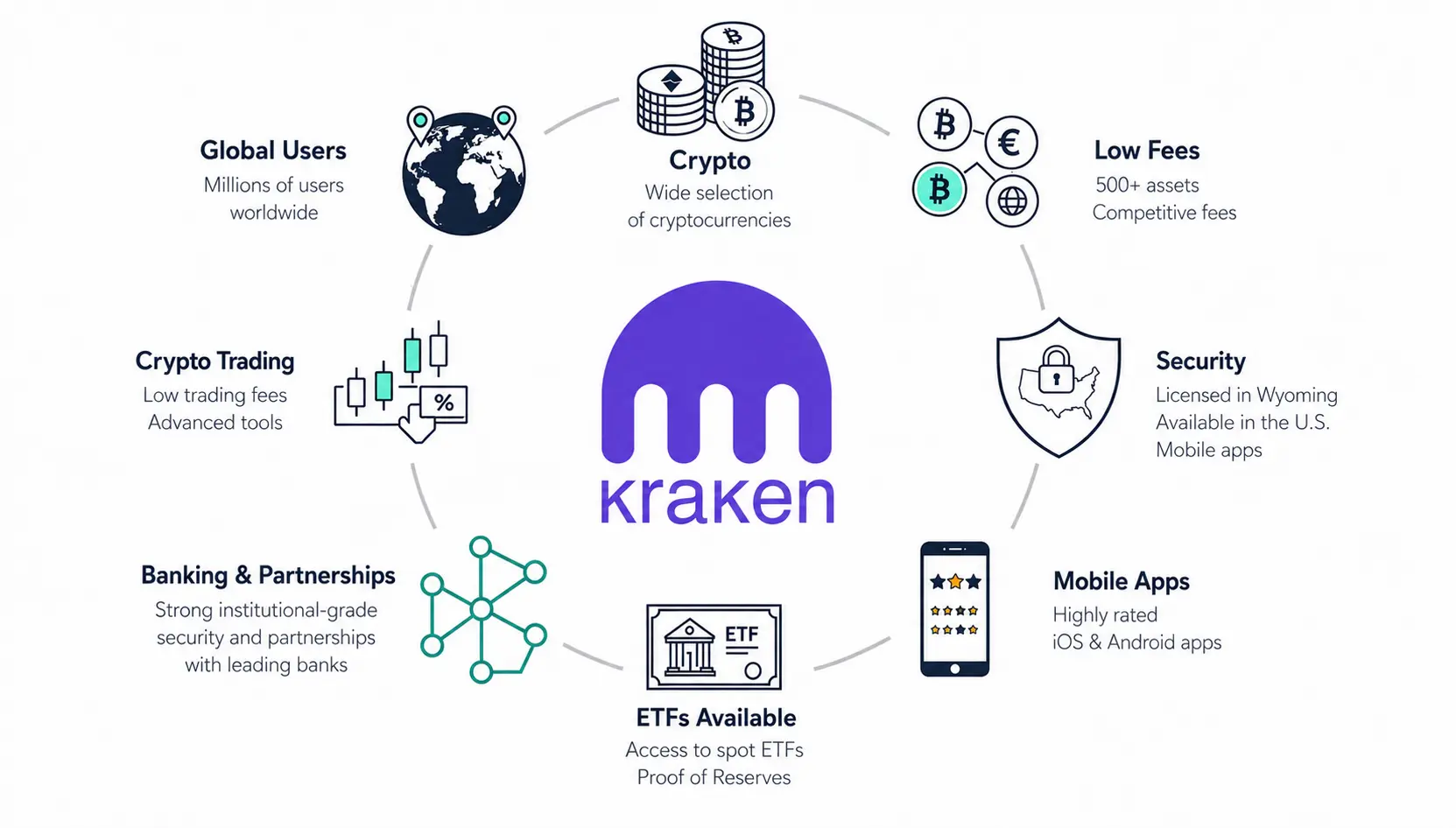
The table below pulls together the core facts in one place before going into the details of each category.
| Feature | Details |
|---|---|
| Founded | 2011 by Jesse Powell. Parent company: Payward, Inc. Headquartered in Cheyenne, Wyoming |
| Users | Over 15 million traders across 190+ countries |
| Cryptocurrencies | 500+ assets, 1,200+ trading pairs |
| Instant buy fee | 1% (standard app) plus spread |
| Pro maker/taker fee | 0.25% maker / 0.40% taker at base tier, falling to 0.00% / 0.05% at highest public tier |
| Staking | Available in 39 US states after SEC case dismissal; relaunched January 2025 |
| Stocks and ETFs | 11,000+ US stocks and ETFs, commission-free (select states) |
| Security certifications | ISO 27001, SOC 2 Type 2, Wyoming bank charter, MiCA license (EU) |
| US availability | All US states except Maine and New York |
| Proof of Reserves | Quarterly Merkle-tree attestations, user-verifiable in-account |
| App ratings | iOS: 4.7/5 | Android: 4.1/5 | Trustpilot: 3.1/5 |
Is Kraken Legitimate and Has It Ever Been Hacked
Kraken is a legitimate, regulated crypto exchange that has operated since 2011 without losing customer funds to a hack. That record puts it among a very short list of major exchanges that have run for over a decade without a custody breach. Kraken is registered with FinCEN as a money services business in the United States, holds a Wyoming bank charter, and operates under a MiCA license from the Central Bank of Ireland for EU customers.
The SEC filed a case against Kraken in November 2023, alleging it operated as an unregistered securities exchange. The court dismissed that case with prejudice in March 2025, which means the SEC cannot refile the same claims. This resolved the most significant regulatory overhang the exchange faced and allowed Kraken to relaunch US on-chain staking in January 2025.
The one real security event in Kraken’s recent history occurred in June 2024. A third-party security research firm discovered and exploited a bug in Kraken’s deposit and funding system that allowed certain users to artificially inflate account balances without fully completing a deposit. Kraken says no customer funds were at risk, the bug was patched within an hour, and all affected balances were reversed. This was not a wallet breach or custody failure, but it was a real control gap in a sensitive payment workflow and deserves to be part of any honest risk assessment.
Kraken Pros and Cons
Pros:
- No confirmed customer-fund loss in over 13 years of operation
- Quarterly Proof of Reserves that users can verify independently in-account
- Kraken Pro fees are significantly lower than Coinbase Advanced (0.25%/0.40% vs 0.40%/0.60% at base)
- ISO 27001 and SOC 2 Type 2 certified, Wyoming bank charter, MiCA license
- SEC case dismissed with prejudice March 2025
- Commission-free trading on 11,000 US stocks and ETFs
- On-chain staking relaunched for US clients in 39 states
Con:
- 1% instant buy fee on the standard app is steep compared to what Kraken Pro charges
- ACH deposits trigger a 7-day withdrawal hold; card and PayPal purchases trigger a 72-hour hold
- Not available in Maine or New York
- Running two separate apps (Kraken and Kraken Pro) plus a separate wallet app adds complexity for new users
- Some features, including staking, derivatives, and certain coins, vary by state
- Trustpilot rating sits at 3.1/5, with recurring complaints about account verification delays and withdrawal holds
Who Is Kraken Best For
Kraken works well across several types of users, though it fits some better than others depending on how they plan to use it.
Beginners
The standard Kraken app is built for simple buy, sell, and convert transactions with a clean interface and minimal setup. Beginners do not need to touch Kraken Pro at all to get started. The Kraken+ membership at $4.99 per month eliminates the 1% trading fee on up to $20,000 in monthly volume, which makes it a reasonable option for regular buyers who want to avoid paying the standard instant buy fee. The main caveat for beginners is that the dual-app structure between the standard Kraken app and Kraken Pro can be confusing before you understand what each one is for.
Active and Advanced Traders
Kraken Pro is where the exchange makes its strongest case for active traders. The fee schedule starts at 0.25% maker and 0.40% taker and drops with 30-day trading volume, reaching 0.00% maker and 0.05% taker at the highest public tier. Access to more than 15 advanced order types, TradingView-integrated charting, margin trading with up to 5x leverage, futures, and OTC block trading puts it in a different class from basic retail platforms.
Stock and Multi-Asset Investors
US clients in eligible states can now trade 11,000+ stocks and ETFs commission-free directly in the Kraken app. Fractional shares start at $1. For investors who want to manage crypto and traditional equity positions from a single account without juggling multiple brokerage relationships, this is a genuine advantage over crypto-only exchanges. Availability rolls out state by state, so checking current eligibility before opening an account is worth doing.
Kraken Standard vs Kraken Pro: What Is the Difference
Kraken splits its product into two distinct experiences, and choosing the right one affects both what you pay and what tools you have access to.
| Feature | Kraken (Standard) | Kraken Pro |
|---|---|---|
| Best for | Beginners, casual buyers | Active traders, advanced users |
| Fee model | Fixed 1% + spread on buy/sell/convert | Maker/taker from 0.25% / 0.40%, volume-based |
| Order types | Market orders only | 15+ order types including limit, stop-loss, take-profit, trailing stop |
| Charting | Basic price chart | Full TradingView integration with indicators |
| Margin | No | Yes, up to 5x on select pairs |
| Kraken+ eligible | Yes, up to $20K/month at 0% fee | No, Kraken+ does not reduce Pro fees |
| Access | Separate app and web interface | Separate app and web interface; same account login |
For anyone who trades more than a few times per month, Kraken Pro almost always makes more financial sense than paying 1% on every instant buy. The two platforms use the same account, so switching between them requires no additional setup.
Understanding the broader custody model behind any exchange account matters before depositing significant funds. The guide on custodial vs non-custodial wallets covers exactly what it means to leave assets on an exchange versus controlling them yourself.
Kraken Fees: Full Breakdown
Kraken’s fee structure differs significantly depending on which interface you use. The standard app and Kraken Pro are priced in completely different ways, and the total cost of using each one is not always obvious from the headline numbers alone.
Instant Buy Fee: 1% on the Standard App
Every buy, sell, and convert transaction on the standard Kraken app carries a fixed 1% trading fee, and the quoted price also includes a spread on top of that. The spread is not disclosed as a separate line item; it is embedded in the price you see. This makes the standard app convenient but expensive for frequent trading. The 1% fee is also charged on recurring buy orders set up through the standard interface.
Kraken Pro Maker and Taker Fees
Kraken Pro uses a volume-based maker/taker model where fees fall as your 30-day rolling trading volume increases. Trading volume generated through instant buy on the standard app does not count toward your Kraken Pro volume tier.
| 30-Day Volume | Maker Fee | Taker Fee |
|---|---|---|
| $0 and above | 0.25% | 0.40% |
| $10,000 and above | 0.20% | 0.35% |
| $100,000 and above | 0.12% | 0.22% |
| $1,000,000 and above | 0.06% | 0.16% |
| $10,000,000 and above | 0.00% | 0.10% |
| $100,000,000 and above | 0.00% | 0.08% |
| $500,000,000 and above | 0.00% | 0.05% |
At base tier, Kraken Pro’s taker fee of 0.40% is lower than Coinbase Advanced’s base taker fee of 0.60%. Kraken does not have a native exchange token that unlocks fee discounts, which keeps the fee model simpler than competitors who use token-staking to reduce rates.
Kraken+ Membership: Is It Worth It
The Kraken+ membership costs $4.99 per month and waives the fixed 1% trading fee on up to $20,000 in monthly volume through the standard Kraken app buy, sell, and convert flow. Spreads and payment processing fees still apply even with Kraken+, and the membership does not reduce fees on Kraken Pro, futures, OTC, or API trading at all.
Kraken+ makes sense for regular buyers who use the standard app and want to avoid the 1% fee on moderate monthly purchases. For anyone already using Kraken Pro or trading in large volumes, the membership adds no value.
Deposit and Withdrawal Fees
| Method | Deposit Fee | Withdrawal Fee | Minimum |
|---|---|---|---|
| ACH (US, via Plaid) | Free | Free | $1 |
| FedWire (US) | Free or varies by processor | $4 | $1 |
| SWIFT (USD) | Varies | Varies | $100 |
| Debit card (US) | 3.75% + $0.25 | Not available | $10 |
| PayPal (US) | Variable, shown at checkout | Not a standard fiat rail | $1 |
| Crypto withdrawal | N/A | Asset and network-specific | Asset-specific |
Crypto withdrawal fees on Kraken are set per asset and per network rather than as a simple network gas pass-through. Always check the fee displayed at withdrawal confirmation for the specific asset and network you plan to use. For stablecoins like USDT and USDC, Kraken supports multiple networks including ERC-20, TRC-20, and others, with different fees per network. Choosing the wrong network can result in permanent loss of funds, so always match the network to the receiving wallet exactly.
How to Open a Kraken Account
Opening a Kraken account takes 10 to 30 minutes when identity verification is automated. Manual review can take longer and is more common for US clients requiring domestic funding access.
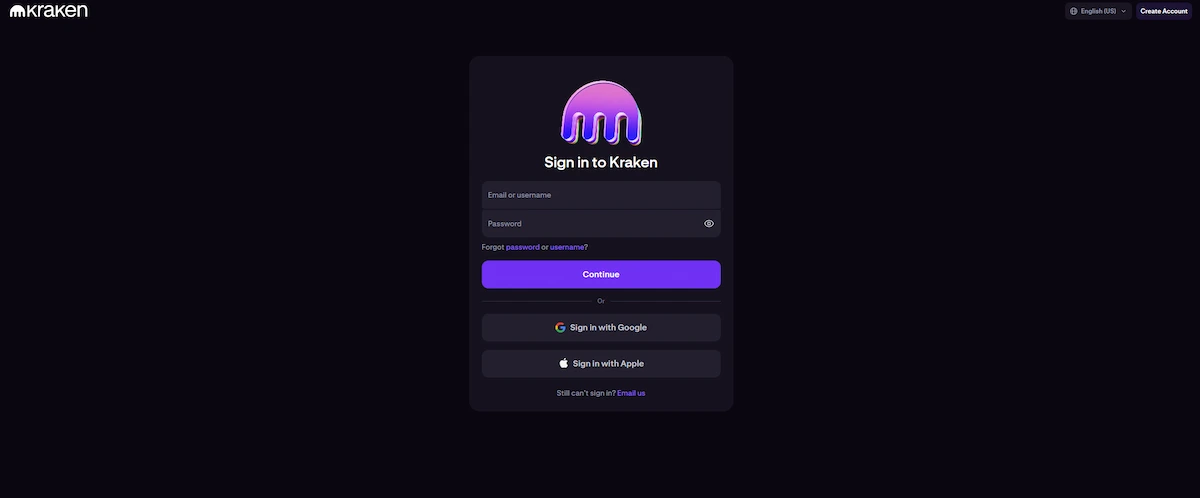
- Create your account: Go to kraken.com or download the Kraken app. Enter your email address, choose a username, and set a password. You can also sign up using Apple or Google.
- Verify your identity: Kraken requires your full name, date of birth, phone number, physical address, and occupation. US clients must also provide a Social Security Number or tax ID. Upload a government-issued photo ID. Some accounts require a selfie or proof of address.
- Fund your account: ACH bank transfer via Plaid is free and the most common US funding method. Wire transfers, debit card, and PayPal are also available. Debit card and PayPal incur higher fees and trigger withdrawal holds.
- Choose your platform: Log in to the standard Kraken app for simple buy and sell, or open Kraken Pro for limit orders, charting, and lower fees. Both use the same account.
KYC and Verification Requirements
Kraken requires identity verification for all accounts before trading or withdrawing. There is no anonymous or limited tier. US clients must provide a Social Security Number or tax ID for domestic funding access, along with a government-issued ID and in some cases proof of address. Verification is usually automated and completes within minutes, but manual review can take up to 24 to 48 hours during high-demand periods. Trustpilot reviews cite verification delays as one of the most common friction points, particularly for new accounts trying to verify quickly during volatile markets.
Verification Levels and Withdrawal Limits
| Level | Fiat Daily Limit | Fiat Monthly Limit | Crypto Daily Limit |
|---|---|---|---|
| Verified individual | $100,000 | $500,000 | $500,000 |
| Higher limits (on request) | $10,000,000+ | $100,000,000+ | $10,000,000+ |
Applying for higher limits requires sign-in 2FA to be active on the account and usually receives a response within two business days. Additional documentation such as proof of funds or source of wealth may be required for very large limit applications.
Deposits, Withdrawals and Availability
Deposit Methods by Region
Kraken’s deposit options vary by country. US clients use ACH, wire, debit card, and PayPal. European clients use SEPA. UK clients use Faster Payments. The exchange operates through different legal entities per region: Payward Interactive for US clients, Payward Ireland for EU clients under MiCA regulation, and Payward Limited for UK clients. This matters because some features described on Kraken’s global website, such as specific staking assets or certain fiat pairs, may not be available in your region.
Funding Holds: The Detail Most Reviews Skip
This is the detail that generates the most negative feedback on Trustpilot and Reddit, and it is consistently underexplained in most Kraken reviews.
When you deposit via ACH through Plaid, Kraken places a seven-day hold on both fiat and crypto withdrawals after the deposit. This means you can buy crypto immediately, but you cannot withdraw it for seven days. For debit card, credit card, and PayPal purchases, the hold is 72 hours. FedWire deposits generally do not trigger the same hold.
The reason is fraud prevention. ACH deposits can be reversed for several days after they settle, so Kraken holds withdrawal access until the deposit is final. Experienced traders who need to move funds quickly should use FedWire or deposit crypto directly rather than relying on ACH for time-sensitive operations.
New withdrawal addresses also face an additional confirmation delay if your account does not have sign-in 2FA or a Master Key enabled. Setting up 2FA before you need to move funds avoids this friction.
Where Is Kraken Available
Kraken is available in all 50 US states except Maine and New York. Globally, it serves customers in 190+ countries. Texas and New Hampshire residents face an additional restriction: they cannot deposit or hold EUR or trade EUR pairs. Feature availability within the US also varies by state for products like staking, derivatives, and certain coin listings.
Is Kraken Safe? Security and Proof of Reserves
Kraken consistently ranks among the safer centralized exchanges by the measures that matter most: account security controls, custody transparency, and regulatory standing. The honest picture includes both the strong track record and the areas where caution is warranted.
Account Security Controls
Kraken supports a range of account-level protections that go well beyond the basics. Key controls include:
- FIDO2-compatible 2FA and passkeys: hardware security key support, which is more phishing-resistant than SMS or app-based 2FA
- Global Settings Lock: freezes sensitive account changes and introduces a timed unlock process. Activating this adds meaningful protection against account takeover even when login credentials are compromised
- Withdrawal address allowlisting: new withdrawal addresses require email confirmation before funds can be sent to them
- PGP-signed email: allows users to verify that emails are genuinely from Kraken and not spoofed
- Master Key: an additional authentication layer for high-security operations
- Session and device management: active sessions visible and revocable from account settings
Kraken avoids SMS-based account recovery, which removes exposure to SIM-swap attacks that have compromised accounts on other platforms. The most important thing to note is that these controls are not all on by default. Users with large balances should actively enable Global Settings Lock, sign-in 2FA, and the Master Key rather than assuming the default configuration is hardened.
Cold Storage and Custody Model
Kraken holds the majority of customer crypto in air-gapped cold storage, with a smaller portion in hot wallets for liquidity and withdrawals. The exchange maintains segregated custody, meaning customer assets are tracked separately from Kraken’s own funds.
Kraken accounts are not FDIC-insured. Kraken is explicit about this. Your crypto balance is not a bank deposit, and it does not carry the federal insurance protection that a checking or savings account would. Kraken’s legal terms acknowledge that in an insolvency scenario, the treatment of customer assets could be subject to court interpretation. This is standard language across centralized crypto exchanges and reflects the legal reality rather than specific risk at Kraken, but it is worth understanding before depositing significant amounts.
Understanding the difference between leaving assets on a custodial exchange and holding them in a wallet you control is one of the most important concepts in crypto self-custody. The comparison of cold wallet storage options explains what self-custody actually provides and what you give up by keeping funds on an exchange.
Proof of Reserves: How Kraken Runs It and How to Check It Yourself
Kraken publishes quarterly Proof of Reserves reports using Merkle-tree attestations verified by an independent third-party accountant. The most recent public snapshot (December 31, 2025) shows reserve ratios above 100% for all major in-scope assets. Kraken holds reserves at 101% to 105% for assets like BTC, ETH, SOL, XRP, ADA, USDC, and USDT. That slight overcollateralization means Kraken holds more of each asset than its total customer liabilities.
Unlike most exchanges that publish generic “we hold 1:1 reserves” statements, Kraken lets individual users verify that their own balances were included in the attestation. Here is how to do it:
- Log in to Kraken Pro and open the Proof of Reserves page from your account menu.
- Select the most recent report date to see the in-scope assets and reserve ratios.
- Click “Verify yourself” to find your Record ID and Merkle Leaf ID.
- Compare your Merkle Leaf ID against the Merkle tree path using the third-party accountant tool linked from the review flow.
- Check the snapshot date and the list of in-scope assets before treating the result as a guarantee. Proof of Reserves only covers in-scope assets at that specific point in time and cannot prove the absence of hidden liabilities.
Security Certifications and Regulatory Standing
Kraken holds ISO 27001 certification for information security management and has completed SOC 2 Type 2 examinations, which test the design and operating effectiveness of security controls over time rather than just at a single point. It also holds a Wyoming bank charter, which subjects it to state banking regulation, and a MiCA license from the Central Bank of Ireland for EU operations. In the US, it is registered with FinCEN as a money services business.
The SEC case dismissal in March 2025 removed the most significant regulatory cloud over the exchange’s US operations. Kraken plans an IPO at some point, which would introduce public company-level financial reporting and oversight if completed.
The June 2024 Security Incident
In June 2024, a third-party security research company discovered a bug in Kraken’s deposit and funding system that allowed users to artificially inflate their account balances without completing a valid deposit. The researchers exploited the bug to generate real funds rather than simply reporting it, which Kraken characterized as extortion. According to Kraken’s official statement, the flaw was patched in under an hour, no customer funds were at risk, and all affected balances were reversed. This was a real control failure in a sensitive part of the platform even though customer assets were not ultimately lost.
If you are managing significant crypto holdings and want to understand the broader landscape of seed phrase storage and backup security that applies regardless of which exchange you use, that guide covers the fundamentals.
Supported Assets and Markets
Kraken supports over 500 cryptocurrencies and 1,200 trading pairs, including major assets like Bitcoin, Ethereum, Solana, XRP, Cardano, and Dogecoin, alongside hundreds of mid-cap and small-cap altcoins. Stablecoin support covers USDT, USDC, DAI, USDG, PYUSD, RLUSD, EURC, and EURQ, with multiple deposit and withdrawal networks available for the most widely used stablecoins.
Fiat trading is available in seven currencies: USD, EUR, GBP, CAD, AUD, JPY, and CHF. US clients are operationally tied to USD and do not have access to the full multi-currency functionality visible on Kraken’s global pages. Some listed assets are not available in specific US states, so checking asset availability for your location before depositing is worth doing.
Kraken runs a public Listings Roadmap showing assets that have cleared internal approval and are progressing toward launch. When assets are scheduled for removal, Kraken follows a step-down process: trading and deposits stop first, withdrawals remain open for a defined period, and final liquidation comes last. This gives users time to act before the deadline.
Kraken Staking
Kraken relaunched on-chain staking for US clients in January 2025 after settling with and then defeating the SEC. The service is currently available in 39 US states and US territories. Outside the US, Kraken offers staking on a broader range of assets with more flexible terms.
Flexible Staking vs Bonded Staking
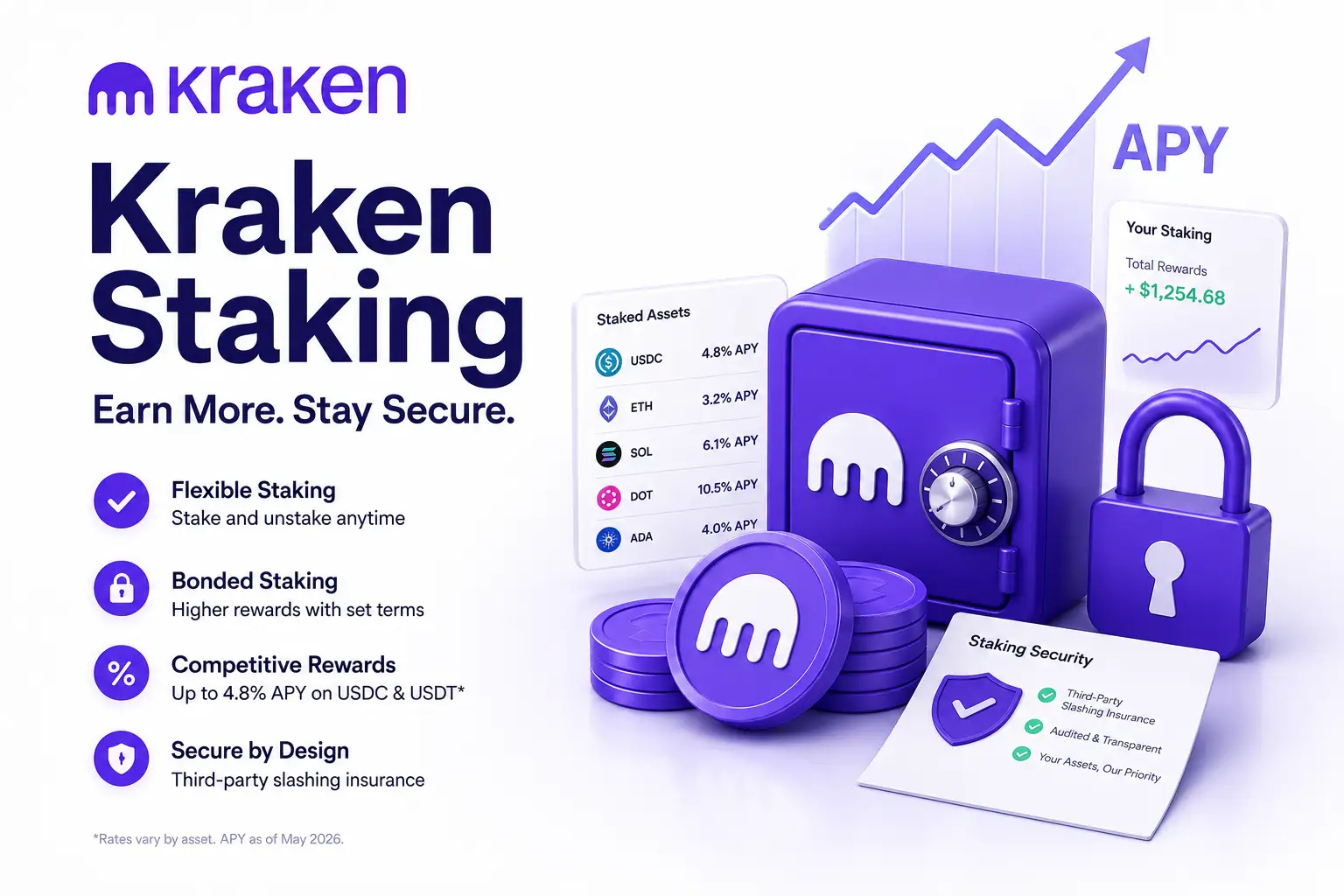
Flexible Staking allows users to unstake without a traditional lockup period, though Kraken only stakes up to 50% of selected balances on assets with on-chain unbonding requirements in order to maintain sufficient liquidity. Bonded Staking involves locking your assets for a defined period tied to the underlying blockchain’s staking mechanism. ETH restaking is also available on Kraken for eligible users.
Staking Rewards, APY and Commission
Staking rewards vary by asset. As of 2026, USDC and USDT on Kraken earn approximately 4.8% APY. ETH, SOL, DOT, and ADA are among the 17 assets available for US clients to stake, each at different reward rates.
Kraken takes a commission from staking rewards rather than charging a transaction fee. The commission rate is 30% on Flexible Staking and Auto Earn products in many cases, and 20% on some other flexible reward products. This means if the underlying network offers a 5% staking yield, Kraken’s cut reduces your net yield to roughly 3.5%. The quoted APY on Kraken’s staking page already reflects the net rate after Kraken’s commission, but it is worth understanding the structure when comparing rates across platforms.
All staked assets on Kraken are covered by third-party slashing insurance, which protects against losses caused by validator errors.
Staking for US Clients
Kraken agreed to a $30 million settlement with the SEC in February 2023 and shut down its US staking service. After winning the subsequent case in March 2025, Kraken relaunched on-chain staking for US clients. The new service is available in 39 states, meaning it is not universally accessible across all of the US states where Kraken otherwise operates.
For context on why Bitcoin specifically differs from staked assets in how it generates returns without a staking mechanism, that guide covers the fundamental differences in how BTC and proof-of-stake assets are designed.
Kraken Pro: Advanced Trading Features
Kraken Pro is a full-featured trading platform, not just a version of the standard app with lower fees. It runs as a separate interface with its own app and web experience, accessed through the same account login as the standard platform.
Order Types and Charting Tools
Kraken Pro supports more than 15 order types including limit orders, stop-loss, take-profit, and trailing stop orders. Charts are powered by TradingView integration with technical indicators, customizable timeframes, and alert functionality. The desktop experience also extends into Kraken Desktop, which offers a more workstation-oriented layout for heavy traders.
Margin Trading
Margin trading on Kraken Pro allows up to 5x leverage on select spot pairs. Kraken publishes its margin classes, leverage schedules, and collateral requirements on its support pages. Leverage and pair availability vary by asset. Liquidation risk is real: if losses exceed deposited margin, the exchange closes the position automatically. Margin trading is best suited to experienced traders who understand how collateral requirements and liquidation thresholds work in practice.
Futures and Derivatives
Futures access on Kraken differs significantly between US and non-US clients. US clients can access Kraken Derivatives US, which offers CME-listed crypto futures under US regulatory oversight. Non-US clients in eligible markets can access Kraken’s perpetual futures offering with leverage up to 50x on some assets. This is a fundamentally different product structure, and US traders should not assume the 50x leverage figures they may see on Kraken’s global pages apply to their accounts.
Futures contracts carry funding rates that can be positive or negative on a daily basis, affecting the actual profit and loss of a position independent of the underlying price move. Traders holding futures positions overnight need to account for the funding rate impact on their position’s cost over time.
OTC Desk
Kraken’s OTC desk handles large block trades that are too large to execute cleanly on the standard order book without moving the market. The minimum trade size for OTC is typically $50,000 to $100,000. Execution is available through a self-service RFQ portal or via direct contact with the OTC desk. Collateral for OTC trades is held in Kraken’s Wyoming custodian, which adds a layer of regulated oversight compared to offshore OTC alternatives.
API and Programmatic Trading
Kraken’s API stack covers Spot REST, Spot WebSocket, Futures REST, Futures WebSocket, and Unified FIX protocol. Granular API key permissions allow traders to create keys with specific access rights, IP restrictions, and self-trade prevention controls. A dead-man-switch tool automatically cancels open orders if the system loses connectivity, which is critical for automated strategies. Subaccount management is available for institutional users running multiple trading strategies from one master account.
Kraken Stocks and ETF Trading
In 2025, Kraken launched commission-free trading on 11,000+ US stocks and ETFs directly within the Kraken app and Kraken Pro interface. Fractional shares are available starting at $1. Extended hours trading is also supported. This feature is available in select US states and continues rolling out, initially launching in New Jersey, Connecticut, Wyoming, Oklahoma, Idaho, Iowa, Rhode Island, Kentucky, Alabama, and Washington DC.
The practical value of this feature is consolidation: crypto and traditional equity positions managed from one account, one app, and one login. For investors who want exposure to both asset classes without maintaining separate brokerage relationships, this removes a meaningful layer of friction. Stocks and ETFs traded on Kraken are separate from the crypto products and operate under Kraken Securities LLC.
Kraken Wallet: Self-Custody Within the Kraken Ecosystem
Kraken Wallet is a separate self-custody product where you control the Secret Recovery Phrase. Assets held in Kraken Wallet are not in Kraken’s custody, which means they sit outside the exchange risk if Kraken were to experience operational issues. The wallet supports Bitcoin, Ethereum, Polygon, Arbitrum, Optimism, Solana, Dogecoin, Base, and Blast, along with thousands of ERC-20, EVM-compatible, and SPL tokens. NFT support covers Ethereum, Arbitrum, Base, Optimism, Polygon, and Solana.
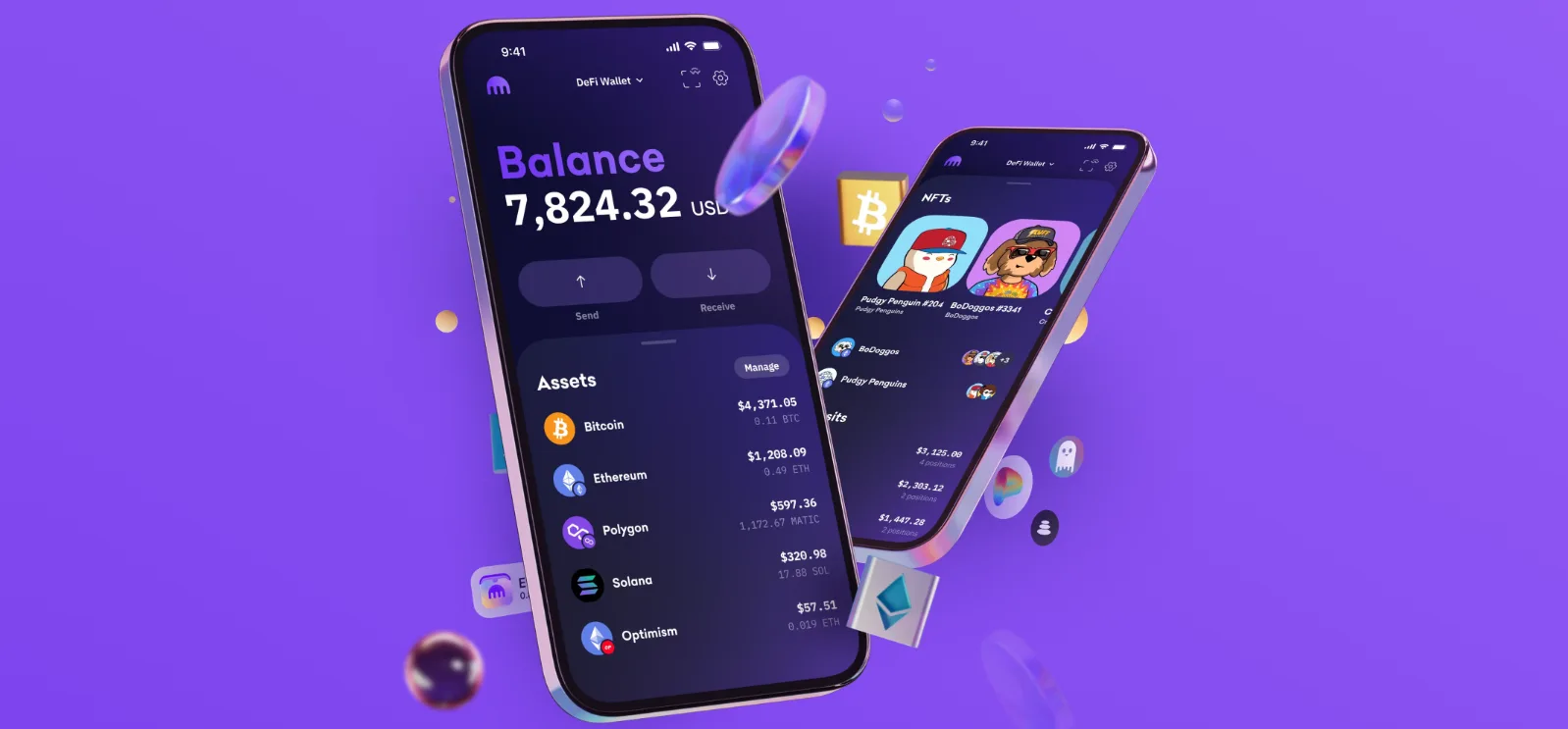
Once assets are in Kraken Wallet, users pay network transaction fees rather than exchange custody fees. The wallet connects to DeFi protocols, DApps, and NFT platforms directly. The key responsibility this places on the user is managing the seed phrase: if it is lost, there is no recovery option through Kraken or anyone else.
For anyone moving crypto between a custodial exchange and a self-custody wallet for the first time, the guide on how to move crypto from an exchange to a private wallet covers the process step by step. The same mechanics apply when moving from Kraken.
Kraken App and Customer Support
Kraken App vs Kraken Pro App
Kraken operates two official exchange apps for retail users: the standard Kraken app and Kraken Pro. Both are available on iOS and Android. The standard app carries a 4.7/5 rating on the App Store and a 4.1/5 rating on Google Play, reflecting general satisfaction among active users with the mobile experience. The standard app handles account setup, portfolio tracking, buying and selling, and basic order management. Kraken Pro handles full charting, limit orders, margin, and advanced trading tools. A separate Kraken Wallet app provides self-custody access.
The split between three separate apps (Kraken, Kraken Pro, Kraken Wallet) is the clearest usability criticism reviewers raise, particularly for users who expect one app to handle everything. Once you understand which app to use for each purpose, navigation is logical. Until then, it can feel fragmented.
Customer Support Options
Kraken offers 24/7 support through live chat, a ticket submission system, and phone support. Phone support is available only through the Kraken app and only in specific situations, not through a publicly listed general support line. On mobile, live chat is accessible from any support article by tapping “Chat with us.” Response times for live chat are typically within a few minutes for common issues.
Kraken’s Trustpilot rating sits at 3.1 out of 5, which is below average for a major financial platform. The most common complaint categories are account verification delays and holds on withdrawals following ACH or card deposits. Positive reviews consistently credit the security features, the range of supported assets, and the quality of Kraken Pro for active traders.
Kraken’s official support channels are the only ones to trust. The exchange will never ask for your password, 2FA code, Master Key, or seed phrase through any channel, and any unsolicited contact claiming to be from Kraken support should be treated as a phishing attempt.
How Kraken Compares to Other Exchanges
| Exchange | Cryptocurrencies | Pro/Advanced Base Fees | Stock Trading | US Availability | Proof of Reserves |
|---|---|---|---|---|---|
| Kraken | 500+ | 0.25% / 0.40% | Yes (select states) | All except ME, NY | Yes, user-verifiable |
| Coinbase | 260+ | 0.40% / 0.60% | No | All 50 states | Yes |
| Binance.US | 150+ | 0.10% / 0.10% | No | Limited states | Yes |
| Crypto.com | 350+ | 0.075% / 0.075% | No | Most states | Yes |
| eToro | 100+ | 1% spread | Yes | Most states | No |
On fees alone, Binance.US and Crypto.com offer lower base trading rates than Kraken. But Binance.US operates with significant geographic restrictions following its regulatory issues, and Crypto.com’s lower rates depend on holding their native CRO token. Kraken’s edge over Coinbase on fees is clear at every volume level: its base taker fee of 0.40% beats Coinbase Advanced’s 0.60%, and the gap widens at higher tiers.
For users comparing Kraken specifically against Coinbase, the Robinhood Crypto review offers useful context on the zero-fee model and how hidden spreads on commission-free platforms compare in practice to Kraken’s transparent fee structure.
For those considering using crypto earnings or rewards alongside a physical payment card, the crypto debit card guide covers how different platforms handle crypto-to-fiat spending at the point of sale.
Two external references used in preparing this review:
Frequently Asked Questions
Is Kraken safe for beginners?
Yes, Kraken is safe for beginners when used through the standard app. The interface is straightforward for buying and selling, the exchange has never lost customer funds to a hack, and the account security controls are among the strongest available. The main adjustment for new users is understanding the funding hold policy: ACH deposits trigger a 7-day withdrawal hold, and card purchases trigger a 72-hour hold. Setting up 2FA immediately after account creation and using the Kraken+ membership to reduce the 1% instant buy fee are the two most practical starting points for beginners.
What are Kraken’s fees?
Kraken charges a flat 1% fee on buy, sell, and convert transactions through the standard app, plus a spread on the price. Kraken Pro uses a maker/taker model starting at 0.25% maker and 0.40% taker at base tier, dropping with 30-day trading volume. The Kraken+ membership at $4.99 per month waives the 1% standard app fee on up to $20,000 monthly. ACH deposits and withdrawals are free. Debit card deposits cost 3.75% plus $0.25. Crypto withdrawal fees vary by asset and network.
Is Kraken available in all US states?
Kraken is available in 48 US states. It does not serve residents of Maine or New York. Within the 48 eligible states, some features including staking, derivatives, and specific coin listings vary by state. Texas and New Hampshire residents cannot deposit EUR or trade EUR pairs. Checking the current eligibility for specific features in your state before opening an account is worthwhile.
Is Kraken better than Coinbase?
Kraken offers lower fees at every volume level on its Pro platform compared to Coinbase Advanced. It also offers on-chain staking (where eligible), more supported assets, and user-verifiable Proof of Reserves. Coinbase is available in all 50 US states and is generally considered slightly easier for complete beginners. For active traders or anyone who cares about fee efficiency and regulatory transparency, Kraken is the stronger option. For someone who just wants the simplest possible first crypto purchase and already has a Coinbase account, the difference is minimal at small volumes.
Does Kraken offer staking?
Yes. Kraken relaunched on-chain staking for US clients in January 2025 after the SEC case was dismissed. Staking is currently available in 39 US states for 17 assets including ETH, SOL, DOT, and ADA. Flexible Staking and Bonded Staking options are both available. Kraken takes a 30% commission on Flexible Staking rewards. ETH restaking is also available for eligible users. Outside the US, Kraken offers staking on a wider range of assets.
How long do Kraken withdrawals take?
Crypto withdrawals to verified addresses typically process within minutes to a few hours. Bank withdrawals via ACH take one to three business days depending on your bank. If your account does not have sign-in 2FA or a Master Key enabled, new withdrawal addresses face an additional hold of up to 24 hours for security reasons. ACH deposits trigger a 7-day withdrawal hold, meaning you cannot withdraw crypto or fiat for seven days after an ACH deposit regardless of your verification level.
Does Kraken require KYC?
Yes. All Kraken accounts require identity verification before trading or withdrawing. There is no anonymous tier. US clients must provide a government-issued photo ID and Social Security Number or tax ID. Some accounts also require proof of address or a selfie. Kraken does not offer limited-access accounts without KYC completion.
Is Kraken FDIC insured?
No. Kraken is not a bank, and your crypto or cash balance on Kraken is not covered by FDIC insurance. Kraken holds fiat with banking partners in some regions, but that does not extend FDIC protection to your Kraken account balance. Customer crypto is held in cold storage custody with segregated accounts, but this is not the same legal protection as a bank deposit. This is standard across all centralized crypto exchanges, not a specific limitation of Kraken.