Crypto has its own language. Walk into any trading community, Discord server, or on-chain analytics forum and you will immediately encounter words, acronyms, and slang terms that do not exist anywhere else. HODL, gas fees, rug pull, impermanent loss, WAGMI: these are not jargon for jargon’s sake. Each term describes something real about how the market works, how communities behave, and where the risks are.
This crypto glossary covers over 150 terms organized into eight categories: core concepts, market and trading terms, crypto slang, technical terms, DeFi and Web3 vocabulary, security, scam red flags, and new terms that entered the dictionary in the current cycle. It is designed as a reference you return to, not something you read once and forget.
How to Use This Glossary
This glossary is organized by topic, not alphabetically. That structure is intentional. Knowing what a liquidity pool is makes more sense after you understand what a DEX is. Understanding cold storage becomes more meaningful once you know what a private key controls.
- Start with Core Concepts if you are new. Those ten terms are the foundation every other definition builds on.
- Use the section headings as a map. If you heard a term in a trading context, check Market and Trading Terms first. If it came from a DeFi protocol, go to the DeFi section.
- Bookmark this page. New terms appear every cycle, and the 2026 section at the bottom covers what this cycle added that did not exist before.
Core Concepts: 10 Terms You Need Before Anything Else
These ten terms are the foundation of everything else in this glossary. If you are new to crypto, these are the only terms you need to understand on day one. Everything else can wait.
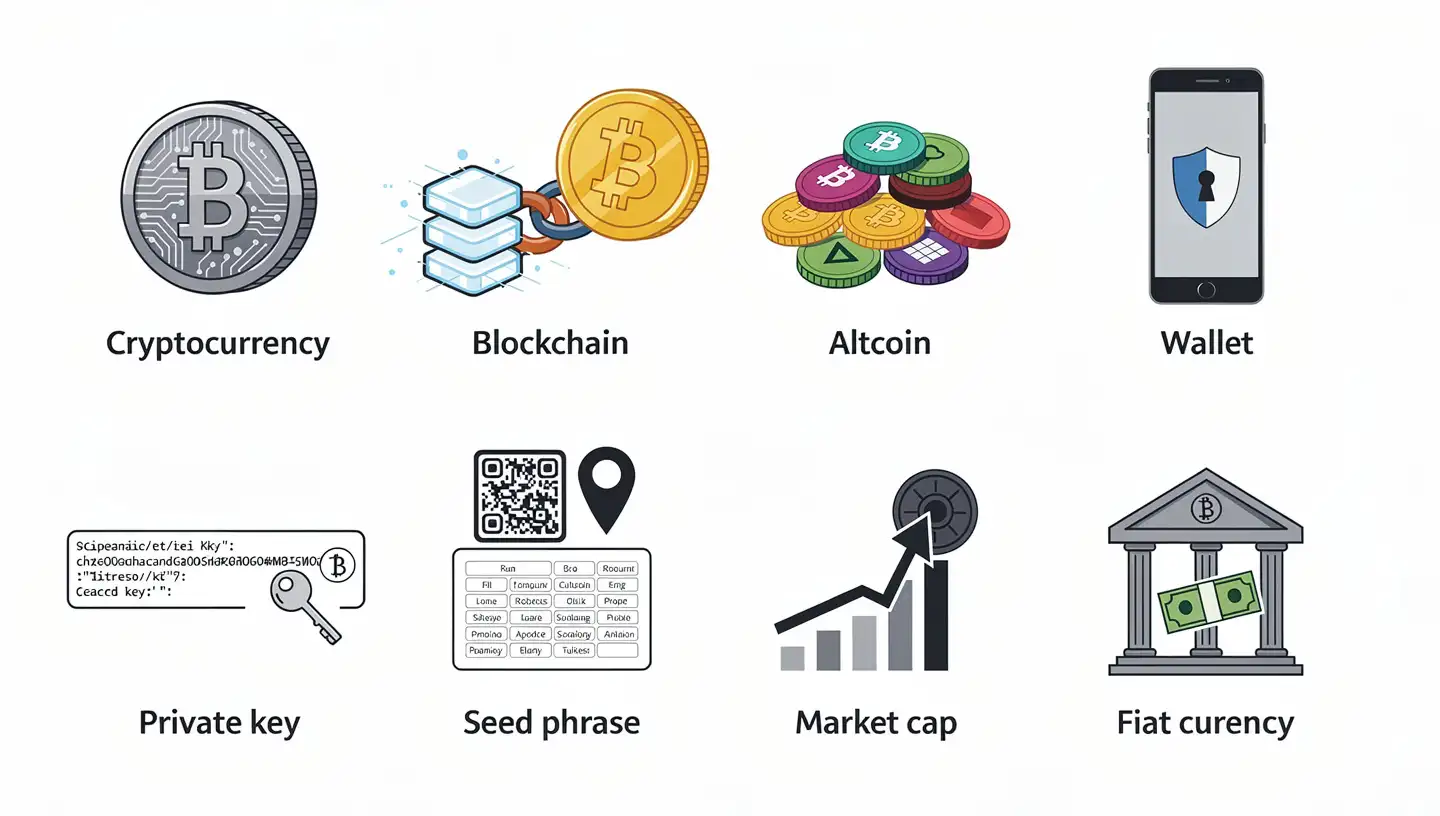
Cryptocurrency is a digital currency secured by cryptography and recorded on a decentralized network called a blockchain. Unlike dollars or euros, no central bank issues it or controls its supply.
Blockchain is a distributed ledger: a permanent, public record of every transaction, stored simultaneously across thousands of computers worldwide. No single entity controls it, and no record can be altered after it is written.
Bitcoin is the first and largest cryptocurrency by market cap, created in 2009 by a pseudonymous person or group called Satoshi Nakamoto. It introduced both the blockchain concept and the proof of work consensus mechanism.
Altcoin is any cryptocurrency other than Bitcoin. Ethereum, Solana, XRP, and Dogecoin are all altcoins. There are tens of thousands of altcoins in existence, ranging from serious infrastructure projects to outright scams.
Wallet is a tool (software app, hardware device, or paper) that stores the private and public keys needed to send and receive cryptocurrency. A wallet does not hold coins the way a physical wallet holds cash. It holds the keys that prove ownership of coins recorded on the blockchain.
Private key is a long alphanumeric code that proves ownership of your crypto and authorizes transactions. Anyone who has your private key controls your funds. Lose it and access is gone permanently. Share it and your funds are gone immediately.
Public key is the address you share with others to receive crypto. It is derived from your private key mathematically but cannot be used to reverse-engineer the private key. Think of it as your account number.
Seed phrase is a set of 12 or 24 random words generated when you create a wallet. It is a backup for your private key. Anyone with your seed phrase can restore your wallet on any compatible device and access all your funds. Store it offline, never in a photo or cloud document.
Market cap is the total value of all coins of a cryptocurrency in circulation. It is calculated by multiplying the current price by the circulating supply. Bitcoin’s market cap, for example, is the current BTC price multiplied by all bitcoins that have been mined so far.
Fiat currency is government-issued money that is not backed by a physical commodity. Dollars, euros, pounds, and yen are fiat currencies. Central banks can increase or decrease fiat supply at will. Bitcoin’s supply, by contrast, is fixed at 21 million coins by code.
For a deeper look at how Bitcoin specifically differs from altcoins and fiat in its design and purpose, the guide on what BTC is in crypto covers the structural differences clearly.
Market and Trading Terms
These are the terms you will encounter on price charts, in trading communities, and in market analysis. Some come from traditional finance and carry the same meaning.
Others are specific to crypto markets.
| Term | Definition |
|---|---|
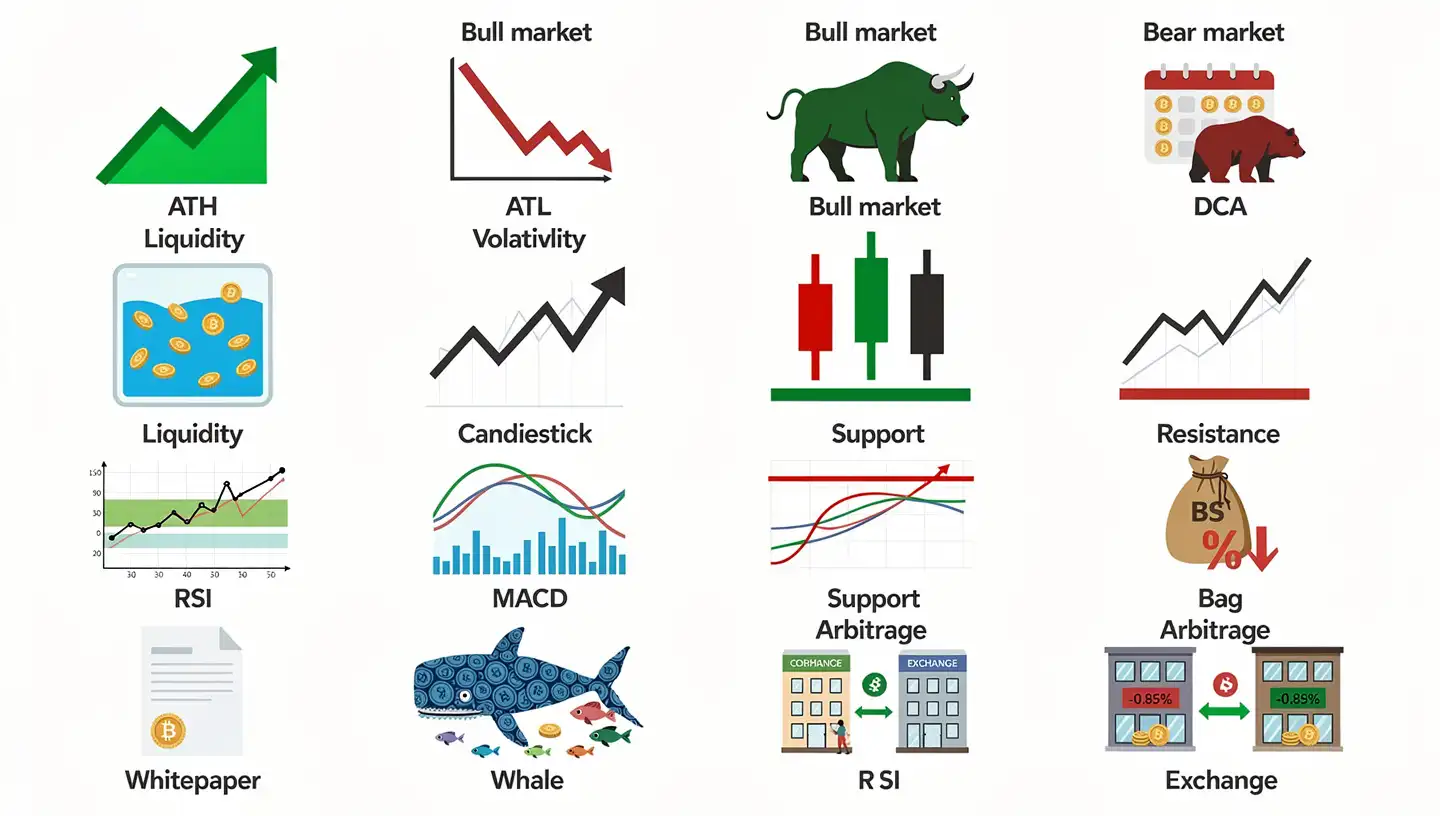
| ATH (All-Time High) | The highest price a cryptocurrency has ever traded at in its history. |
| ATL (All-Time Low) | The lowest price a cryptocurrency has ever traded at. Usually set during bear market bottoms. |
| Bull market | A sustained period of rising prices and positive market sentiment. In crypto, bull markets have historically followed Bitcoin halvings. |
| Bear market | A sustained period of falling prices and negative sentiment. Crypto bear markets are typically more severe than traditional finance, with 70-90% drawdowns common. |
| DCA (Dollar Cost Averaging) | Investing a fixed amount at regular intervals regardless of price. Reduces the impact of volatility on the average purchase price over time. |
| Liquidity | How easily an asset can be bought or sold without significantly affecting its price. High liquidity means large orders can be filled without moving the market much. Low liquidity means even small orders shift the price significantly. |
| Volatility | The degree to which a price moves up or down over a period. Bitcoin is more volatile than most stocks. Small-cap altcoins are more volatile than Bitcoin. |
| Candlestick | A chart type that shows the open, close, high, and low price of an asset over a specific time period. The body shows open-to-close, the wicks show the high and low. |
| Support level | A price zone where buying pressure has historically been strong enough to prevent further price decline. Traders watch support levels to identify potential bounce points. |
| Resistance level | A price zone where selling pressure has historically been strong enough to prevent further price increase. When price breaks above resistance, that level often becomes support. |
| RSI (Relative Strength Index) | A momentum indicator that measures whether an asset is overbought (above 70) or oversold (below 30) on a scale of 0 to 100. |
| MACD | Moving Average Convergence Divergence. A trend-following indicator that shows the relationship between two moving averages of price. Used to identify momentum shifts. |
| Whale | An individual or entity holding a large enough quantity of a cryptocurrency to move its market price when they buy or sell. For Bitcoin, a whale typically holds 1,000 BTC or more. |
| Bag | A holding of a specific cryptocurrency, often used to describe a large or loss-making position. Holding a “heavy bag” means sitting on significant unrealized losses. |
| Arbitrage | Buying a cryptocurrency on one exchange where the price is lower and simultaneously selling it on another where the price is higher to capture the price difference as profit. |
| Whitepaper | The technical document a crypto project releases that explains the problem it claims to solve, how its technology works, and how its token is structured. Bitcoin’s whitepaper was published in 2008 by Satoshi Nakamoto. |
| Roadmap | A public document showing a project’s planned development milestones and timeline. A missing or constantly shifting roadmap is a warning sign. |
| Tokenomics | The economic design of a cryptocurrency: total supply, circulating supply, how new tokens are issued, how they are distributed, and what mechanisms exist to manage inflation or deflation. |
| Bear trap | A false signal where price appears to be breaking below a support level, luring sellers in, before reversing sharply upward. Designed or coincidental, it traps short sellers who entered at the wrong moment. |
| Divergence | When price moves in one direction while a technical indicator like RSI or MACD moves in the opposite direction. Often signals a weakening trend and potential reversal. |
Market Cycle Terms
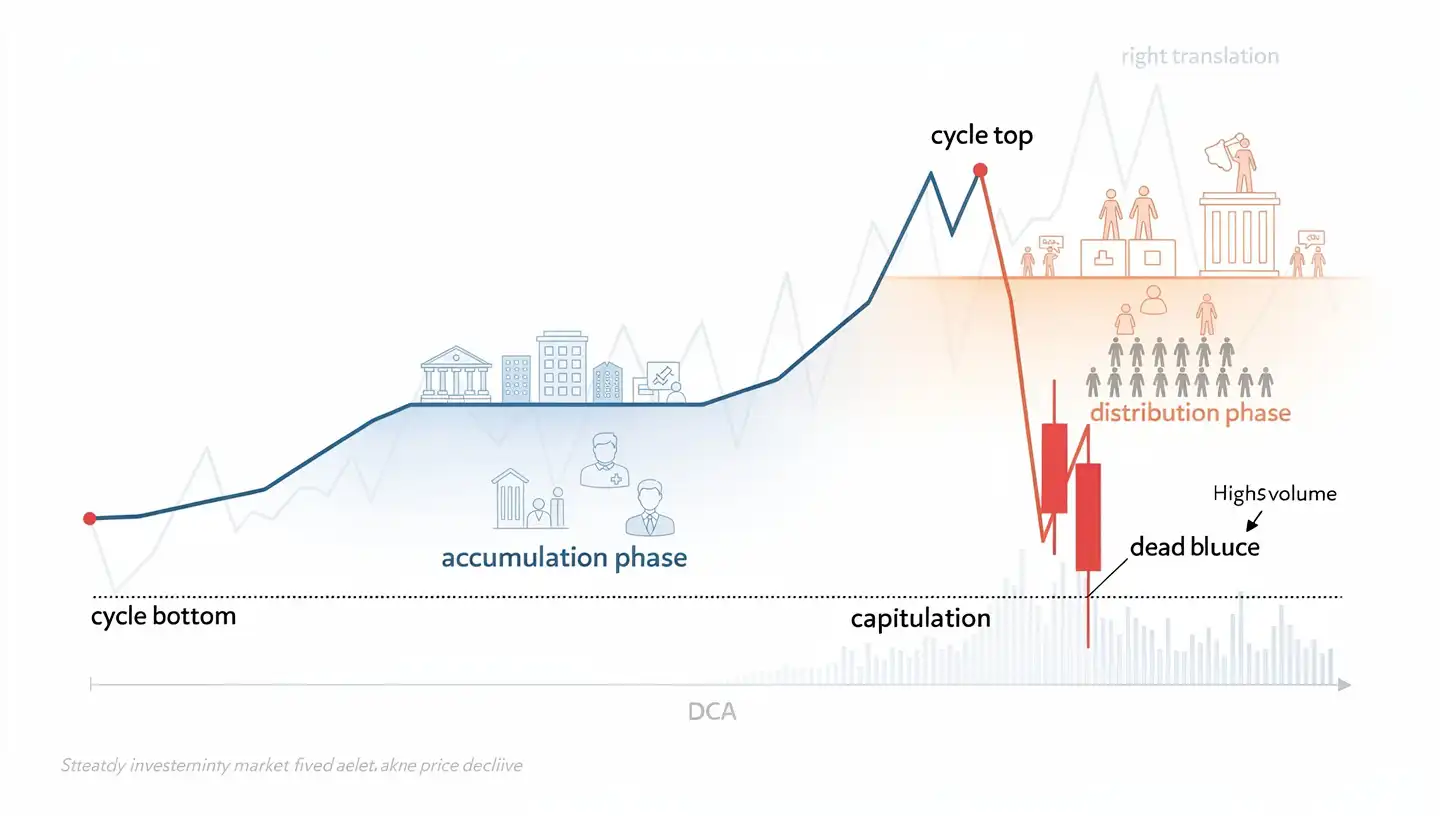
Accumulation phase is the period following a market bottom when institutional investors and long-term holders steadily buy an asset before the broader market recognizes the opportunity. Price moves sideways or slightly upward during this phase.
Distribution phase is the opposite: the period near a market peak when early buyers and large holders gradually sell their positions into retail demand. Price stays elevated but begins to show weakness.
Capitulation is the point in a bear market where the majority of remaining holders give up and sell regardless of price, producing a high-volume crash. It often marks or precedes the market bottom because the sellers who were going to sell have all sold.
Dead cat bounce is a temporary, short-lived price recovery following a significant decline, before the downtrend resumes. The term comes from the dark observation that even a dead cat will bounce if it falls from a great enough height.
Right translation is when the peak of a bull market cycle occurs later than the midpoint of the cycle, suggesting strong bullish momentum. When the peak occurs earlier than the midpoint, it is called left translation and indicates weaker momentum.
Cycle top / cycle bottom refers to the highest price in a bull market and the lowest price in the subsequent bear market. Identifying these in real time is impossible, which is why many long-term investors use DCA instead of trying to time entry and exit precisely.
Order Book and Exchange Mechanics
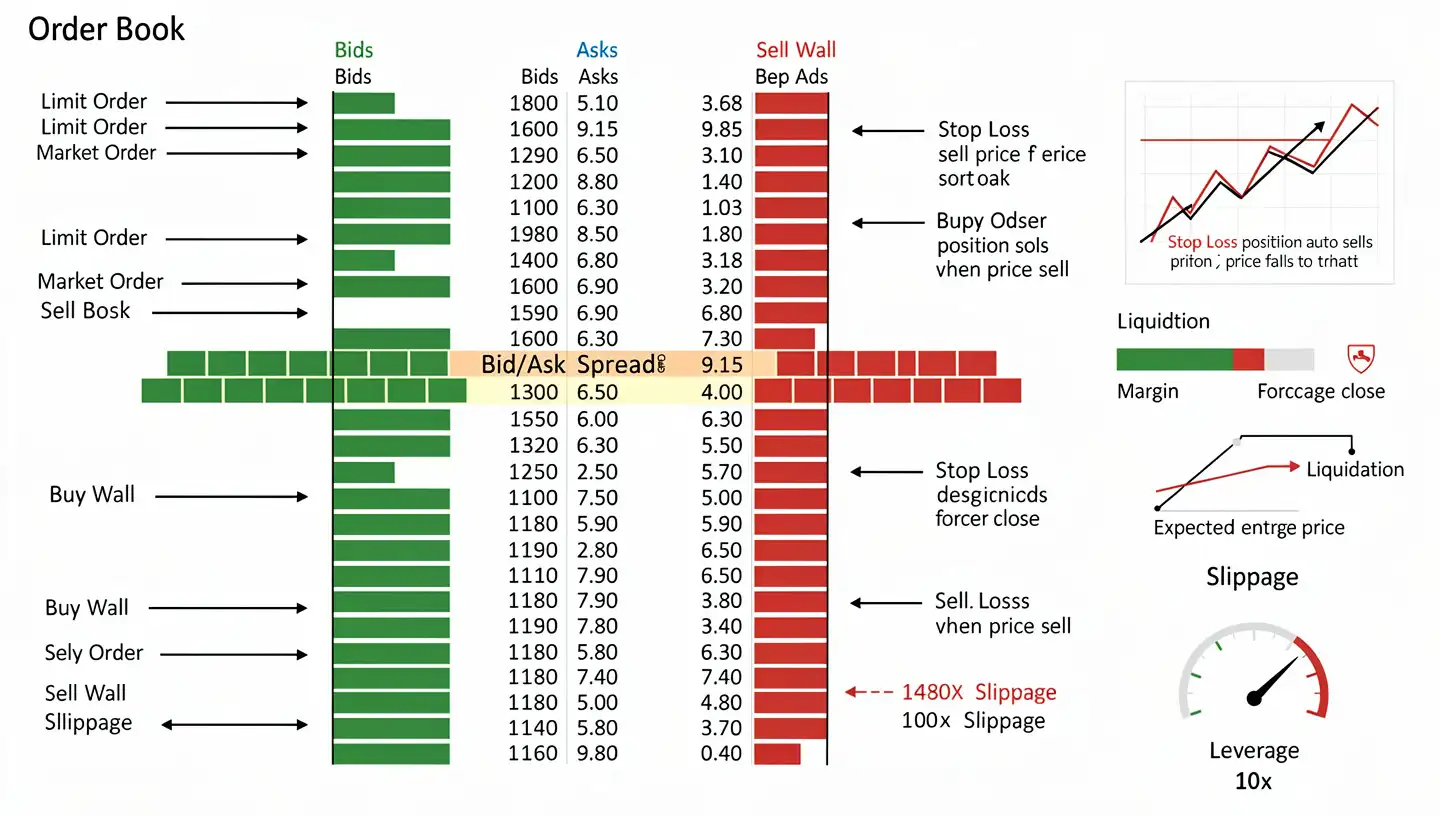
Limit order is an instruction to buy or sell a specific amount of crypto at a specific price or better. The order sits in the order book until the market reaches that price or you cancel it.
Market order is an instruction to buy or sell immediately at the best available current price. It executes instantly but offers no price guarantee, particularly in thin markets where slippage can be significant.
Stop loss is an order that automatically sells a position if the price drops to a specified level, limiting the maximum loss on a trade.
Liquidation occurs in leveraged trading when losses exceed the margin deposited. The exchange automatically closes the position to prevent the trader’s debt from exceeding what they put in. Getting liquidated means losing all deposited margin.
Leverage is borrowed capital that amplifies both gains and losses. Trading with 10x leverage means a 10% price move produces a 100% gain or 100% loss on the position.
Slippage is the difference between the price you expected when placing a trade and the price at which it actually executed. Slippage increases with trade size and decreases with liquidity.
Buy wall / sell wall are large limit orders sitting in the order book at a specific price. A buy wall at a certain price creates visible support. A sell wall creates visible resistance. Large walls can be genuine or placed temporarily to influence market perception.
Bid/ask spread is the difference between the highest price a buyer is willing to pay (bid) and the lowest price a seller is willing to accept (ask). Tighter spreads indicate higher liquidity.
The current Bitcoin price and market data show these trading mechanics in real time, with order book depth and spread visible on any major exchange.
Crypto Slang and Community Terms
Crypto slang originated on internet forums, migrated to Reddit, and now lives primarily on X (formerly Twitter), Discord, and Telegram. Much of it started as a typo or inside joke and became standard vocabulary for an entire industry.
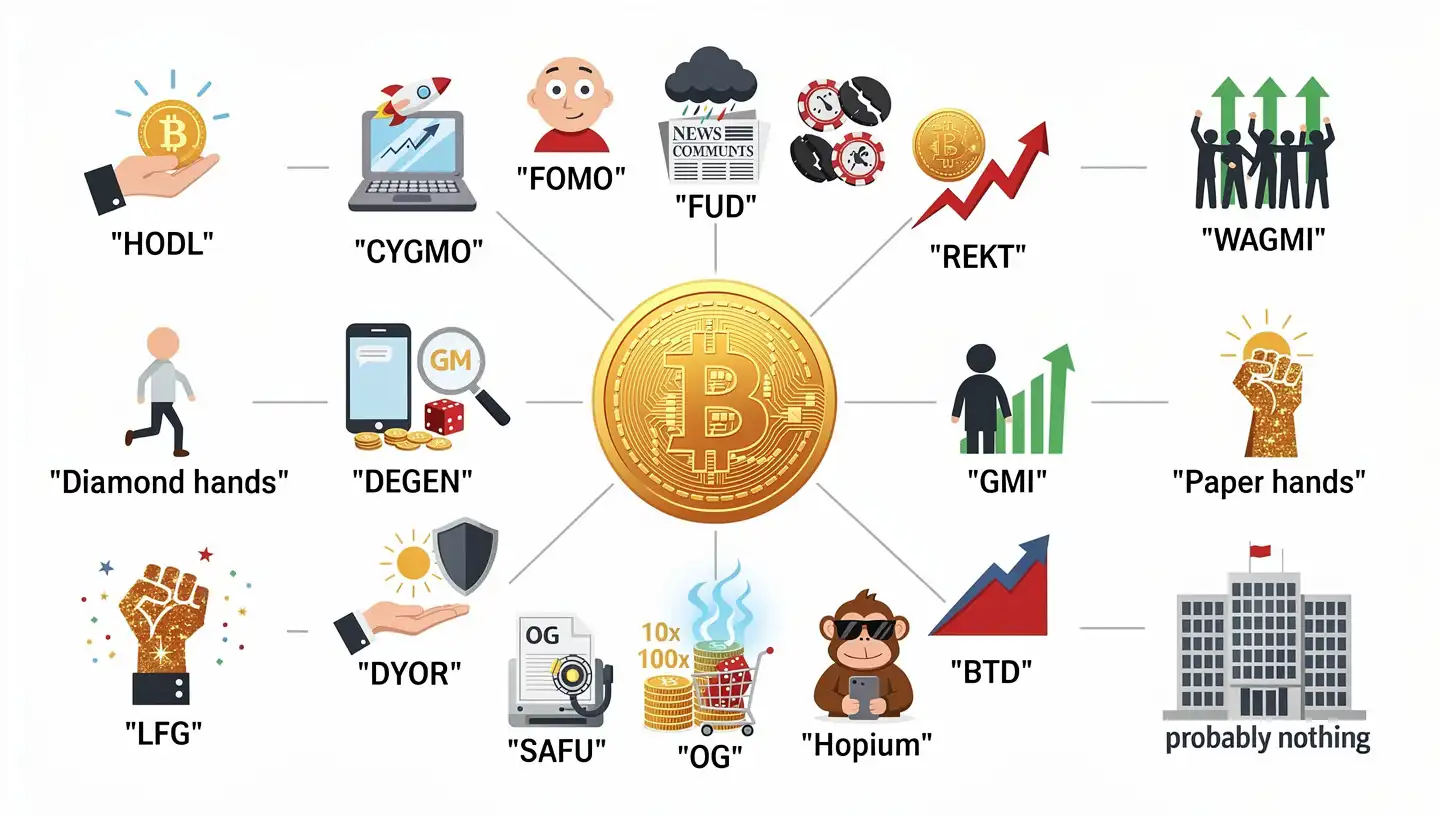
Knowing the slang lets you follow community sentiment in real time and helps you spot when something is being genuinely discussed versus hyped.
| Term | What It Means | How It Is Used |
|---|---|---|
| HODL | Hold on for dear life. Originally a 2013 typo of “hold” in a Bitcoin forum post. Now means refusing to sell despite price drops. | “I’m HODLing through the dip.” |
| FOMO | Fear of missing out. The anxiety that drives people to buy at market tops after seeing others profit. | “Don’t buy just because of FOMO.” |
| FUD | Fear, uncertainty, and doubt. Negative news or sentiment, whether genuine or deliberately spread to lower prices. | “That regulatory story is FUD, ignore it.” |
| REKT | Wrecked. Used when a trader loses most or all of a position, typically through liquidation or a bad trade. | “He got rekt shorting Bitcoin at $40k.” |
| WAGMI | We’re all gonna make it. An expression of community optimism, often used to encourage holding through difficult periods. | “Don’t panic sell. WAGMI.” |
| NGMI | Not gonna make it. Used about someone making a decision the community considers poor, like selling Bitcoin at a loss before a rally. | “He sold at $16k. NGMI.” |
| DEGEN | Short for degenerate. Used both critically and affectionately to describe someone who takes extreme risks in crypto, often in low-cap memecoins or new DeFi protocols. | “Only degens are aping into that new chain.” |
| GM | Good morning. A greeting ritual in NFT and Web3 communities on X, used to signal participation and community membership. | “GM fam.” Posted as the first tweet of the day. |
| LFG | Let’s f***ing go. An expression of excitement, usually when a coin pumps or a project launches. | “Bitcoin just broke $100k. LFG.” |
| Diamond hands | Holding a position through extreme volatility without selling. A compliment in most crypto circles. | “Real diamond hands never sell the dip.” |
| Paper hands | Selling at the first sign of weakness or loss. The opposite of diamond hands. Used as mild criticism. | “Paper hands sold at $30k and missed the run.” |
| DYOR | Do your own research. A reminder not to rely blindly on other people’s analysis before investing. Also used as a disclaimer by analysts who do not want liability for their predictions. | “I like this project but DYOR before buying.” |
| SAFU | Funds are safe. Originally a Binance CEO typo. Now used ironically when something is clearly not safe, or genuinely to confirm security. | “Funds are SAFU.” (sometimes genuine, often ironic) |
| OG | Original gangster. Someone who was involved in crypto early, typically before 2017. Used as a term of respect. | “He’s an OG, been holding Bitcoin since 2011.” |
| Copium | The psychological coping mechanism of making up reasons why a failing investment will recover. A portmanteau of “cope” and “opium.” | “Saying your altcoin will 10x from here is pure copium.” |
| Hopium | Similar to copium but focused on hope rather than rationalization. Believing without evidence that price will recover simply because you want it to. | “That project is down 90%, stop feeding on hopium.” |
| BTD | Buy the dip. The strategy of buying an asset after a price decline, on the assumption it will recover. | “Every dip is a buying opportunity. BTD.” |
| 10x / 100x | Shorthand for a ten-fold or hundred-fold return on an investment. Used to describe expectations or past gains. | “That memecoin 100x’d in three days.” |
| Ape / Apeing in | Buying a cryptocurrency or NFT immediately after launch or discovery, with little or no research, driven by fear of missing out. | “He aped into that new token before reading anything.” |
| Probably nothing | Sarcastic phrase used when something is clearly significant. Often used when a major company or institution makes a crypto move. | “BlackRock just filed for a Bitcoin ETF. Probably nothing.” |
2026 Slang: New Terms That Appeared This Cycle
Trenches refers to the high-risk, low-cap end of crypto trading: newly launched memecoins, anonymous tokens, and anything with a market cap under a few million dollars. Trading in the trenches means accepting that most trades will fail but looking for the rare 100x winner.
Jeet is someone who sells a position very early, often just after a token launches and before the full price discovery plays out. Jeets are blamed for suppressing early price action on new launches.
PVP (Player vs Player) describes a trading environment where participants are primarily competing against each other for the same pool of money rather than investing in genuine value creation. Used to describe memecoin markets where most participants lose to the few who time entries and exits best.
IYKYK (If You Know You Know) is used when sharing information or context that only insiders or experienced participants would recognize as significant. Implies that the speaker has knowledge others do not.
Technical Terms
These terms describe how blockchains and crypto networks function at a protocol level.
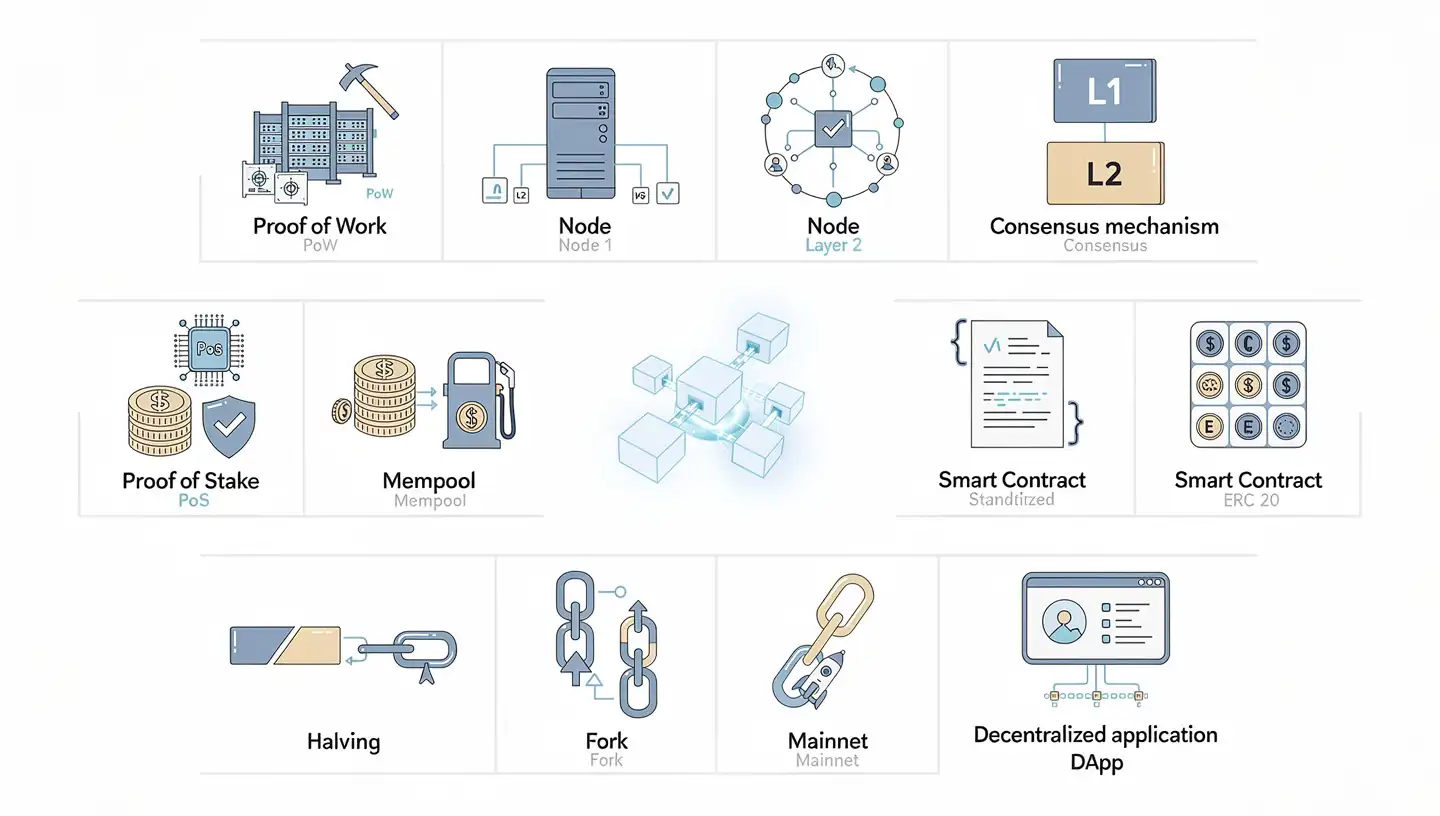
You do not need to understand all of them to invest, but knowing the most important ones helps you read project documentation, understand risk, and avoid being misled by technical-sounding marketing.
| Term | Definition |
|---|---|
| Proof of Work (PoW) | A consensus mechanism where miners compete to solve complex mathematical puzzles to validate transactions and add blocks. Requires significant computing power and electricity. Used by Bitcoin. |
| Proof of Stake (PoS) | A consensus mechanism where validators are chosen to add blocks based on the amount of cryptocurrency they lock up as collateral. More energy-efficient than PoW. Used by Ethereum after its 2022 Merge. |
| Node | A computer that participates in a blockchain network, downloading and verifying a copy of the blockchain. Full nodes enforce the rules of the protocol independently. More nodes means more decentralization. |
| Hash / Hash rate | A hash is the fixed-length output produced by running data through a cryptographic algorithm. Hash rate measures how many hash calculations a miner or the entire network performs per second. Higher hash rate means stronger network security. |
| Mempool | The queue of unconfirmed transactions waiting to be picked up by miners and included in the next block. When the mempool is full, fees rise as users compete for limited block space. |
| Gas fees | The transaction fees paid to validators on the Ethereum network to process a transaction or execute a smart contract. Gas fees fluctuate based on network demand. High demand means high fees. |
| Layer 1 (L1) | The base blockchain: Bitcoin, Ethereum, Solana, Avalanche. Layer 1 is where final settlement happens and where the core security guarantees live. |
| Layer 2 (L2) | A secondary network built on top of a Layer 1 that processes transactions faster and cheaper, then periodically settles on the Layer 1. Arbitrum, Optimism, and Base are Ethereum Layer 2 networks. |
| Consensus mechanism | The rules by which a blockchain network reaches agreement on which transactions are valid and which version of the ledger is correct. Proof of Work and Proof of Stake are the two dominant mechanisms. |
| Smart contract | Self-executing code stored on a blockchain that automatically carries out predefined actions when specific conditions are met. No intermediary required. The foundation of DeFi, NFTs, and DAOs. |
| ERC-20 | The technical standard for fungible tokens on the Ethereum blockchain. Most altcoins that run on Ethereum follow this standard, which ensures they are compatible with wallets and exchanges built for Ethereum. |
| Halving | The pre-scheduled reduction in Bitcoin’s block reward by 50%, occurring every 210,000 blocks (roughly every four years). Each halving reduces the rate of new Bitcoin supply entering the market. |
| Fork | A change to a blockchain’s protocol. A soft fork is backward-compatible (old nodes still recognize new blocks). A hard fork creates an incompatible rule change, sometimes splitting the chain into two separate blockchains. |
| Mainnet | The live, production version of a blockchain where real transactions take place with real value. Contrasted with testnet, where developers experiment without real funds at risk. |
| Decentralized application (DApp) | An application that runs on a blockchain rather than a centralized server. Its backend code lives in smart contracts. Users interact with it through a wallet rather than a username and password. |
The mechanics behind Bitcoin’s halving schedule and how the block reward has changed over time are covered in the guide on Bitcoin halving.
Forks and Protocol Upgrades
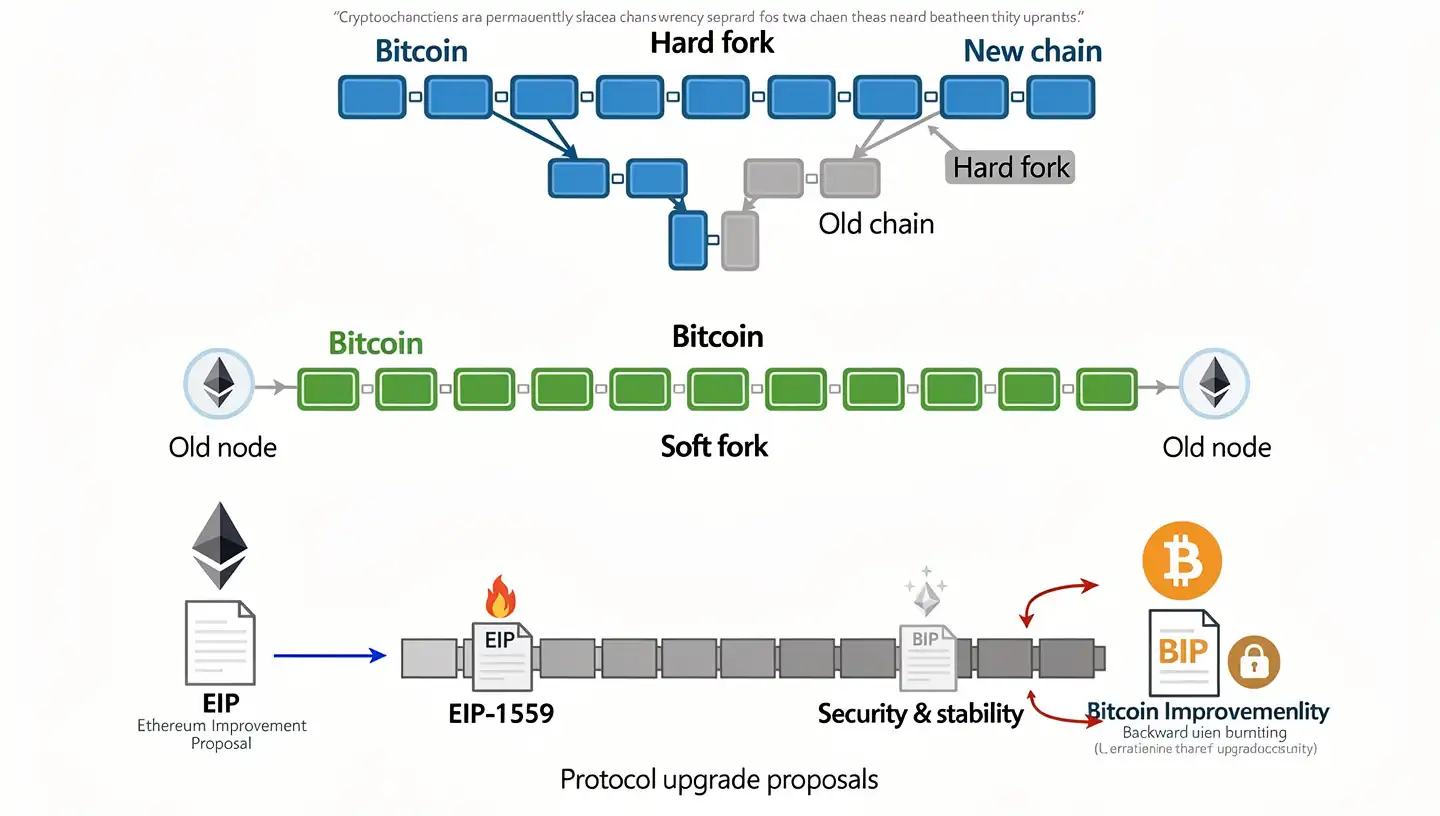
Hard fork is a protocol change so significant that it is not backward-compatible. Old software cannot recognize blocks produced under the new rules. If a large portion of the network refuses to upgrade, the chain splits into two: the old chain and the new one. Bitcoin Cash emerged from a hard fork of Bitcoin in 2017.
Soft fork is a backward-compatible protocol upgrade. Old nodes still accept blocks produced under the new rules, so the chain does not split. Bitcoin’s SegWit upgrade in 2017 was a soft fork.
EIP (Ethereum Improvement Proposal) is a formal document proposing changes to the Ethereum protocol. EIP-1559, for example, introduced the fee-burning mechanism that makes ETH deflationary at times of high network activity. Anyone can write an EIP, but implementation requires broad developer and validator consensus.
BIP (Bitcoin Improvement Proposal) is the equivalent for Bitcoin. BIPs are how changes to Bitcoin are proposed, discussed, and either accepted or rejected by the developer community. Bitcoin’s upgrade process is deliberately conservative, prioritizing security and stability over new features.
On-Chain Metrics
On-chain metrics are data points derived directly from blockchain transaction records, not from price charts or trading volumes on exchanges. They give a picture of network health and holder behavior that price charts alone cannot provide.
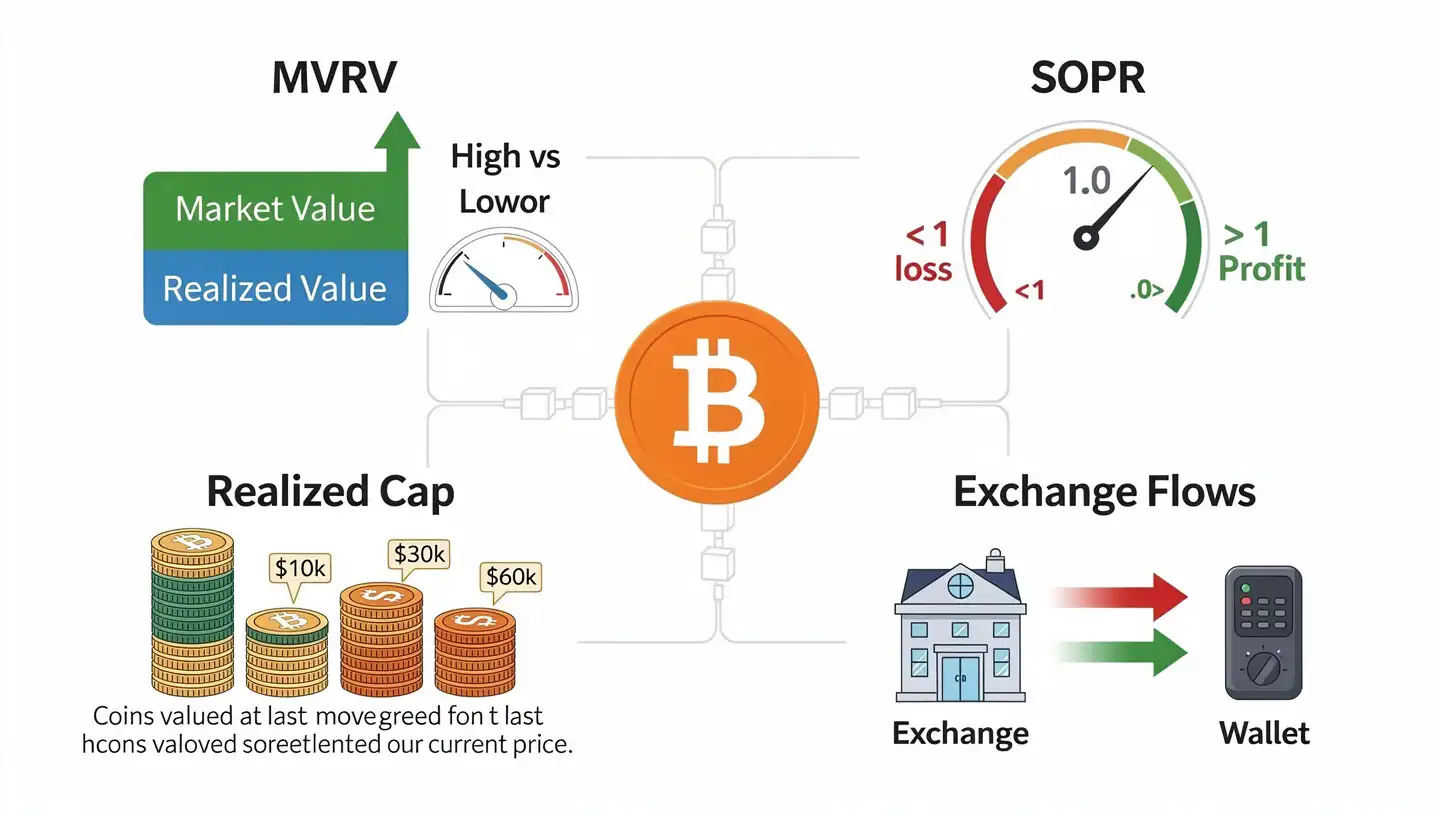
MVRV ratio (Market Value to Realized Value) compares Bitcoin’s current market cap to its realized cap, which is calculated by pricing each coin at the value it last moved on-chain. When MVRV is high, holders are sitting on large unrealized gains, historically a signal of market tops. When it is low, most coins are at a loss, historically a signal of market bottoms.
SOPR (Spent Output Profit Ratio) measures whether coins being moved on-chain are doing so at a profit or at a loss. A SOPR above 1 means spent coins are, on average, being sold at a profit. A SOPR below 1 means sellers are taking losses.
Realized cap is an alternative to market cap that values each Bitcoin at the price it last moved rather than the current market price. It provides a clearer picture of the actual capital invested in Bitcoin compared to a market cap that simply multiplies circulating supply by current price.
Exchange inflows and outflows track how much crypto is moving into exchanges (a possible signal that holders are preparing to sell) versus out of exchanges into private wallets (a possible signal of accumulation and long-term holding).
The overall picture of network security and miner commitment is visible through the Bitcoin network hash rate, which is one of the most important on-chain signals for assessing network health.
DeFi and Web3 Terms
DeFi (decentralized finance) describes financial services built on smart contracts that operate without banks, brokers, or intermediaries. Web3 is the broader vision of a decentralized internet where users own their data and digital assets.
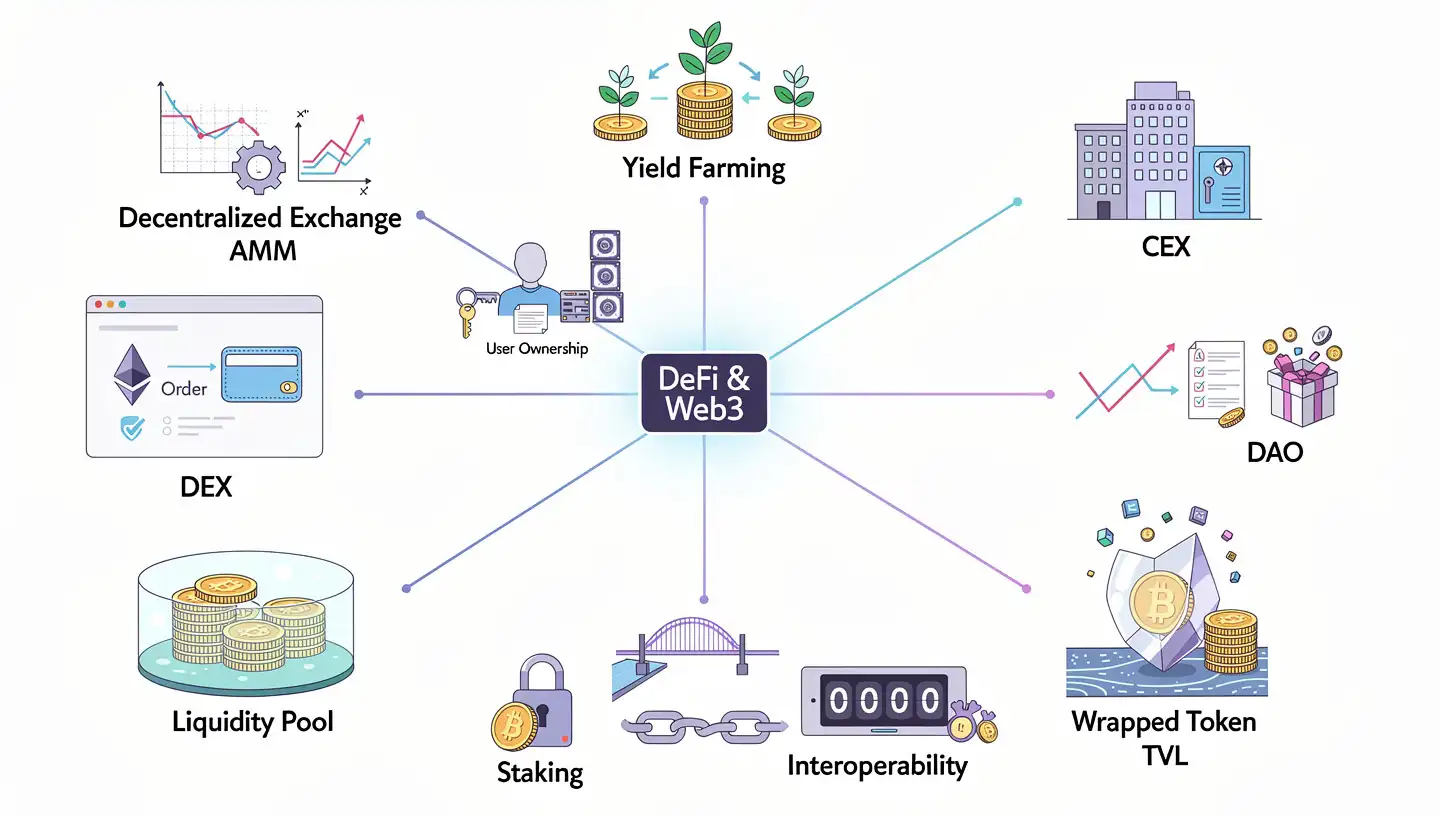
These terms describe how both work.
| Term | Definition |
|---|---|
| DeFi | Decentralized finance. Financial services including lending, borrowing, trading, and earning yield, delivered through smart contracts rather than banks or brokers. |
| DEX (Decentralized Exchange) | A trading platform that operates through smart contracts rather than a company. Users trade directly from their wallets without giving up custody. Uniswap, Curve, and dYdX are examples. |
| CEX (Centralized Exchange) | A trading platform run by a company. Users deposit funds and the exchange holds custody. Coinbase, Binance, and Kraken are examples. Convenient but introduces counterparty risk. |
| Liquidity pool | A pool of tokens locked in a smart contract that provides the liquidity DEXs need to process trades. Liquidity providers deposit tokens and earn a share of trading fees in return. |
| AMM (Automated Market Maker) | The algorithm DEXs use to price assets automatically based on the ratio of tokens in a liquidity pool, rather than matching individual buyers and sellers through an order book. |
| Yield farming | The practice of moving crypto between DeFi protocols to maximize the return earned from staking, lending, or providing liquidity. Higher yields typically come with higher risk. |
| Staking | Locking cryptocurrency in a network or protocol to earn rewards. On Proof of Stake networks, staking helps secure the blockchain. In DeFi protocols, it often means depositing tokens to earn yield. |
| TVL (Total Value Locked) | The total dollar value of crypto deposited in a DeFi protocol. Used as a measure of a protocol’s size and adoption. A rising TVL usually signals growing user confidence. A falling TVL signals withdrawals. |
| Airdrop | A distribution of free tokens to holders of a specific cryptocurrency or users of a specific protocol. Projects use airdrops to reward early adopters and distribute governance tokens to their communities. |
| DAO (Decentralized Autonomous Organization) | An organization governed by smart contracts and token holder votes rather than a management team. Token holders propose and vote on decisions. No CEO, no board. |
| Impermanent loss | The temporary loss of value experienced by liquidity providers when the ratio of tokens in a pool changes due to price movement. If prices return to their original ratio, the loss disappears. If they do not, the loss becomes permanent when you withdraw. |
| Web3 | A term for the next iteration of the internet, built on blockchains and smart contracts, where users own their data, digital assets, and online identities rather than surrendering them to platforms. |
| Interoperability | The ability of different blockchains to communicate and transfer assets between each other. A lack of interoperability means assets on one chain are stuck there unless a bridge or cross-chain protocol is used. |
| Bridge | A protocol that allows crypto assets to move between different blockchains. Bridges have been a major target for hacks, with over $2 billion stolen from bridge protocols in 2022 alone. |
| Wrapped token | A token on one blockchain that represents an asset from another blockchain at a 1:1 ratio. Wrapped Bitcoin (WBTC) is an ERC-20 token on Ethereum backed 1:1 by actual Bitcoin, allowing BTC to be used in Ethereum DeFi protocols. |
NFT Terms
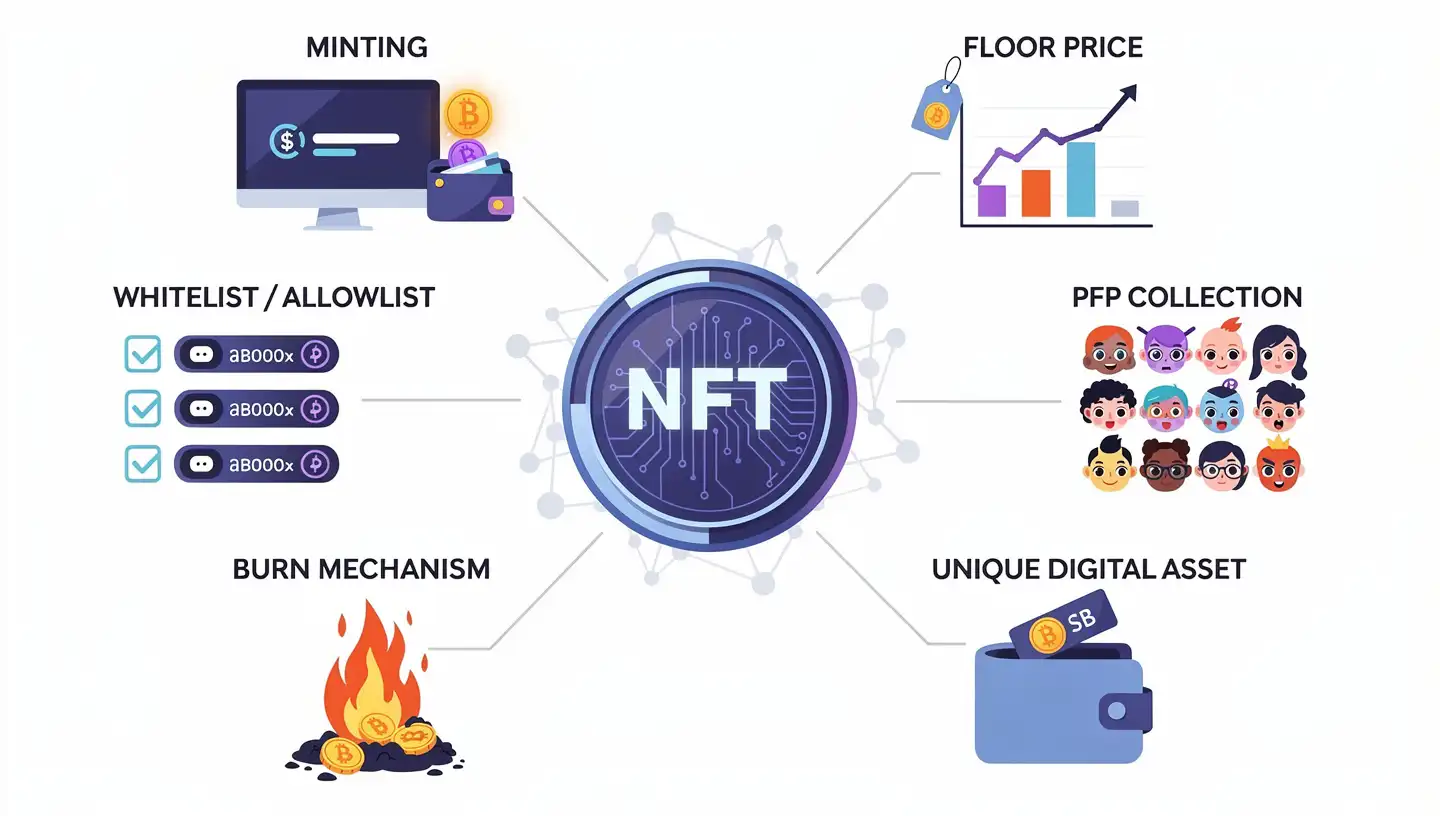
NFT (Non-Fungible Token) is a unique digital asset recorded on a blockchain. Unlike Bitcoin, where each coin is identical and interchangeable, each NFT is distinct and cannot be replaced by another.
Minting is the process of creating an NFT and recording it on the blockchain. When a collection launches, buyers mint NFTs by paying a fee that triggers the smart contract to generate a unique token and assign it to their wallet.
Floor price is the lowest price at which any NFT in a collection is currently listed for sale. It represents the minimum entry cost into a collection and is one of the primary indicators of a collection’s health.
Whitelist / Allowlist is a pre-approved list of wallet addresses that are guaranteed or prioritized access to mint an NFT collection before it opens to the public. Being on the whitelist reduces gas competition and often provides a discounted or guaranteed mint price.
PFP collection (Profile Picture) is an NFT collection designed to be used as a social media profile photo. Bored Ape Yacht Club and CryptoPunks are the most well-known PFP collections.
Burn mechanism is a process by which tokens or NFTs are permanently removed from circulation by sending them to an address with no accessible private key. Used to reduce supply and theoretically support price.
Security Terms Every Holder Should Know
The most avoidable losses in crypto come from security failures rather than bad investments.
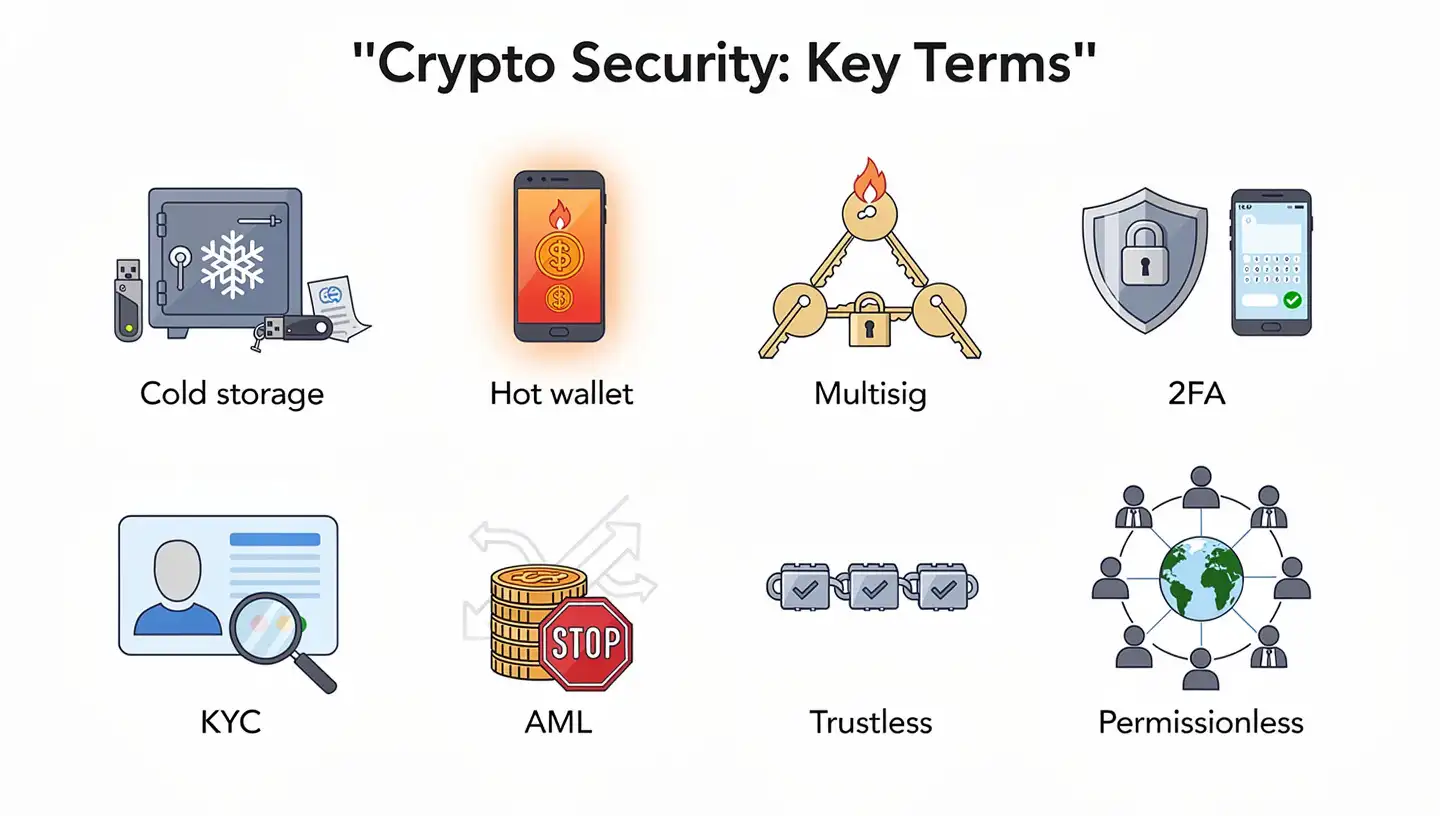
These terms describe the security infrastructure of crypto and the choices that determine whether your holdings are vulnerable or protected.
Cold storage is keeping crypto private keys offline, on a hardware device or paper, completely disconnected from the internet. Cold storage eliminates the remote attack surface that makes exchange accounts and software wallets vulnerable. For long-term holders, it is the standard security practice.
Hot wallet is any wallet connected to the internet: a mobile app, a browser extension like MetaMask, or funds held on an exchange. Hot wallets are convenient for frequent transactions but more exposed to phishing attacks and malware than cold storage.
Multisig (Multi-signature) is a wallet configuration that requires multiple private keys to authorize a transaction. A 2-of-3 multisig, for example, needs any two of three designated keys to sign before funds can move. Used by exchanges, DAOs, and institutional holders to prevent single points of failure.
2FA (Two-Factor Authentication) is a security layer that requires a second verification step beyond a password, typically a code from an authenticator app. Always use an authenticator app rather than SMS for 2FA, as SMS codes can be intercepted through SIM swapping.
KYC (Know Your Customer) is the identity verification process required by regulated exchanges. Users must provide government-issued ID and sometimes proof of address. KYC is a legal requirement in most jurisdictions to prevent money laundering and fraud.
AML (Anti-Money Laundering) refers to the laws, regulations, and procedures designed to prevent the use of cryptocurrency to launder illegally obtained funds. Exchanges are required to monitor transactions and report suspicious activity to regulators under AML rules.
Trustless describes a system where participants do not need to trust each other or any central authority because the rules are enforced by code. Bitcoin transactions are trustless because the protocol validates them, not a bank.
Permissionless means anyone can participate in a network or protocol without needing approval from a central authority. Anyone can run a Bitcoin node, send a Bitcoin transaction, or deploy a smart contract on Ethereum without asking permission from anyone.
For a direct comparison of how custody affects security, the guide on custodial vs non-custodial wallets covers exactly what you give up and what you gain with each approach.
Scam and Red Flag Terms
Crypto markets attract fraud. Understanding the vocabulary of scams protects you from the most common ones.
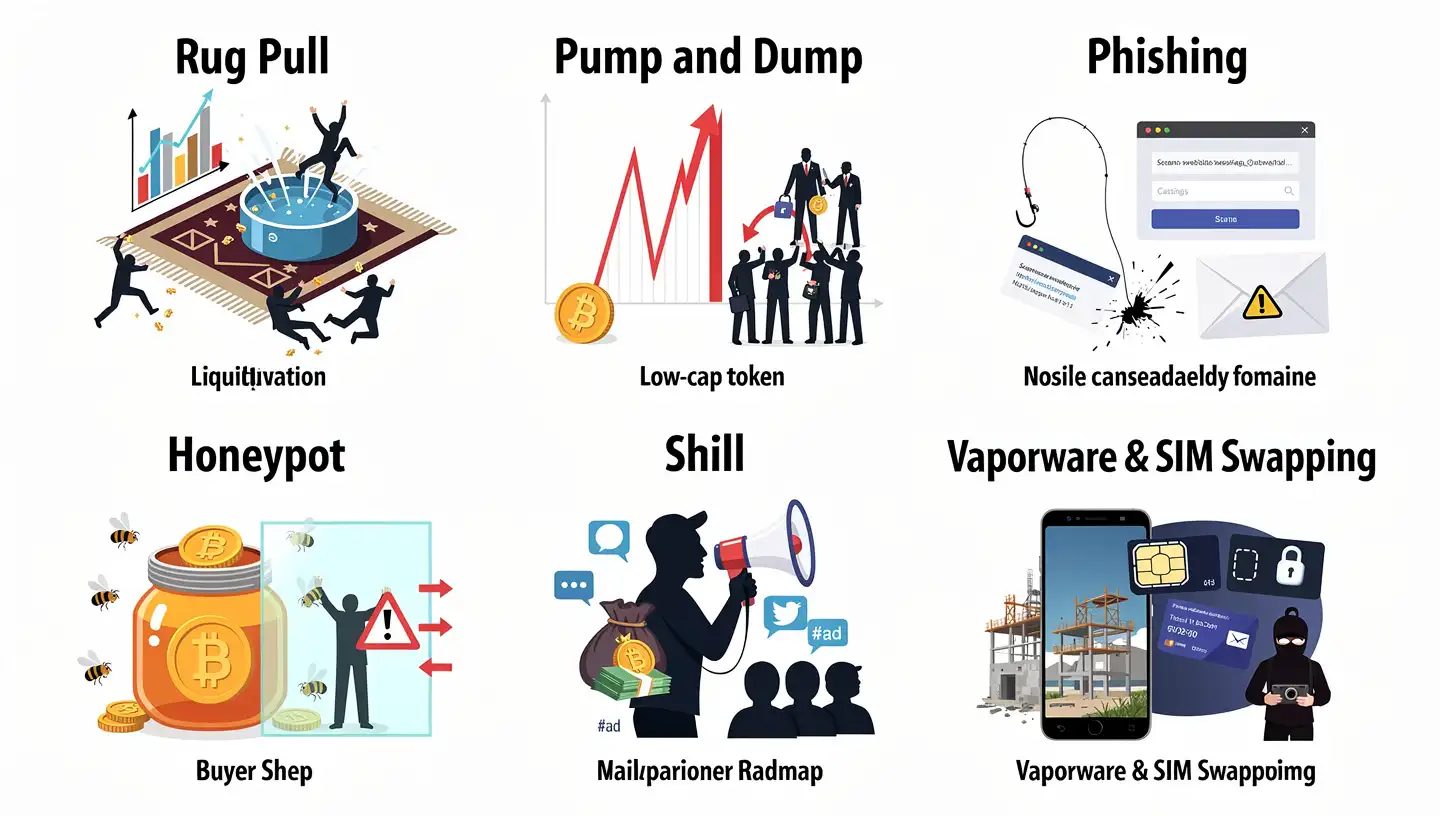
These are not rare edge cases: rug pulls, pump and dumps, and phishing attacks cost investors billions annually.
Rug pull is a scam where project developers promote a token or protocol, attract investment, and then suddenly withdraw all liquidity or disappear with the funds. The term comes from “pulling the rug out from under” investors. Common in new DeFi protocols and memecoin launches where smart contracts are not audited.
Pump and dump is a manipulation scheme where a group buys a low-cap token to drive up the price, promotes it heavily to attract outside buyers, and then sells their holdings at the inflated price, leaving later buyers with a worthless or near-worthless asset.
Phishing is a social engineering attack where a scammer impersonates a legitimate service (an exchange, a wallet provider, a support team) to steal login credentials, private keys, or seed phrases. Common vectors include fake websites that look identical to real ones, unsolicited emails with links, and fake support accounts on social media.
Honeypot is a scam token where the smart contract allows people to buy but prevents them from selling. The price rises as more buyers enter, then the developer drains the liquidity. Buyers cannot exit because the sell function is disabled in the contract code.
Shill is the act of promoting a cryptocurrency with undisclosed financial interest in its success. Someone who holds a token and publicly promotes it without disclosing that holding is shilling. Paid influencer promotions without disclosure are a regulated form of this in many jurisdictions.
Vaporware is a project that promises technology it has not built and may never build. The whitepaper sounds credible, the roadmap looks ambitious, but development never materializes. Common exit strategy: raise funds through an ICO or token sale, then go quiet.
SIM swapping is an attack where a criminal convinces a mobile carrier to transfer a victim’s phone number to a SIM card the attacker controls, allowing them to bypass SMS-based 2FA and access exchange accounts. The solution is using an authenticator app rather than SMS for 2FA.
The regulatory frameworks that govern crypto exchanges and require scam reporting are covered in the overview of UAE and Dubai crypto regulation, one of the more developed frameworks for consumer protection in the industry.
New Terms in 2026: What This Cycle Added to the Dictionary
Each crypto market cycle produces new terms that did not exist in the previous one. The 2020-2021 cycle gave us “DeFi summer,” “yield farming,” and “rug pull” as mainstream vocabulary.
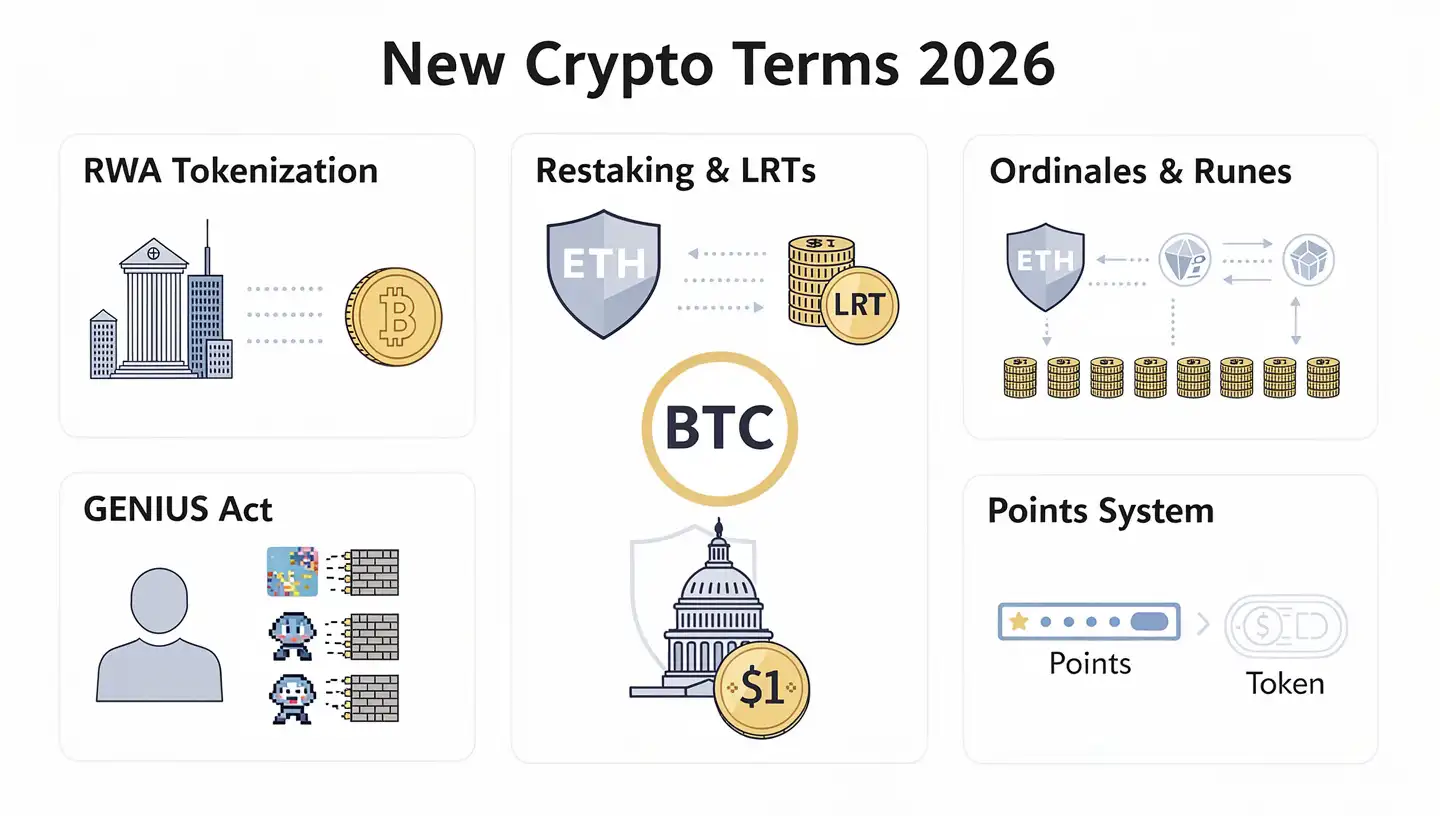
The current cycle has added its own layer of terminology, driven by new infrastructure, new regulatory frameworks, and new on-chain behaviors.
RWA (Real World Asset) tokenization is the process of representing ownership of a real-world asset, such as government bonds, real estate, commodities, or private credit, as a token on a blockchain. In 2025-2026, RWA tokenization became one of the fastest-growing sectors in DeFi, with protocols like Ondo, BlackRock BUIDL, and Centrifuge managing billions in tokenized assets.
Restaking is an extension of staking in which already-staked ETH (or liquid staking tokens) is used to simultaneously secure additional protocols, earning additional rewards for doing so. EigenLayer pioneered this concept in 2023-2024 and it has since generated a new category of tokens and protocols built around it.
LRT (Liquid Restaking Token) is a token received in exchange for restaked ETH, representing the restaked position in a transferable and tradeable form. LRTs allow restakers to use their restaking position in DeFi without locking up their capital completely.
Ordinals is a protocol developed in 2023 that allows arbitrary data, including images and text, to be inscribed directly onto individual satoshis (the smallest units of Bitcoin). It effectively created Bitcoin-native NFTs, a concept that was previously considered impossible or undesirable within Bitcoin’s design philosophy.
Runes is a fungible token protocol on Bitcoin launched in April 2024 (at the Bitcoin halving block). It improved on earlier Bitcoin token standards by creating a more efficient method for issuing and transferring fungible tokens directly on the Bitcoin blockchain without requiring a separate layer.
GENIUS Act is US legislation passed in 2025 that established the first federal regulatory framework for payment stablecoins. Under the Act, stablecoins used for payments must be issued by federally or state-licensed entities and backed by US dollars or short-term treasuries at a 1:1 ratio. It represented the first comprehensive stablecoin regulation at the federal level in the United States.
Points system refers to pre-airdrop reward structures where DeFi protocols reward early users with off-chain points rather than tokens. Points can later convert to tokens when the protocol launches its token, incentivizing early adoption and sustained use without immediately creating a liquid speculative market around the token.
For context on how regulatory frameworks like the GENIUS Act fit into the broader global picture, the overview of Japan’s crypto regulation shows how one of the earliest comprehensive frameworks has evolved since its introduction.
Frequently Asked Questions
What is the difference between a coin and a token?
A coin is a cryptocurrency that operates on its own blockchain. Bitcoin operates on the Bitcoin blockchain. Ether operates on the Ethereum blockchain. A token is built on top of an existing blockchain using a standard like ERC-20. Most altcoins are tokens rather than coins because building on an established blockchain is far cheaper and faster than building an entirely new one. The terms are often used interchangeably in casual conversation, but the technical distinction matters when assessing a project’s infrastructure.
What does DYOR mean and why does it matter?
DYOR stands for “do your own research.” It originated as a genuine reminder that crypto is full of paid promoters, biased analysts, and outright scammers, and that no investment decision should rest on someone else’s recommendation alone. It now also functions as a legal disclaimer: influencers and analysts use it at the end of posts to distance themselves from liability if a prediction goes wrong. The principle behind it remains sound regardless of how it gets used. Reading whitepapers, checking team backgrounds, reviewing on-chain data, and verifying claims independently are all part of doing your own research.
What is the difference between a CEX and a DEX?
A CEX (centralized exchange) is run by a company that holds your funds in custody. You create an account, deposit crypto, and the exchange controls the private keys. Coinbase, Binance, and Kraken are CEXs. They are more user-friendly, support fiat on and off-ramps, and offer customer support. The risk is counterparty: if the exchange is hacked, freezes withdrawals, or goes bankrupt, your funds are at risk. A DEX (decentralized exchange) runs through smart contracts. You trade directly from your own wallet without depositing funds anywhere. Uniswap and Curve are DEXs. They offer no custodial risk but also no customer support, no fiat options, and require more technical knowledge to use safely.
What does “not your keys, not your coins” mean?
It means that if you do not control the private keys to a wallet, you do not actually own the crypto in any meaningful sense. You have a claim on a balance in someone else’s system. The phrase became widely repeated after major exchange collapses, most notably FTX in 2022, where customers who held funds on the exchange discovered they had no access to them once the exchange froze withdrawals. Moving crypto from an exchange to a private wallet where you hold the keys is the practical application of this principle. The guide on cold wallets covers how to do this safely.
What is gas and why do I have to pay it?
Gas is the fee required to process a transaction or execute a smart contract on the Ethereum network. It compensates the validators who do the computational work of processing your request. Gas is priced in Gwei (a denomination of ETH) and varies based on network demand: when many people are using Ethereum at the same time, competition for block space drives fees up. Simple token transfers cost less gas than complex smart contract interactions like minting an NFT or executing a multi-step DeFi trade. Gas costs are one of the reasons Layer 2 networks like Arbitrum and Optimism gained traction: they process transactions off the main Ethereum chain at a fraction of the cost.
What is the difference between staking and yield farming?
Staking means locking cryptocurrency in a protocol or network to earn rewards. On a Proof of Stake blockchain, staking helps secure the network and earns newly issued tokens as a reward. In DeFi protocols, staking usually means depositing tokens to earn a share of protocol revenue or governance incentives. The process is relatively straightforward and the risks, while real, are generally limited to the price risk of the staked asset. Yield farming is a more active strategy that involves moving funds between DeFi protocols to capture the highest available returns, often by providing liquidity to pools, lending assets, and then using received tokens in other protocols. Yield farming generates higher potential returns than simple staking but carries more risk: smart contract vulnerabilities, impermanent loss, and protocol insolvency all apply.