Cryptocurrency is legal in South Korea and operates within a structured regulatory framework that has been tightening steadily since 2024. The Financial Services Commission (FSC) is the primary regulator, backed by three other agencies that oversee different aspects of exchange operations, anti-money laundering, and security standards. In 2026, the country is advancing the second phase of its crypto framework through the Digital Asset Basic Act (DABA), lifting its nine-year ban on corporate crypto investment, and preparing the ground for spot Bitcoin ETFs. There is currently no capital gains tax on crypto profits in South Korea. A planned 20% rate has been delayed to 2027 at the earliest.
Is crypto legal in South Korea?
Yes. Cryptocurrency is officially legal in South Korea and is not treated as a legal gray area. The government’s position shifted decisively with the Act on the Protection of Virtual Asset Users (VAUPA), which came into force in July 2024. That law established investor protections, banned unfair trading practices including market manipulation, wash trading, and front-running, and required all virtual asset service providers to meet specific operational standards. Initial Coin Offerings remain banned since 2017, though the government is working on a framework that may eventually allow regulated token issuance.
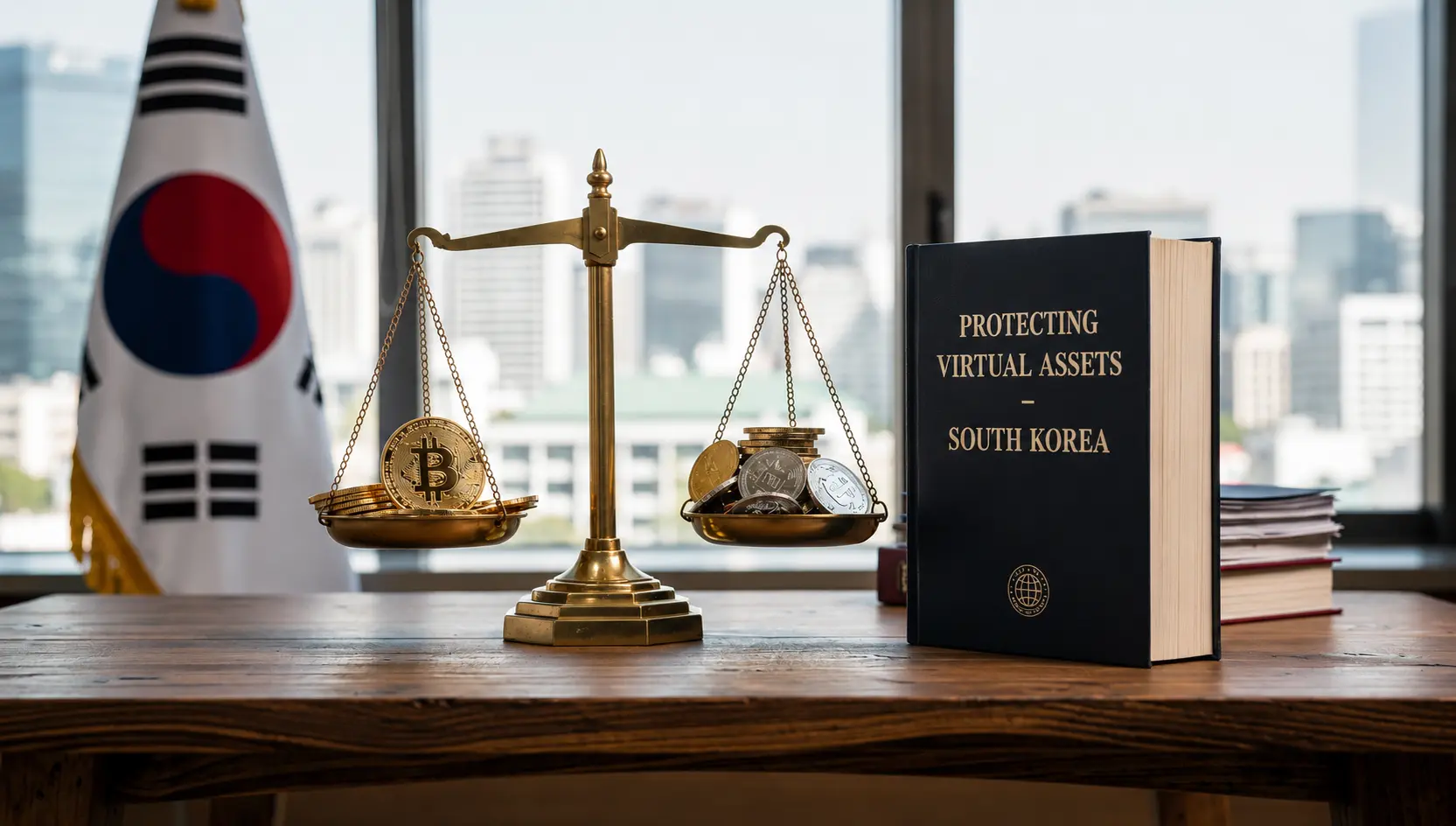
Foreign exchanges cannot operate in South Korea without registering with local authorities. Binance is not available to South Korean users because it has not completed the registration process required by domestic law. South Korean residents are expected to use domestic exchanges that have met all regulatory requirements. The guide to what is crypto covers the foundational concepts behind digital assets and how they are classified.
How South Korea’s crypto rules evolved: 2017 to 2026
South Korea’s regulatory journey began with the 2017 ICO ban and escalated rapidly after the same year’s market frenzy drove extraordinary trading volumes. In 2018, the government mandated a real-name bank account system for all exchange users, linking every trading account to a verified identity at a domestic bank. This requirement became the backbone of the country’s anti-money laundering infrastructure.
A major legislative shift came with a 2020 amendment that formally recognized and legalized cryptocurrency service providers, requiring them to register with the Korea Financial Intelligence Unit (KoFIU) by 2021. This triggered significant market consolidation: many smaller exchanges could not secure the banking partnerships required to comply, and they shut down. The survivors emerged as a small group of fully registered operators dominated by Upbit, which now controls an estimated 80% or more of domestic trading volume. The VAUPA in July 2024 extended this framework with investor protection rules and market integrity provisions. The current DABA process in 2026 represents the third major phase of this progression.
Who regulates crypto in South Korea?
Four agencies share responsibility for different aspects of south korea crypto regulation. Understanding which body covers which function helps investors and businesses work through their compliance obligations.
- Financial Services Commission (FSC): The primary financial regulator. Supervises virtual asset service providers, enforces consumer protection laws, investigates unfair trade practices, and leads the development of new crypto rules including the DABA.
- Financial Supervisory Service (FSS): Works alongside the FSC as the operational enforcement arm. Investigates abnormal transactions, detects unfair trading activity, and is responsible for the VISTA surveillance platform upgrade in 2026.
- Korea Financial Intelligence Unit (KoFIU): The anti-money laundering body. All virtual asset service providers must register with KoFIU. It enforces KYC procedures, the real-name account mandate, and the travel rule for cross-border transactions.
- Korea Internet Security Agency (KISA): Issues mandatory Information Security Management System (ISMS) certifications. Any exchange operating in South Korea must hold a valid ISMS certificate issued by KISA.
These four agencies operate as interlocking layers of oversight. An exchange that complies with only some of them cannot legally operate. The FSC sets policy, the FSS investigates violations, KoFIU handles financial crime, and KISA handles technical security standards. How Bitcoin fits within the broader regulatory landscape for digital assets globally is covered in the guide to what is Bitcoin.
The Virtual Asset User Protection Act: what is in force now
The Virtual Asset User Protection Act, effective from July 2024, is the foundation of South Korea’s current investor protection regime. It is the first phase of what regulators describe as a two-phase approach to crypto regulation. The VAUPA focuses on market integrity and user safety. The DABA, still pending, addresses asset classification, stablecoin governance, and broader financial market integration.
Key investor protections under the VAUPA
The VAUPA imposes a set of concrete obligations on all registered virtual asset service providers operating in South Korea. The core requirements are:
- Cold wallet storage: At least 80% of all customer crypto assets must be held in offline cold storage at all times.
- Segregated funds: Customer assets must be kept entirely separate from the exchange’s own corporate funds, held in a designated bank.
- Real-name bank accounts: Every user must transact through a verified real-name bank account matched to their exchange identity.
- Liability insurance: Exchanges must hold insurance or reserves to cover hacking losses. For major exchanges, the minimum coverage is KRW 3 billion, set at no less than 5% of the value of assets held in hot wallets.
- Suspicious transaction reporting: Exchanges must monitor for abnormal activity and report any suspicious transactions to financial and investigative authorities immediately.
- No arbitrary fund blocks: Exchanges may not block user withdrawals or deposits without legal grounds. If a block is necessary, the exchange must notify the user and is liable for resulting damages.
The 80% cold wallet requirement is one of the strictest cold storage mandates among major regulated crypto markets. Japan’s comparable rule requires 95%. The guide to cold wallets for crypto explains what offline storage means in practice and why the distinction between hot and cold matters for security.
What the VAUPA means for unfair trading
The VAUPA explicitly prohibits a range of market manipulation and unfair trading practices that were previously unaddressed by Korean law. These include wash trading, spoofing, insider trading on material non-public information, front-running, and coordinating artificial price movements. The FSS investigates violations and refers cases to prosecutors. Since July 2024, several domestic exchange operators and individual traders have faced inquiries under these provisions.
The FSS operates the VISTA surveillance platform, which monitors trading data across registered exchanges for patterns consistent with manipulation. In 2026, the FSS has committed to significant upgrades of the VISTA system including AI-powered analytics, discussed in the surveillance section below. The distinction between custodial exchange accounts and self-custody is relevant to how these rules apply. Exchanges in South Korea hold user assets in custodial arrangements. The guide to custodial vs non-custodial wallets explains what that means for user rights and risk.
The Digital Asset Basic Act (DABA): what Phase 2 brings
The Digital Asset Basic Act is the second phase of South Korea’s crypto regulatory framework. While the VAUPA addressed market conduct and user protection, the DABA addresses the legal classification of digital assets, the governance of stablecoins, the licensing of crypto businesses under financial regulations, and the treatment of tokenized physical-world assets. The Democratic Party has been drafting the legislation through 2025 and 2026, with final implementation targeted for late 2026 or Q1 2027 depending on the resolution of a central regulatory dispute.
Stablecoin rules: 100% reserves and bank authorization
The DABA introduces the first formal legal framework for stablecoins in South Korea. Stablecoins used in cross-border or foreign exchange transactions will be classified as “means of payment” under the Foreign Exchange Transactions Act. Issuers must obtain authorization from financial authorities, maintain reserves exceeding 100% of the circulating supply in high-quality assets such as bank deposits or government bonds, and guarantee full redemption rights for all holders at any time. Restrictions on yield generation from idle reserve balances are also expected.
Dollar-pegged stablecoins such as USDT and USDC face additional scrutiny under this framework. Regulators have expressed concern that widespread use of dollar-backed stablecoins accelerates capital flight from the Korean won and reduces monetary control. President Lee Jae Myung has made the development of a KRW stablecoin a political priority, describing it as necessary for protecting monetary sovereignty in a global market where US dollar stablecoins currently dominate cross-border transactions.
The FSC vs Bank of Korea dispute: why DABA keeps getting delayed
The central obstacle to DABA implementation has been a disagreement between the FSC and the Bank of Korea over who should be allowed to issue stablecoins. The Bank of Korea has pushed for a rule requiring that only banks with at least 51% ownership by financial institutions be permitted to issue stablecoins. The Bank of Korea argues this requirement is necessary to prevent systemic risk and align stablecoin issuance with financial stability mandates.
The FSC and the ruling Democratic Party have resisted this position. They argue that a 51% bank ownership rule would effectively exclude fintech companies and blockchain startups from the stablecoin market, concentrating issuance capacity in incumbent financial institutions and slowing innovation. The unresolved dispute pushed the DABA submission from 2025 to 2026, and the implementation target has since shifted to late 2026 or early 2027 pending further consultations. The longer the delay, the greater the risk of capital flight as South Korean crypto users seek out foreign platforms not subject to local restrictions. The parallel regulatory development in Japan, including how Japan resolved its own crypto classification debate, is covered in the guide to Japan crypto regulation.
What DABA means for crypto businesses and exchanges
The DABA replaces the current registration system for crypto exchanges with a positive authorization regime, meaning exchanges must apply for and receive a license rather than simply registering. This raises the compliance bar significantly. Businesses will face mandatory capital requirements, detailed disclosure obligations, and operational standards comparable to those required of traditional financial institutions.
The legislation also introduces no-fault liability for digital asset operators, meaning companies can be held legally responsible for user losses even in the absence of proven negligence. Tokenized physical-world assets will require the underlying assets to be held in trust under Capital Markets Act rules. The overall effect is a shift from light-touch crypto-specific rules toward something closer to full securities regulation for the most active exchanges and asset issuers.
Corporate crypto investment: the 2026 greenlight
One of the most significant practical changes of 2026 is the lifting of South Korea’s nine-year ban on corporate crypto investment. Under finalized guidelines that took effect in early 2026 as part of the government’s 2026 Economic Growth Strategy, listed companies and professional investors are now permitted to allocate up to 5% of their annual equity capital into digital assets. This represents the first time South Korean corporations have had a legal pathway to hold cryptocurrency on their balance sheets.
The change brings South Korea closer to the approach adopted by publicly listed companies in the United States and Japan, where corporate Bitcoin treasury strategies have become a recognized investment practice. South Korean company Metaplanet had already been following a Bitcoin accumulation strategy modeled on that approach before the domestic rule change formalized what companies could do. How Bitcoin functions as a treasury asset and what drives its price is explained in the guide to Bitcoin vs crypto.
Dollar-pegged stablecoins such as USDT and USDC may face restrictions or additional scrutiny for corporate treasury use. Regulators have indicated a preference for KRW-linked or more tightly regulated assets in corporate portfolios to reduce the risk of large-scale capital movements out of the Korean won. Professional investors are expected to have more flexibility than general corporate treasuries in the initial implementation.
Spot Bitcoin ETF and 24/7 trading: what South Korea is planning
South Korea is preparing to allow spot Bitcoin ETFs as part of the same 2026 Economic Growth Strategy that enabled corporate crypto investment. The FSC has accelerated preparatory work following the approval and success of spot Bitcoin ETF products in the United States and Hong Kong. Korea Exchange officials have publicly stated readiness to list such products once the legislative and supervisory foundations are in place, with potential launches possible before the end of 2026.
A spot Bitcoin ETF would allow retail and institutional investors to gain exposure to Bitcoin’s price through a regulated fund structure without directly holding or managing the underlying asset. This removes the operational requirements of exchange accounts, seed phrase management, and custody decisions. South Korean investors currently accessing Bitcoin through domestic exchanges would gain an additional regulated channel that integrates with standard brokerage infrastructure. The mechanics of Bitcoin as an asset and how its supply changes through halvings are covered in the guide to Bitcoin halving.
Korea Exchange has also outlined plans for 24/7 trading of digital assets in 2026, which would eliminate the trading hour restrictions that currently apply to some domestic crypto products. Around-the-clock trading aligns with how global crypto markets operate and would reduce the price gaps that form when Korean markets close while international trading continues.
Crypto tax in South Korea: what applies now
There is currently no crypto tax on cryptocurrency profits in South Korea. A planned 20% capital gains tax on crypto gains above a threshold was originally scheduled to take effect in 2022, then delayed to 2023, then again to 2025. In late 2024, the Ministry of Economy and Finance announced a further delay, pushing the tax’s implementation to 2027 at the earliest. As of mid-2026, no date for final implementation has been confirmed.
No capital gains tax until at least 2027
For individual investors in South Korea, this means that gains from buying and selling Bitcoin, Ethereum, and other cryptocurrencies on domestic exchanges are not currently subject to any dedicated crypto capital gains tax. A trader who bought Bitcoin at 50,000,000 KRW and sold at 100,000,000 KRW owes no tax on that 50,000,000 KRW gain under current law. This is a meaningful advantage compared to crypto tax regimes in Japan, the United States, and most of Europe, where gains are taxed at rates ranging from 20% to 55%. The planned rate, when it does take effect, is expected to be a flat 20% on gains exceeding a basic deduction threshold.
What crypto activity is taxable today in South Korea
The absence of a capital gains tax does not mean all crypto-related income is tax-free. Profits from crypto trading conducted as a professional business activity, rather than passive investment, may be subject to business income tax. Mining income is taxed as income in the period it is received. Income received in cryptocurrency as payment for goods or services is taxable at the fair market value of the crypto at the time of receipt. NFTs with identifiable investment or payment characteristics are regulated the same as other virtual assets, and any income from them falls under the same general income tax treatment. Purely collectible NFTs are generally excluded from these rules. How crypto transactions work technically, including how wallets send and receive assets that may trigger tax events, is explained in the guide to how crypto works.
Exchange licensing and operational requirements
Operating a crypto exchange in South Korea requires registration with KoFIU and compliance with a set of operational standards that goes beyond most other jurisdictions. Foreign exchanges that have not completed this registration are not permitted to serve South Korean customers. Binance is the most prominent example of an exchange that is not legally available to South Korean users as a result of this requirement.
Real-name bank account: one account per user
Every user on a South Korean crypto exchange must transact through a real-name bank account that matches their verified identity. The system requires a single dedicated bank account per user per exchange, linked to a banking partner that has agreed to provide identity verification services. When a user deposits or withdraws Korean won, the transfer must go through this account. Exchanges must maintain banking partnerships with Korean financial institutions approved to provide this service. This requirement was introduced in 2018 primarily to combat money laundering and tax evasion, and it remains one of the most distinctive features of the South Korean crypto market. The travel rule, which applies to crypto transfers above a threshold, requires exchanges to collect and transmit sender and recipient information alongside the transaction, consistent with Financial Action Task Force (FATF) standards. KoFIU enforces both requirements. The AML/KYC framework underpinning these rules is designed to prevent the use of crypto exchanges for money laundering, tax evasion, and sanctions circumvention. Exchanges that fail to maintain the real-name account system or the travel rule face registration cancellation.
Cold wallet storage: the 80% rule
All registered exchanges must keep at least 80% of all customer crypto assets in offline cold wallet storage. The remaining 20% may be held in hot wallets connected to the internet for operational liquidity. Any amount held in hot wallets must be covered by liability insurance or equivalent reserves equivalent to at least 5% of the hot wallet value, with a minimum of KRW 3 billion for major exchanges. If a hot wallet is compromised, the exchange bears the loss from its own funds rather than drawing on customer assets. This structure gives South Korean exchange users meaningful protection against hacking losses that most global exchanges do not provide. The guide to hot wallets explains the security tradeoffs between connected and offline storage.
ISMS certification: mandatory security standard
Every crypto exchange operating in South Korea must hold a valid ISMS (Information Security Management System) certification issued by the Korea Internet Security Agency (KISA). The ISMS certification verifies that the exchange has the technical infrastructure, policies, and procedures in place to protect critical information assets for both the company and its users. Without ISMS certification, an exchange cannot legally operate regardless of whether it has completed KoFIU registration. The certification is reviewed periodically and must be renewed. It is one of the most technically demanding compliance requirements in South Korea’s crypto regulatory framework and has contributed to the consolidation of the market among a small number of well-capitalized operators.
The travel rule and cross-border reporting
The travel rule, as implemented in South Korea following FATF guidance, requires virtual asset service providers to collect and share identifying information about the sender and recipient for crypto transfers above a threshold. Domestic transfers between registered Korean exchanges are subject to this rule. Cross-border transfers to or from foreign platforms add another layer of complexity because the receiving platform must also be a registered VASP capable of accepting the required data. Transfers to unregistered foreign exchanges trigger enhanced due diligence requirements. This makes moving crypto from a South Korean exchange to a self-custody wallet or to a foreign platform operationally more involved than in many other jurisdictions. The guide to crypto seed phrase storage is relevant for users who move assets into self-custody after navigating these transfer requirements.
AI market surveillance: the FSS 2026 plan
The Financial Supervisory Service has outlined an aggressive market surveillance plan for 2026 centered on technology-driven detection of manipulation and fraud. The FSS will deploy AI monitoring systems that track trading data across all registered exchanges in real time. The system is designed to identify whale trades that move prices artificially, coordinated pump schemes, API-based abuse where automated trading bots are used to manipulate order books, and social media-driven misinformation campaigns that precede market moves. The VISTA surveillance platform, which the FSS has operated since VAUPA came into force, is receiving significant upgrades in 2026 with new funding for AI analytics and expanded data collection from exchange APIs.
In February 2026, members of the ruling Democratic Party proposed a new rule requiring crypto-focused social media influencers, sometimes called finfluencers, to disclose any financial compensation received for promoting specific tokens and to report their personal holdings in the assets they recommend publicly. The proposal would amend the Capital Markets Act and the Virtual Asset User Protection Act. Violations would carry penalties aligned with existing capital market offenses. The proposal reflects concern that coordinated social media campaigns have been driving retail investment into tokens where influencers hold undisclosed positions. The guide to what is BTC in crypto explains how Bitcoin’s ticker, trading pairs, and market data appear on the exchanges that these surveillance systems monitor.
ICO ban, NFTs, and DeFi: where the lines are drawn
South Korea has maintained a ban on domestic Initial Coin Offerings since 2017. The ban was introduced after the government identified ICOs as a primary vehicle for investor fraud during the 2017 market boom. The government has acknowledged that a new framework for regulated token issuance may eventually be needed, and the DABA process includes provisions for regulated securities token offerings, but no formal ICO replacement has been launched as of mid-2026.
NFTs fall under different rules depending on their characteristics. An NFT that has investment or payment functions is regulated the same as any other virtual asset under the VAUPA and KoFIU rules. An NFT that is primarily a collectible with no practical investment or payment utility is generally excluded from these regulations. The FSS has been developing guidance on how to assess which NFTs cross the line into regulated territory, but definitive rules have not been published.
DeFi has no dedicated legal framework in South Korea. The FSC and FSS have been monitoring DeFi activity and have flagged it as an area requiring future attention, but no rules currently apply specifically to decentralized protocols or the income generated through them. Users who generate yield through DeFi protocols do so in a regulatory gray zone where the applicable rules depend on how the specific activity is characterized by tax and financial regulators. The guide to does MetaMask support Bitcoin is relevant for users exploring which wallets support the DeFi activities that remain outside South Korea’s current regulatory perimeter.
What investors should watch: market impact and outlook
South Korea is one of the most active retail crypto markets in the world. Daily trading volumes on Upbit alone regularly exceed those of major US exchanges on a per-capita basis. Understanding the regulatory changes underway is important for anyone investing in, or through, the South Korean market.
Capital flight and Upbit’s market dominance
A tension that runs through every aspect of South Korea’s regulatory tightening is the risk of capital flight. As domestic rules become more restrictive, South Korean users have shown a willingness to move to foreign platforms that offer products and flexibility not available domestically. The Bank of Korea has observed that the shift toward foreign platforms reduces cross-market arbitrage opportunities, which historically created liquidity and tighter spreads. The regulatory impasse over stablecoins has accelerated this dynamic because users seeking dollar-backed stablecoin exposure increasingly turn to unregistered offshore platforms.
Upbit’s dominance of the domestic market, estimated at over 80% of trading volume among registered Korean exchanges, means that regulatory changes affecting Upbit have an outsized impact on the entire market. The concentration of trading in a single platform is itself a concern that regulators have noted, though no structural remedy has been proposed. Investors accessing the Korean market through domestic exchanges are largely interacting with Upbit or its much smaller registered competitors. Price discrepancies between Korean exchange prices and international prices for the same assets, a phenomenon historically known as the kimchi premium, can widen during periods of regulatory uncertainty when arbitrage flows are disrupted.
How South Korea compares globally
South Korea’s two-phase approach to crypto regulation draws comparisons with the European Union’s MiCA framework, which similarly builds investor protection rules before moving to more detailed asset classification requirements. Hong Kong has followed a parallel track by first registering exchanges and then expanding to allow spot crypto ETFs. Japan moved earlier than South Korea on exchange licensing and has recently implemented a significant tax reform. South Korea’s planned 20% flat capital gains rate, when it takes effect in 2027, will align with Japan’s revised 20% rate and sit below US rates for many income levels. The guide to how to sell crypto covers the practical steps for liquidating crypto holdings that are relevant once tax obligations are in place.
Key dates and what comes next
The events that will most directly affect investors in the near term are the DABA’s passage through the National Assembly, expected in late 2026 or Q1 2027; the potential launch of spot Bitcoin ETFs on Korea Exchange before the end of 2026; and the implementation date for the 20% capital gains tax, which remains officially set for 2027 but has been delayed multiple times. Finfluencer disclosure rules, if passed, would take effect upon amendment of the Capital Markets Act. Investors who currently hold assets on South Korean exchanges should monitor the DABA’s progress closely, since the shift from registration to positive authorization will impose new requirements on exchanges and may affect which operators remain active in the market.
Frequently asked questions
Is crypto legal in South Korea?
Yes. Cryptocurrency is legal in South Korea and has been formally regulated since July 2024 under the Act on the Protection of Virtual Asset Users. All virtual asset service providers must register with KoFIU, obtain ISMS certification, and comply with investor protection rules enforced by the FSC and FSS. Bitcoin, Ethereum, and other major cryptocurrencies can be legally bought, sold, and held by individuals and, since early 2026, by qualifying corporations.
Is there a crypto tax in South Korea in 2026?
No. There is currently no capital gains tax on crypto profits in South Korea. A planned 20% tax rate on gains above a basic deduction was delayed multiple times and is now targeted for implementation in 2027 at the earliest. As of mid-2026, crypto trading gains for individual investors are not subject to any dedicated crypto tax, though income from crypto received as business revenue or wages is taxed under standard income tax rules.
Can foreign exchanges operate in South Korea?
Foreign exchanges must complete KoFIU registration and meet all domestic compliance requirements before serving South Korean customers. This includes establishing a local legal presence, securing a banking partnership with a Korean financial institution for the real-name account system, and obtaining ISMS certification. Binance has not completed this process and is not legally available to South Korean users. Several international exchanges have chosen to stay out of the Korean market rather than meet these requirements.
What is the Digital Asset Basic Act?
The Digital Asset Basic Act (DABA) is the Phase 2 of South Korea’s crypto regulatory framework, building on the VAUPA. It introduces formal licensing for crypto businesses (replacing the current registration system), a stablecoin framework requiring 100% reserves at authorized institutions, no-fault liability for operators, and rules for tokenized physical-world assets. Implementation is targeted for late 2026 or Q1 2027, pending resolution of a dispute between the FSC and Bank of Korea over who may issue stablecoins.
Can companies invest in crypto in South Korea?
Yes, as of early 2026. Listed companies and professional investors may allocate up to 5% of their annual equity capital into digital assets under guidelines that took effect as part of the 2026 Economic Growth Strategy. This ended a nine-year ban on corporate crypto holdings. Dollar-pegged stablecoins such as USDT and USDC may face additional restrictions for corporate treasury use, with regulators favoring KRW-linked assets for institutional holdings.
What cold storage rule applies to Korean exchanges?
South Korean exchanges registered under the VAUPA must hold at least 80% of all customer assets in offline cold wallet storage. The remaining 20% may be in hot wallets, but those amounts must be fully covered by liability insurance or reserves at a minimum of 5% of hot wallet value. For major exchanges the insurance floor is KRW 3 billion. If a hot wallet is compromised, the exchange covers the loss from its own capital. Customers are protected from hot wallet hacking losses under this structure.