The United Arab Emirates has built one of the most structured and transparent regulatory frameworks for virtual assets anywhere in the world. By June 2026, the country ranks first in MENA and fifth globally for crypto adoption, according to the World Crypto Rankings 2025 report by Bybit and DL Research. Roughly three million people in the UAE hold or trade digital assets, representing about one-third of the total population.
What sets the UAE apart is not just adoption numbers. It is the deliberate approach to regulation. Rather than forcing every crypto business into a banking framework designed for fiat, the UAE built dedicated regulators, clear licensing categories, and jurisdiction-specific rules that distinguish between retail exchanges, institutional custodians, DeFi protocols, and stablecoin issuers. The result is a market where major global exchanges like Binance, Crypto.com, and Bybit operate under proper licenses, institutional custodians like BitGo and Laser Digital have set up operations, and new entrants know exactly which authority to approach and what it will cost.
This guide covers the full UAE crypto regulatory structure, VARA rules, how to get licensed, what changed in 2026, the tax picture, and the challenges that come with operating in a five-regulator environment.
Why the UAE Became a Global Crypto Hub
The foundation was laid by Cabinet Resolution No. 111 of 2022, which established a binding federal framework for virtual assets and virtual asset service providers across all emirates and free zones. This was not a set of guidelines. It created licensing obligations, compliance requirements, and penalties for operating without authorisation. For the first time, crypto businesses in the UAE had a clear legal basis on which to build.

Before this resolution, crypto businesses in many major economies operated in gray zones, waiting for regulators to decide how to classify digital assets. The UAE took a different approach: define the rules, build the infrastructure, and let businesses that meet the standards enter the market. That clarity attracted serious operators who needed regulatory legitimacy to serve institutional clients and access banking services.
The Numbers Behind UAE Crypto Adoption
According to the World Crypto Rankings 2025 report, the UAE holds the top position in MENA for crypto adoption and ranks fifth globally. The report describes the country as a “policy-first” tokenisation hub that is becoming a central link between Asia, Europe, and Africa in tokenised finance. Over 1,000 crypto-related businesses were operating in the UAE as of recent data, with transaction volumes exceeding $25 billion recorded in a single year.
The UAE also leads the region in real estate tokenisation. In July 2025, Dubai Land Department signed an agreement with Crypto.com to support digital investment linked to virtual real estate assets. In Ras Al Khaimah, RAK Properties enabled international buyers to purchase property using cryptocurrency through a regulated payment flow that converts to AED. DAMAC has publicly discussed enabling property purchases using Bitcoin and Ethereum.
Who Chose Dubai and Why
Binance obtained a Virtual Asset Service Provider license in Dubai, operating under VARA oversight. Crypto.com is licensed and has a formal partnership with Dubai Land Department. Bybit operates from the UAE under applicable licenses. On the institutional custody side, BitGo and Laser Digital have both established regulated UAE operations.
The reasons are consistent across all of them: regulatory clarity, zero capital gains tax, no personal income tax, a large base of high-net-worth residents, and a government that actively supports the digital asset industry rather than treating it as a compliance burden. The UAE also offers a straightforward path to residency for founders and employees, which matters for companies building long-term operations.
Understanding what cryptocurrency is and how it differs from traditional financial instruments is the starting point for understanding why the UAE’s dedicated regulatory framework was necessary in the first place.
How UAE Crypto Regulation Is Structured: The Five Regulators
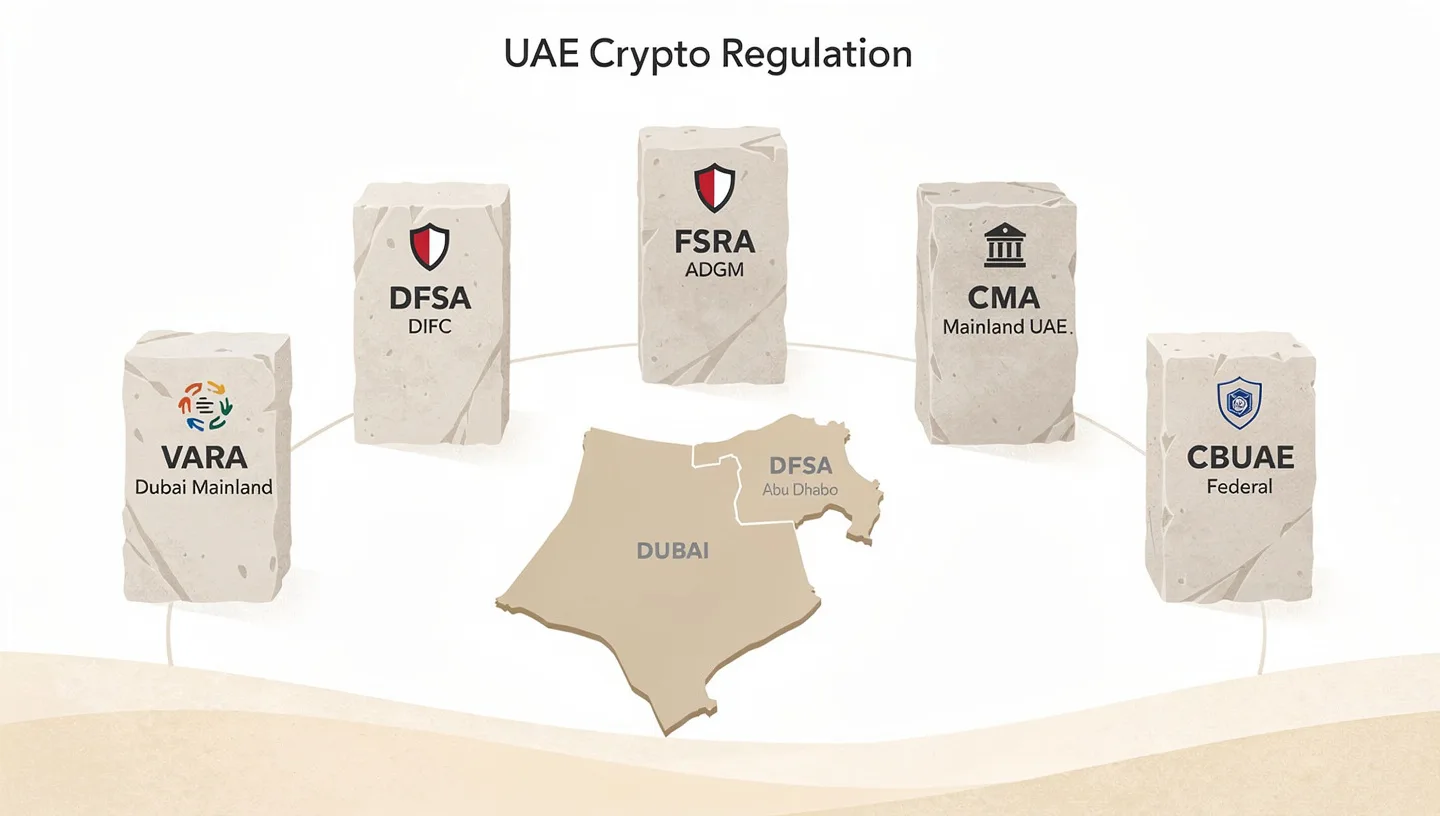
The UAE does not have a single crypto regulator. It operates what Emifast describes as a “layered jurisdictional” model. Five separate regulatory authorities govern virtual asset activities depending on where and how a business operates. Understanding which one applies to your business is the first step before any application or compliance work begins.
| Regulator | Jurisdiction | Primary Focus | Best For |
|---|---|---|---|
| VARA | Dubai mainland (excluding DIFC) | Bespoke crypto licensing, consumer protection | Exchanges, brokers, token issuers targeting retail |
| DFSA | DIFC (free zone) | International financial standards, institutional focus | Institutional trading, wealth management, TradFi-crypto hybrid |
| FSRA (ADGM) | Abu Dhabi Global Market | Common law, innovation sandbox | Web3 startups, DeFi protocols, DAOs, institutional custody |
| CMA (former SCA) | Mainland UAE (federal) | Investment-related virtual assets, securities | Tokenised securities, public offerings, cross-emirate operations |
| CBUAE | Federal | Payment tokens, stablecoins, fiat conversions | Payment token service providers, remittances, stablecoin issuers |
VARA: Dubai’s Dedicated Crypto Regulator
VARA (Virtual Assets Regulatory Authority) was established under Law No. 4 of 2022 Regulating Virtual Assets in the Emirate of Dubai. It is widely regarded as the world’s first purpose-built crypto regulator. Unlike traditional financial regulators that retrofitted existing banking rules to cover digital assets, VARA was designed from the ground up for this industry. Its staff understand blockchain technology, smart contracts, and token economics, which makes technical applications more straightforward for founders building crypto-native businesses.
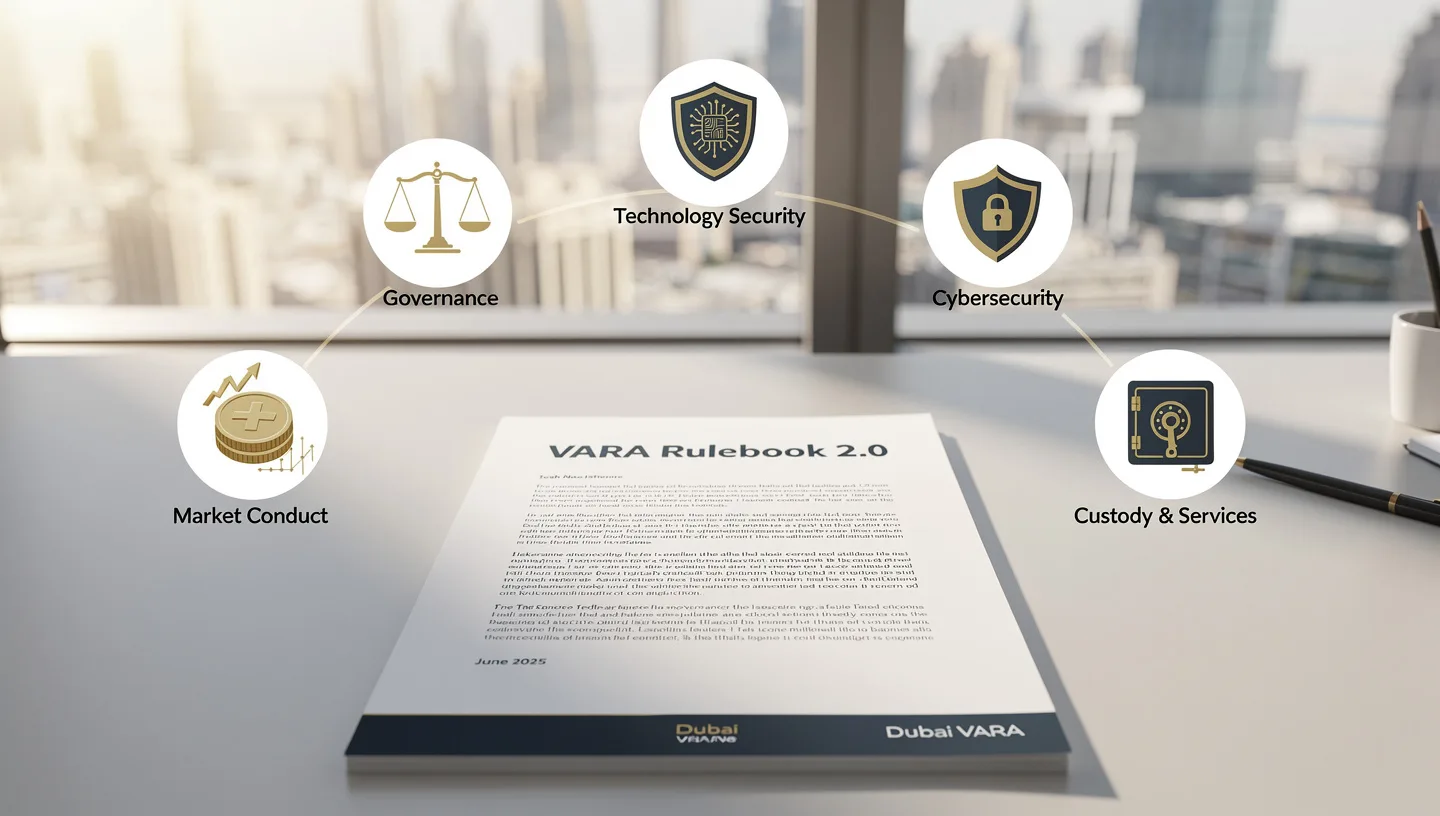
VARA licenses and supervises exchanges, custodians, brokers, transfer services, wallet providers, and token issuers operating in onshore Dubai, excluding the DIFC. Its rulebooks set detailed expectations for governance, technology security, cybersecurity standards, market conduct, and marketing. All businesses offering virtual asset services in or from Dubai must obtain a VARA license before operating.
ADGM and FSRA: Abu Dhabi’s Institutional Framework
The Abu Dhabi Global Market (ADGM), supervised by the Financial Services Regulatory Authority (FSRA), operates under common law principles similar to the legal frameworks used in London and New York. This makes it the preferred entry point for international institutional investors, hedge funds, and large asset managers who are familiar with common law protections and want legal certainty on par with major financial centres.
ADGM is particularly suited for Web3 innovation, decentralised autonomous organisations (DAOs), and real-world asset tokenisation. In January 2026, the FSRA introduced “Product Intervention Powers,” giving the regulator the authority to restrict specific crypto-derivatives if they are judged to pose a systemic risk. This addition makes ADGM attractive to high-frequency traders and institutional funds that need a regulator willing to act decisively on market stability issues.
DIFC and DFSA: The Common Law Zone
The Dubai International Financial Centre (DIFC), regulated by the Dubai Financial Services Authority (DFSA), operates under its own legal system based on common law, independent of the UAE civil law framework that governs mainland Dubai. This structure appeals to international banks, prime brokers, and fintech companies that need familiar contract enforcement mechanisms.
The DFSA’s Crypto Token regime defines how recognised tokens can be issued, traded, and held within the DIFC. In January 2026, the DFSA shifted from a regulator-led to a firm-led suitability assessment. Under this change, firms are now responsible for documenting why a specific token is suitable for their market, which offers more operational flexibility but demands higher internal compliance standards. The DIFC also launched a PropTech Hub in July 2025, aimed at supporting over 200 startups, creating 3,000 jobs, and attracting $300 million in investment by 2030. Dubai Land Department ran tokenisation pilots through this hub with sold-out issuances, signalling genuine market demand for on-chain property titles.
CMA (Former SCA): Federal Oversight
The Capital Market Authority (CMA), previously known as the Securities and Commodities Authority (SCA), is the federal regulator responsible for virtual assets across mainland UAE. Under Cabinet Resolution No. 111 of 2022, the CMA oversees exchanges, brokers, custodians, and other VASPs operating outside of Dubai and the financial free zones.
In August 2025, the CMA and VARA agreed on a shared framework that includes mutual recognition of VASP licenses issued by either authority. Since January 2026, both regulators maintain a unified VASP register, meaning a business licensed in Dubai is visible federally, simplifying cross-emirate operations. The CMA also recognises certain crypto assets as securities, meaning issuers and intermediaries for those assets must follow securities regulations in addition to virtual asset rules.
CBUAE: Payment Tokens and Stablecoins
The Central Bank of the UAE (CBUAE) is the sole regulator for the issuance of payment tokens. Under its Payment Token Services Regulation (PTSR), only AED-backed stablecoins are permitted for local retail payments. Algorithmic tokens and privacy-centric tokens are banned from use in retail payment contexts. The CBUAE ended its Payment Token transition period in Q3 2025, meaning all relevant entities are now fully subject to the permanent framework with no transition grace.
The CBUAE also implemented Federal Decree Law No. 6 of 2025, which extended its regulatory scope to cover technology-enabling platforms, protocols, and decentralised applications that facilitate or enable licensed financial activities. This brought DeFi protocols and Web3 infrastructure into the regulatory perimeter for the first time at a federal level.
VARA Rulebook 2.0: What Changed in June 2025
In May 2025, VARA issued Version 2.0 of its complete Rulebook framework. The updated rules took effect on 19 June 2025 after a 30-day transition period. The Rulebook 2.0 covers governance, technology security, cybersecurity, market conduct, issuance of virtual assets, and marketing regulations. It applies to all entities licensed by VARA and, in the case of marketing rules, to all market participants in the UAE regardless of whether they hold a VARA license.
The Six VARA License Categories
VARA licenses six primary virtual asset activities. Each category has its own capital requirements, governance obligations, and operational standards:
- Exchange services: operating a platform where users trade virtual assets against fiat or other virtual assets
- Broker-dealer services: executing trades on behalf of clients (fiat-to-virtual and virtual-to-virtual)
- Transfer services: processing virtual asset transfers between parties
- Custody services: holding and safeguarding virtual assets on behalf of clients
- Wallet provision: providing software or hardware solutions for storing virtual assets
- Token issuance: split into Category 1 (requires license and specific VARA approval, typically for utility tokens or those with significant economic rights) and Category 2 (distribution through a licensed entity, with some closed-loop tokens exempt but still subject to oversight)
Travel Rule: Fully Implemented February 2026
As of February 2026, VARA has fully implemented the Travel Rule. All VASPs licensed by VARA must provide specific originator and beneficiary information for every virtual asset transfer. This aligns the UAE with FATF (Financial Action Task Force) standards and with Travel Rule requirements that major jurisdictions like the EU, Singapore, and Japan have also adopted. Businesses that process transfers without collecting and transmitting this data are now in breach of VARA’s compliance rules.
For those holding assets across different wallet types, understanding the difference between custodial and non-custodial wallets explains why the Travel Rule applies differently to exchanges versus self-custody arrangements.
FRVA and ARVA: Stablecoin and RWA Issuance Rules
VARA’s Virtual Asset Issuance Rulebook, effective 19 June 2025, sets out the rules for two specific asset classes that have grown rapidly in the UAE market. Fiat-Referenced Virtual Assets (FRVAs) are pegged to a fiat currency, essentially stablecoins. Asset-Referenced Virtual Assets (ARVAs) are backed by real-world assets such as commodities, property, or baskets of assets. The Rulebook locks in approval and disclosure requirements for issuers of both types and defines how FRT intermediation (buying and selling on behalf of clients or issuers) is treated as a regulated activity with its own prudential and conduct rules.
Sponsored VASP Model: What It Is and Who It Suits
VARA Rulebook 2.0 introduced a Sponsored VASP regime. Under this model, an entity that does not hold its own VARA license can operate virtual asset activities under the oversight and licence of a Regulated Sponsor, which is a fully licensed VASP that takes responsibility for the sponsored entity’s compliance. This structure suits smaller operators, startups in early stages, or international firms testing the Dubai market before committing to a full licensing process. The Regulated Sponsor bears regulatory accountability for the sponsored entity’s conduct.
VARA Marketing Regulations: Who They Apply To
In coordination with the CMA, VARA has issued Marketing Regulations that apply to all market participants in the UAE, not only VARA-licensed entities. Any business anywhere that markets virtual asset services to UAE residents must comply with these rules. This includes restrictions on unauthorised promotions, requirements for clear risk disclosures, and a prohibition on all virtual asset activities involving anonymity-enhanced cryptocurrencies (privacy coins). The marketing rules have extraterritorial reach, which means international exchanges without a UAE license that market to UAE-resident customers are exposed to enforcement action.
How to Get a Crypto License in Dubai: The VARA Process
Before offering any virtual asset service in or from Dubai, every business must hold a VARA license. The process is staged and transparent, but it is not fast. Well-prepared applicants with complete documentation and a clear business model typically complete the process in four to ten months, depending on the scope of activities, documentation quality, and regulator feedback rounds.

Step 1: Choose the Right Jurisdiction
Before approaching VARA, determine whether VARA is actually the right regulator for your business. The decision matrix is straightforward in most cases:
- VARA for retail-facing exchanges, brokers, and token issuers operating in Dubai mainland
- DIFC/DFSA for institutional trading desks, wealth managers, and TradFi-crypto hybrid businesses that need common law protections
- ADGM/FSRA for Web3 startups, DeFi protocols, DAOs, and institutional custody operations in Abu Dhabi
- CMA for businesses that want a federal license covering all emirates including cross-emirate operations
- CBUAE for businesses whose primary activity involves payment tokens or stablecoin issuance
Choosing the wrong regulator costs months of rework. Many applicants consult a legal team with UAE crypto experience before filing anything.
Step 2: Submit the Initial Disclosure Questionnaire
All firms planning virtual asset activities in Dubai must complete a Initial Disclosure Questionnaire (IDQ) as the first formal step. The IDQ covers the business model in detail, ownership structure, Ultimate Beneficial Owner (UBO) information, governance approach, and basic compliance readiness. VARA uses this submission to assess whether the business model falls within its jurisdiction and whether the applicant has the foundations for a viable compliance framework.
Step 3: Approval to Incorporate
If VARA accepts the IDQ, it issues an Approval to Incorporate (ATI). This authorises the applicant to set up the legal entity in Dubai and begin operational setup. The ATI stage is not a license to operate. The business cannot conduct any virtual asset activities until the full license is granted. Many applicants hire compliance and legal support at this stage to ensure the entity structure and governance documents meet VARA’s expectations before the full application is filed.
Step 4: Build Operational Setup and Compliance Framework
During the ATI phase, the business must establish:
- A physical office or flexi-desk in Dubai (as required by VARA)
- Responsible managers and a governance structure that passes fit-and-proper assessments
- A Money Laundering Reporting Officer (MLRO) with the relevant qualifications
- AML/CFT policies, risk frameworks, and KYC procedures
- Technology security documentation meeting VARA’s cybersecurity standards
- Insurance coverage as specified in VARA guidelines
- Detailed record-keeping systems
The MLRO is a mandatory appointment. This person is responsible for monitoring transactions for suspicious activity, filing reports with the Financial Intelligence Unit, and maintaining the firm’s AML/CFT programme. Regulators require this role to be filled by a qualified individual, not a nominal appointment.
Step 5: Apply for the Full VASP License
After ATI, the full license application is submitted with complete documentation. VARA reviews the application in detail, may request clarifications or additional documents, and conducts background checks on directors and major shareholders. Once approved, the entity receives its VASP license and can begin operating virtual asset services. The license is activity-specific, meaning a business licensed for custody cannot automatically offer exchange services without a separate approval for that category.
Documents Required for a VARA Application
The standard document set for a VARA application includes:
- Detailed business plan with revenue model and financial projections
- Passport copies and KYC documentation for all owners, directors, and partners
- Proof of address for key personnel
- Company incorporation documents (once entity is established post-ATI)
- Full ownership structure chart with UBO details
- AML/CFT policy framework and compliance manual
- Technology architecture and cybersecurity documentation
- Governance and risk management framework
- Evidence of insurance coverage
Missing or incomplete documents are one of the most common reasons applications stall. VARA expects applicants to arrive with professional-grade documentation, not works in progress.
How Long Does Licensing Take
Well-prepared founders with complete documentation and a clear, focused business model typically complete the VARA licensing process in four to ten months. The lower end applies to straightforward single-activity applications with experienced legal support and clean ownership structures. The upper end applies to businesses with complex multi-jurisdictional ownership, multiple activity categories, or applications that require back-and-forth with VARA on governance or technology documentation. Partial or poorly prepared applications can take longer and may be rejected entirely.
How Much Does a Crypto License in the UAE Cost
The financial requirements for a VARA license are substantial and intentionally designed to filter out undercapitalised operators. The figures below reflect 2026 requirements. They vary by activity type and are subject to change with each Rulebook update.
| Activity Type | Minimum Paid-Up Capital | Application Fee | Annual Supervision Fee |
|---|---|---|---|
| Wallet provision (simpler) | AED 100,000 (~$27,000 USD) | AED 40,000 | AED 80,000 |
| Broker-dealer services | AED 400,000-600,000 | AED 60,000-80,000 | AED 120,000-150,000 |
| Custody services | AED 700,000-1,000,000 | AED 80,000 | AED 150,000 |
| Exchange services (full) | AED 1,500,000-2,000,000 (~$408,000 USD) | AED 100,000 | AED 200,000 |
These figures cover the regulatory fees only. Legal and compliance setup, staffing, office lease, technology infrastructure, and insurance add substantially to the total first-year cost of establishing a licensed UAE crypto operation. The cost structure is deliberately positioned to attract serious businesses rather than speculative or underfunded entrants.
Crypto-Friendly Free Zones in the UAE
Beyond the main regulatory jurisdictions, several UAE free zones have developed specific programmes for crypto and blockchain businesses. Free zones offer benefits including 100% foreign ownership, zero corporate tax on qualifying income, simplified import and export procedures, and streamlined visa processing for employees.
DMCC: Dubai Multi Commodities Centre
The Dubai Multi Commodities Centre (DMCC) has established itself as a major destination for crypto and blockchain companies. DMCC offers a Crypto Centre that provides infrastructure, networking, and regulatory guidance for virtual asset businesses. Companies incorporated in DMCC that offer virtual asset services to external clients still require a VARA license, but DMCC provides the corporate structure and operational environment that underpins many VARA-licensed businesses.
RAK Digital Assets Oasis (RAK DAO)
Located in Ras Al Khaimah, RAK DAO is the UAE’s dedicated free zone for digital asset and Web3 businesses. It is designed specifically for blockchain projects, crypto startups, DAOs, and Web3 developers who want a formal legal structure without necessarily operating as a financial services entity. RAK DAO does not itself issue financial services licenses, but it provides the legal entity framework and business environment for companies that either operate within its scope or combine a RAK DAO entity with a license from one of the main regulators.
DIFC Innovation Hub and Real Estate Tokenisation
The DIFC Innovation Hub, launched in July 2025 in partnership with Dubai Land Department, targets over 200 PropTech startups, with goals to create 3,000 jobs and attract $300 million in investment by 2030. The Hub gives real estate tokenisation teams a direct path from sandbox testing to full-scale operations with regulator touchpoints built into the process.
Dubai Land Department ran its first property title tokenisation pilot through the Hub, in collaboration with VARA, the Central Bank, and Dubai Future Foundation. Partners PRYPCO Mint and CtrAlt executed the pilot, and issuances sold out, confirming real market demand for on-chain property titles. This is the most advanced government-backed real estate tokenisation initiative in the world as of 2026.
For those exploring how to hold and manage digital assets once acquired in UAE markets, the comparison between cold wallet storage and hot wallet options covers the key trade-offs between security and accessibility.
2026 Regulatory Updates: What Is New Across All Regulators
The UAE regulatory environment moves fast. Several significant changes took effect between mid-2025 and early 2026 that any business operating in the UAE needs to know about.
Unified VASP Register: One License Visible Federally
Effective January 2026, the CMA and VARA jointly maintain a unified VASP register. Any business licensed by VARA in Dubai now has its status visible at the federal level. This simplifies cross-emirate operations, reduces the risk of parallel compliance requirements, and signals a move toward a more coordinated national framework. The SCA has simultaneously increased enforcement activity against unlicensed virtual asset operations across all emirates.
Federal Decree Law No. 6 of 2025: DeFi and Web3 Now in Scope
Federal Decree Law No. 6 of 2025 made a decisive change to how DeFi and Web3 are treated under UAE law. The law expressly brings technology-enabling platforms, protocols, and decentralised applications into regulatory scope as soon as they facilitate or enable a Licensed Financial Activity. In plain terms: if a protocol routes transactions, matches orders, or provides liquidity for activities that would otherwise require a financial services license, the protocol operator is no longer shielded by the argument that it is “just code.” This ended what regulators internationally have called the “just code” defense for DeFi operators.
This change affects anyone running a DEX, an automated market maker, a lending protocol, or similar infrastructure in or from the UAE. VARA’s rulebooks already prohibited all virtual asset activities involving anonymity-enhanced cryptocurrencies. The Federal Decree extended that logic to the protocol layer. For builders working in DeFi who want to understand the broader context of how crypto networks function at a technical level, the regulatory implications of Federal Decree Law No. 6 connect directly to on-chain activity that was previously assumed to be outside the regulatory perimeter.
ADGM Product Intervention Powers (January 2026)
Effective January 1, 2026, the FSRA gained Product Intervention Powers that allow it to restrict or prohibit specific crypto-derivatives if they are assessed as posing systemic risk to the market. This gives ADGM regulators a direct tool to act on products before they cause broader market damage, rather than waiting for enforcement action after the fact. For institutional desks trading complex crypto-derivative structures, this change means ADGM can impose position limits or suspend specific instruments without waiting for a formal enforcement process.
DFSA Firm-Led Suitability Assessment (January 2026)
On January 12, 2026, the DFSA moved from a regulator-led to a firm-led suitability assessment for crypto token distribution within the DIFC. Previously, the DFSA conducted its own assessment of whether a given token was suitable for distribution to specific client categories. Under the new model, the firm itself documents and justifies why a token is appropriate for its intended market. This offers greater flexibility for licensed entities but shifts the compliance burden to the firm. Internal documentation standards and token assessment frameworks are now core compliance requirements for any DIFC-based crypto business.
Qualified Investor Classification Update (Early 2026)
New circulars issued in early 2026 refined the definition of Qualified Investor across UAE crypto markets, expanding the pool of investors to whom licensed entities can market high-risk virtual asset products. The change allows firms to reach a broader set of capital-rich individuals and entities while still maintaining investor protection floors. Businesses that previously could only offer certain products to a narrow institutional client base now have more flexibility, provided they meet the updated documentation and suitability requirements.
Crypto Tax in the UAE: VAT, Corporate Tax, and CARF
The UAE’s tax treatment of crypto is one of the most favourable of any major jurisdiction. There is no capital gains tax on crypto in the UAE, no personal income tax, and as of late 2024, most crypto transactions are exempt from VAT. However, two significant reporting and transparency developments in 2025 and 2026 have added new compliance obligations for businesses.
VAT Exemption on Crypto Transactions (November 2024)
Effective November 15, 2024, most transactions involving virtual assets became exempt from the UAE’s 5% VAT. This applies to the buying, selling, and exchange of virtual assets as financial instruments. The exemption removes a practical barrier that had complicated crypto trading and exchange operations, where applying VAT to every transaction created accounting complexity and cost for both businesses and users. Businesses that were previously charging VAT on crypto transactions needed to update their billing systems and accounting processes following this change.
Corporate Tax and Crypto Businesses
The UAE introduced a 9% corporate tax on business profits exceeding AED 375,000 per year, effective June 2023. This applies to licensed crypto businesses operating in mainland UAE. Businesses incorporated in qualifying free zones may benefit from a 0% rate on qualifying income, subject to meeting the economic substance and activity requirements specific to each free zone. The definition of qualifying income for free zone entities is set by the Federal Tax Authority and must be assessed for each business structure individually.
CARF: What It Means for Exchanges and Holders
In September 2025, the UAE Ministry of Finance signed the Multilateral Competent Authority Agreement (MCAA) under the Crypto-Asset Reporting Framework (CARF). CARF is a global standard developed by the OECD for the automatic exchange of information on crypto-assets between tax authorities. The UAE signing commits the country to sharing transaction data with other CARF-participating jurisdictions.
The implementation timeline is phased:
- September 2025: UAE Ministry of Finance signs MCAA, CARF framework adopted
- 2026: Final regulations issued, public consultation closed November 2025
- January 1, 2027: Mandatory reporting begins for UAE-licensed VASPs
- 2028: First automatic exchange of crypto-asset data between countries
Under CARF, licensed exchanges, brokers, custodians, and wallet providers must collect and report buying and selling histories, account balances, transaction records, and customer identification and residency data. The intent is to reduce cross-border tax evasion using crypto. For individual holders, this means that the assumption of privacy around crypto holdings in UAE accounts will not survive 2027 for residents of countries participating in CARF exchanges.
The CARF framework adds a layer of reporting complexity that did not exist before 2025. Businesses operating in UAE crypto markets need to begin upgrading their KYC and transaction monitoring systems well before the January 2027 reporting deadline.
For anyone managing Bitcoin holdings across multiple jurisdictions and considering the UAE as a base, understanding the full picture of what BTC represents within the broader crypto market explains why it remains the primary asset through which most institutional UAE positions are structured.
AML, KYC, and Compliance Obligations for UAE VASPs
Every VARA-licensed entity must maintain a robust AML/CFT (Anti-Money Laundering / Counter-Financing of Terrorism) programme. This is not optional and not delegatable to a third party without formal accountability structures in place. The core requirements are:
- Appointment of a qualified Money Laundering Reporting Officer (MLRO) who reports suspicious transactions to the UAE Financial Intelligence Unit
- Customer due diligence (CDD) and KYC procedures for all clients, with enhanced due diligence for high-risk categories including politically exposed persons (PEPs) and clients from high-risk jurisdictions
- Ongoing transaction monitoring with automated and manual review processes
- Staff training on AML/CFT obligations at least annually
- Compliance with the FATF Travel Rule (fully enforced from February 2026) for all transfers
- Record-keeping for a minimum of five years for all customer and transaction data
Regulators conduct periodic supervisory reviews and can request documentation at any time. Gaps in AML/CFT programmes are treated as serious compliance failures, not administrative oversights.
Penalties for Operating Without a License in the UAE
The UAE treats unlicensed virtual asset activity as a serious offence, not a gray zone. Under the regulatory framework, penalties for operating without the required authorisation include:
- Fines of up to AED 4,000,000 (approximately $1,090,000 USD)
- Disgorgement of profits earned from unlicensed activities, meaning all revenue generated can be clawed back regardless of the fine amount
- Criminal investigation by the Public Prosecutor, which can result in prosecution under UAE criminal law
- Takedown of marketing materials and blocking of services directed at UAE residents
The CMA has increased enforcement actions against unlicensed VASPs since the January 2026 unified register went live, giving regulators a clearer picture of who is operating without authorisation. International exchanges that market to UAE residents without holding an appropriate license are exposed to these penalties even if they have no physical presence in the country.
Common Reasons VARA Applications Get Rejected
VARA’s application process is thorough, and a meaningful share of applications fail or stall due to preventable issues. The most frequent rejection and delay causes are:
- Incomplete or vague business plans that do not clearly define the activity, target clients, revenue model, and operational structure
- UBO structures that lack transparency, including complex offshore holding chains where beneficial ownership is not clearly documented
- Fit-and-proper failures for proposed directors or shareholders with prior regulatory sanctions, criminal records, or insufficient relevant experience
- Weak AML/CFT documentation where policies are copied templates rather than frameworks tailored to the specific business model and risk profile
- Inadequate technology documentation that does not meet VARA’s cybersecurity and system resilience standards
- Insufficient capital at the ATI stage, where the entity does not demonstrate it can meet minimum paid-up capital requirements
- No credible compliance personnel, particularly absence of a qualified MLRO or compliance officer with relevant experience
Applicants who engage specialist UAE crypto legal counsel before submitting the IDQ significantly reduce the risk of rejection. The cost of professional preparation is substantially lower than the cost of a failed application and delayed market entry.
Challenges of Operating a Crypto Business in the UAE
The UAE’s regulatory framework is a genuine competitive advantage for licensed businesses. But it comes with real operational challenges that anyone planning to enter the market should plan for in advance.
Banking Access for Crypto Businesses
Despite the UAE’s pro-crypto regulatory posture, banking access for crypto businesses remains difficult. UAE banks are cautious about onboarding VASPs due to global correspondent banking risk, anti-money laundering exposure, and reputational concerns following high-profile global crypto failures like FTX. A VARA license does not automatically translate into a bank account. Many licensed crypto businesses spend months finding a banking partner willing to provide basic payment infrastructure. This is one of the most commonly cited operational challenges by founders who have gone through the UAE licensing process.
Navigating Five Regulators at Once
The multi-layered regulatory structure that makes the UAE attractive in theory creates real compliance complexity in practice. A business that operates across Dubai and Abu Dhabi, issues stablecoins, and serves both retail and institutional clients may technically fall under VARA, CBUAE, and ADGM simultaneously. Each regulator has its own reporting requirements, supervisory timelines, and documentation standards. Maintaining compliance across multiple regulatory relationships requires dedicated compliance staff, ongoing legal support, and clear internal governance structures.
This complexity also increases the cost of operating. Compliance budgets for multi-licensed UAE entities run significantly higher than for businesses operating under a single regulator in a single jurisdiction.
For businesses looking to understand the competitive landscape of crypto regulation globally and how the UAE compares to other major jurisdictions, the overview of Japan’s crypto regulation provides a useful comparison point as another jurisdiction that built a dedicated virtual asset regulatory framework.
Frequently Asked Questions
Is crypto legal in the UAE?
Yes. Cryptocurrency is legal in the UAE. Bitcoin, Ethereum, and other virtual assets can be legally traded, held, and used for certain transactions. The UAE has established a comprehensive regulatory framework through Cabinet Resolution No. 111 of 2022, with dedicated regulators including VARA, ADGM, and DIFC overseeing virtual asset activities. Businesses that provide virtual asset services must obtain the appropriate license. Personal holding and trading of crypto does not require a license, but using an unlicensed exchange to do so carries the risk that the platform itself is operating illegally.
Do I need a license to trade crypto in the UAE?
Personal crypto trading for your own account does not require a license. You can buy, sell, and hold virtual assets as an individual without regulatory approval. However, if you operate a service that facilitates trading for others, whether as an exchange, broker, custodian, or transfer service, you must hold the appropriate VARA, ADGM, DIFC, or CMA license depending on your jurisdiction and activity type. Operating a commercial virtual asset service without a license exposes you to fines of up to AED 4,000,000 and potential criminal prosecution.
What is the difference between VARA and ADGM?
VARA regulates virtual asset activities in onshore Dubai, outside the DIFC. It was built specifically for crypto and uses a bespoke licensing framework. It is the most common choice for retail-facing exchanges, brokers, and token issuers. ADGM, supervised by the FSRA, is located in Abu Dhabi and operates under common law principles. It attracts institutional investors, hedge funds, and Web3 innovators who need a legal framework similar to London or New York. The two regulators cover different geographic jurisdictions and serve different business models. As of January 2026, they coordinate through the unified VASP register maintained jointly with the CMA.
What crypto exchanges are licensed in the UAE?
Binance, Crypto.com, and Bybit are among the major global exchanges that hold licenses and operate officially in the UAE. Institutional custodians including BitGo and Laser Digital are also licensed. The full and current list of licensed VASPs is maintained on the unified VASP register jointly managed by VARA and the CMA. Any exchange claiming to be UAE-regulated should be verifiable on this register.
Is there capital gains tax on crypto in the UAE?
No. The UAE does not impose capital gains tax on crypto profits for individuals. There is also no personal income tax. Licensed crypto businesses are subject to the 9% corporate tax on profits exceeding AED 375,000 per year, though free zone entities may qualify for a 0% rate on qualifying income. Most crypto transactions became VAT-exempt in November 2024. However, the CARF framework means that from 2027, transaction and account data will be shared automatically with other participating countries’ tax authorities, which affects UAE residents who have tax obligations in those jurisdictions.
What is the CARF and when does it start?
CARF is the Crypto-Asset Reporting Framework, an OECD standard for automatic cross-border sharing of crypto transaction data between tax authorities. The UAE signed the MCAA agreement in September 2025. Mandatory reporting by UAE-licensed VASPs begins January 1, 2027. The first actual exchange of data between countries happens in 2028. VASPs must collect and report buying and selling histories, account balances, transaction records, and customer residency information for all clients.
Can a foreign company get a VARA license?
Yes, with conditions. VARA requires the licensed entity to be incorporated in Dubai, which means a foreign parent company must establish a separate Dubai legal entity, not simply register a branch or representative office. The Dubai entity must have genuine operational substance: a local office, properly appointed directors who pass fit-and-proper assessments, and a compliance team based in Dubai. Foreign ownership of the Dubai entity is permitted at 100% in most cases. The beneficial owners and directors of the parent company are subject to the same KYC and fit-and-proper review as any local applicant.