A bitcoin ETF is an exchange-traded fund that gives investors exposure to the price of Bitcoin through a standard brokerage account, without requiring them to buy, store, or manage the cryptocurrency directly. Since January 2024, when the SEC approved the first batch of spot bitcoin ETFs in the United States, these products have accumulated more than $100 billion in assets under management, making them one of the fastest-growing fund launches in financial history. In 2026, a bitcoin ETF is the most common way for institutional investors and retirement account holders to gain Bitcoin exposure within a regulated framework.
What is a Bitcoin ETF?
A bitcoin ETF is a fund that tracks the price of Bitcoin and trades on a traditional stock exchange like NYSE or NASDAQ, the same way shares of Apple or an S&P 500 index fund do. Investors buy shares in the fund through a brokerage account; the fund holds the underlying Bitcoin on their behalf. The share price moves up and down with the bitcoin price. You gain price exposure to Bitcoin without ever touching a wallet, a private key, or a crypto exchange.
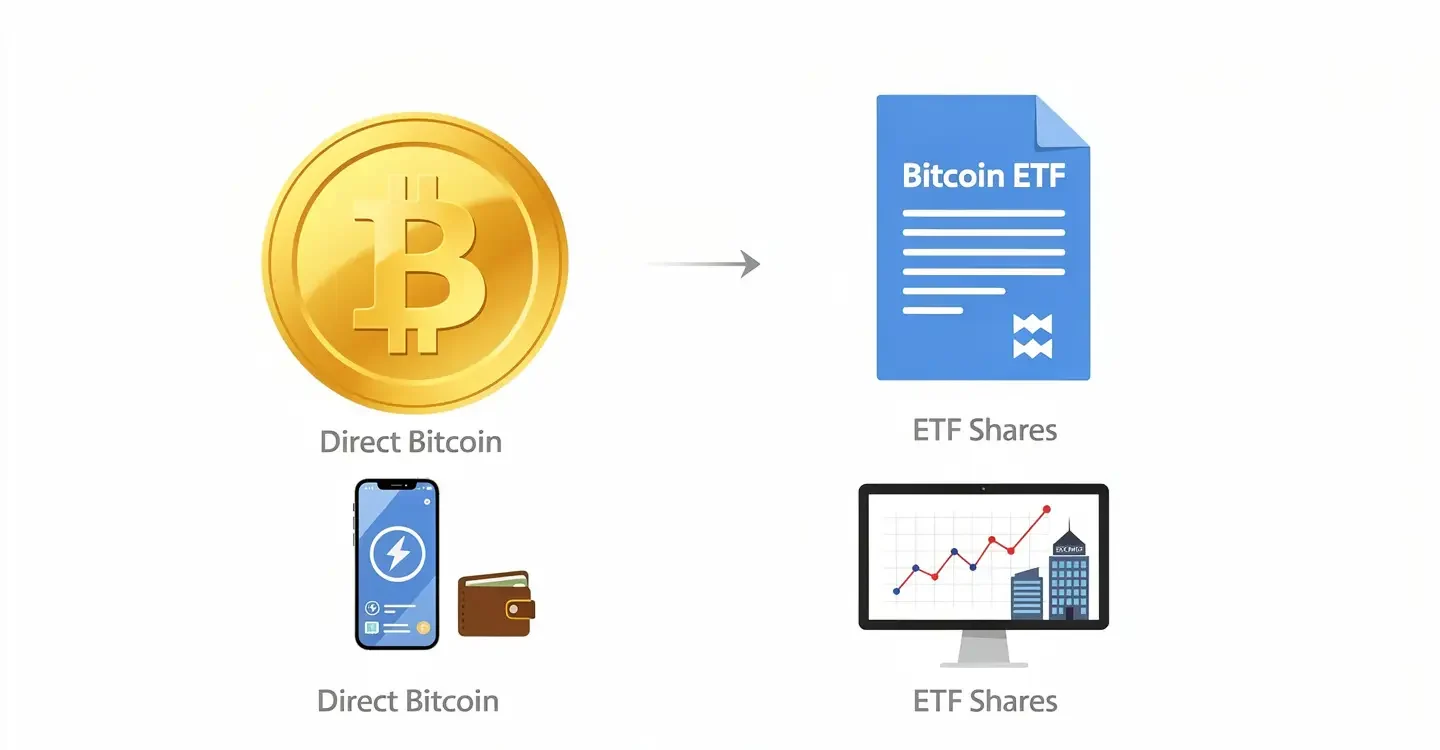
The table below shows the core difference between buying a bitcoin ETF and buying Bitcoin directly, which is the question most investors ask first.
| Feature | Bitcoin ETF | Buying Bitcoin directly |
|---|---|---|
| Where you buy | Stock brokerage (Fidelity, Schwab) | Crypto exchange (Coinbase, Kraken) |
| What you own | Fund shares | Actual Bitcoin |
| Wallet needed | No | Optional |
| Annual fee | 0.15-0.25% expense ratio | No ongoing fee |
| Trading hours | Market hours (9:30am-4pm ET) | 24/7 |
| IRA/retirement use | Yes, any standard IRA | Requires Bitcoin IRA provider |
| Tax reporting | Treated like a stock | Treated as a crypto asset |
A bitcoin ETF does not give you ownership of actual Bitcoin. You cannot transfer your ETF shares to a wallet, stake them, or use them in any transaction on the Bitcoin network. What you own is a financial instrument that moves with Bitcoin’s price. For many investors, that is exactly what they want. For others, it is a meaningful limitation. What Bitcoin itself is and why ownership of the actual asset differs from a fund share is explained in the guide to what is Bitcoin.
Bitcoin ETF vs gold ETF: a familiar analogy
The clearest way to understand a bitcoin ETF is to compare it to a gold ETF. The SPDR Gold Shares ETF (GLD), launched in 2004, holds physical gold bullion in vaults on behalf of its investors. Buying GLD shares does not give you a bar of gold. It gives you a proportional claim on a fund that holds gold, and the share price tracks the spot price of gold as closely as the fund’s structure allows. You can buy and sell GLD shares through any brokerage account, report gains and losses as you would with a stock, and hold it in an IRA without setting foot near a vault.
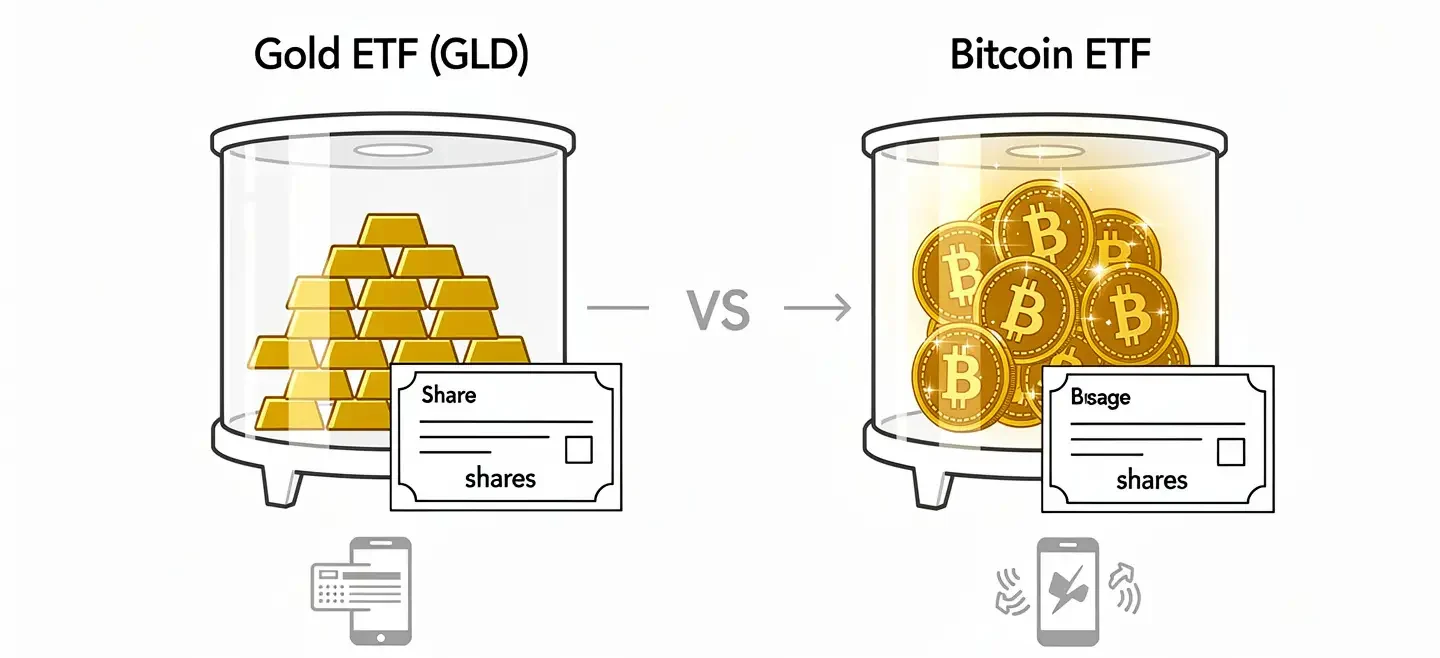
A spot bitcoin ETF works identically with Bitcoin as the underlying asset. The fund buys and holds actual Bitcoin. When you buy shares, the fund’s custodian purchases more Bitcoin to back them. When you sell, it eventually sells Bitcoin to return cash to the market. The share price tracks Bitcoin’s spot price the same way GLD tracks gold’s spot price. For anyone who already understands gold ETFs, spot bitcoin ETFs require no new conceptual framework, only a different underlying asset. How Bitcoin compares to other digital assets in terms of structure and market position is covered in the guide to Bitcoin vs crypto.
How a spot Bitcoin ETF works: step by step
A spot bitcoin ETF is not simply a fund that tracks a price index. It holds actual Bitcoin, and the mechanism keeping its share price aligned with the Bitcoin spot price involves a specific set of institutional actors operating in the background of every trade retail investors make.
- An investor places a buy order for bitcoin ETF shares through their brokerage.
- Authorized participants monitor the ETF price against Bitcoin’s spot price throughout the trading day.
- When demand is high, authorized participants deposit cash with the ETF issuer (creation process) and receive new ETF shares in return.
- The ETF issuer uses that cash to purchase Bitcoin on the open market.
- The custodian takes custody of the purchased Bitcoin and stores it in cold storage.
- The new ETF shares are listed on NYSE or NASDAQ, available for retail investors to buy.
- Redemption reverses the process: authorized participants return ETF shares, the issuer sells Bitcoin, and cash is returned.
The creation and redemption mechanism
The creation and redemption mechanism is what makes a bitcoin ETF function differently from a closed-end fund like GBTC originally was. Authorized participants, large institutional broker-dealers, are the only entities permitted to directly create or redeem ETF shares with the issuer. When bitcoin ETF shares trade at a premium above the fund’s net asset value (NAV), authorized participants can profit by creating new shares (buying Bitcoin, depositing cash with the issuer, receiving shares at NAV, selling those shares at the market premium). This new supply pushes the price back down toward NAV. When shares trade at a discount, the reverse happens: APs buy discounted ETF shares, redeem them with the issuer for cash, and pocket the difference, which pushes the price back up.
US spot bitcoin ETFs use cash creation, meaning authorized participants deposit cash rather than actual Bitcoin with the issuer, and the issuer then purchases Bitcoin. Some international products use in-kind creation, where APs deposit Bitcoin directly. The SEC required cash creation for the January 2024 US approvals. The practical effect is minimal for investors, but the mechanism means no AP ever directly touches raw Bitcoin during the process.
Who are the authorized participants?
Authorized participants are large institutional broker-dealers. For the major US spot bitcoin ETFs, these include firms such as JPMorgan, Goldman Sachs, Jane Street, and Virtu Financial. These firms are not Bitcoin advocates; they participate because the arbitrage between the ETF price and the Bitcoin spot price is a profitable mechanical opportunity that arises whenever supply and demand push the two apart. Their profit-seeking activity is what keeps the ETF price tightly aligned with Bitcoin’s actual market price throughout each trading day.
Who are the custodians?
The custodian is the institution that holds the actual Bitcoin backing the ETF in secure storage. Coinbase Custody serves as custodian for BlackRock’s IBIT and Grayscale’s GBTC. Fidelity Digital Assets, Fidelity’s own custody arm, holds the Bitcoin for FBTC. BitGo and BNY Mellon serve custodial roles for other ETF products. Custodians hold the Bitcoin in cold storage, meaning offline, with institutional-grade security protocols including multisig authorization requirements. Retail investors never interact with the custodian directly. The cold wallet principles behind this kind of institutional storage are explained in the guide to cold wallets for crypto.
How ETF shares are priced: NAV and tracking error
The official net asset value (NAV) of a bitcoin ETF is calculated once daily, at market close, by dividing the total value of Bitcoin held in the fund by the number of outstanding shares. During trading hours, the ETF share price fluctuates in real time on the stock exchange, based on supply and demand among buyers and sellers. This intraday price can differ slightly from the NAV, producing a small premium (shares trade above NAV) or discount (shares trade below NAV). For well-managed spot ETFs like IBIT and FBTC, the premium or discount is typically a fraction of a percent.
Tracking error measures how closely the ETF’s total return matches Bitcoin’s actual spot price return over time. Even a perfectly managed ETF will have some tracking error because the expense ratio is deducted from the fund’s assets daily, meaning the fund holds slightly less Bitcoin over time relative to what a direct holder would own. The legacy product GBTC, which operated as a closed-end trust before converting to an ETF in January 2024, had a severe tracking error problem. Between 2021 and 2023, GBTC traded at discounts to NAV as large as 50%, meaning investors who bought at a 2021 premium and sold during the discount period suffered losses significantly worse than Bitcoin’s own price decline. The new spot ETF structure with creation and redemption prevents this.
Spot Bitcoin ETF vs futures Bitcoin ETF: key differences
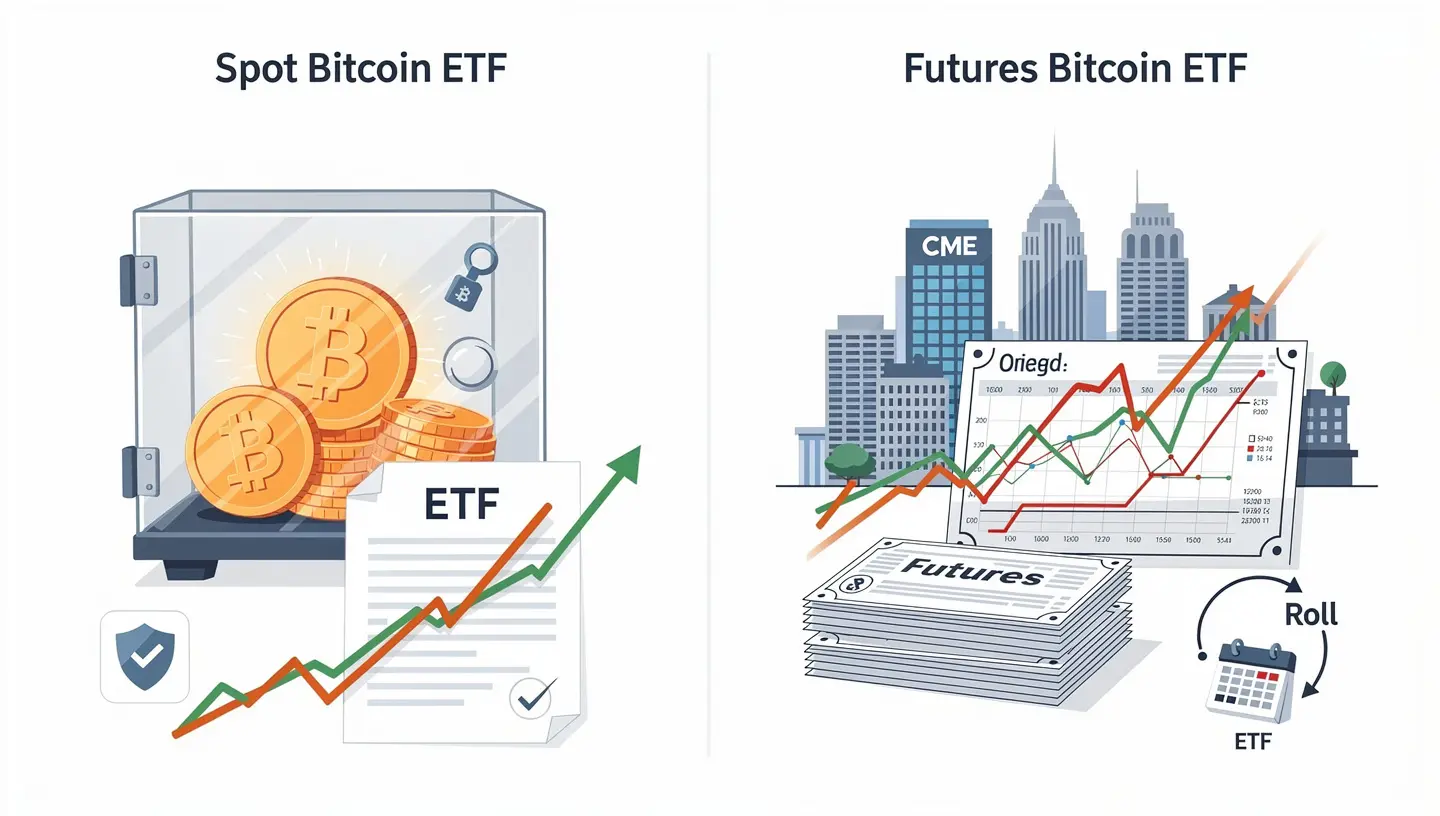
There are two structurally different types of bitcoin ETF. A spot bitcoin ETF holds actual Bitcoin. A futures bitcoin ETF holds Bitcoin futures contracts, which are agreements to buy or sell Bitcoin at a predetermined price on a future date, traded on the Chicago Mercantile Exchange (CME). The distinction matters because it directly affects how closely the fund tracks Bitcoin’s actual price and what costs investors absorb over time.
| Feature | Spot Bitcoin ETF | Futures Bitcoin ETF |
|---|---|---|
| Holds | Actual Bitcoin | CME Bitcoin futures contracts |
| Price tracking accuracy | Very close to spot price | May deviate significantly over time |
| Custodian required | Yes (holds BTC) | No (holds contracts, not BTC) |
| Primary US example | IBIT, FBTC, BITB, ARKB | BITO (ProShares) |
| Available in US since | January 2024 | October 2021 |
| Key cost beyond expense ratio | Minimal | Roll costs (contango) |
What is contango and why it costs futures ETF investors money
A futures bitcoin ETF must replace its contracts before they expire each month, a process called rolling. The fund sells the expiring near-month contract and buys the next month’s contract to maintain its Bitcoin exposure. When the market is in contango, meaning the futures price for the next month is higher than the current spot price, buying the new contract costs more than the proceeds from selling the old one. This difference is the roll cost, and it erodes returns every single month the ETF holds a futures position in a contango market.
ProShares’ BITO, the first US Bitcoin ETF launched in October 2021, illustrates this clearly. In its first year, BITO significantly underperformed the actual Bitcoin spot price because of consistent roll costs in a contango environment. An investor who held BITO through 2022 lost more than an investor who simply held Bitcoin directly, not only because Bitcoin fell but because the roll costs compounded the loss on top of it. Spot ETFs like IBIT and FBTC avoid contango entirely because they hold actual Bitcoin, which does not expire. How the Bitcoin network’s own mechanics drive the value of the underlying asset is covered in the guide to how crypto works.
Why Bitcoin ETFs were created: the institutional problem they solved
Before spot bitcoin ETFs existed, most institutional investors could not buy Bitcoin directly, even if they wanted to. The obstacles were structural, not a matter of preference. Pension funds and endowments typically operate under fiduciary duty rules that require investments to be held in regulated formats with established legal frameworks. Raw Bitcoin on a crypto exchange did not qualify. Corporate treasuries faced accounting standard problems: crypto assets required mark-to-market treatment that created P&L volatility that boards were unwilling to accept. Compliance teams at major asset managers simply did not have approved procedures for interacting with unregulated crypto infrastructure.
Bitcoin ETFs solved all of these problems in a single product. A spot bitcoin ETF is a registered investment company under the Investment Company Act of 1940, the same legal framework as every mutual fund and ETF that institutional investors already hold. It fits into standard portfolio management systems, risk models, and custody frameworks. Pension funds, endowments, registered investment advisors, and family offices can all buy IBIT through their existing prime brokerage relationships the same way they buy AAPL. The result was $100 billion in assets gathered in roughly a year from launch, the fastest accumulation in ETF history. How Bitcoin’s role as a macro asset has developed is covered in the guide to what is BTC in crypto.
The road to Bitcoin ETF approval: from 2013 to January 2024
The first bitcoin ETF application in the United States was filed in 2013 by Cameron and Tyler Winklevoss. The SEC rejected it in 2017, citing concerns about market manipulation and the lack of surveillance-sharing agreements with regulated Bitcoin trading venues. Over the following years, multiple asset managers including VanEck, Bitwise, and WisdomTree filed their own applications. The SEC rejected every spot bitcoin ETF application it received, totaling more than a dozen rejections over a decade.
The compromise that arrived first was a futures-based product. In October 2021, the SEC approved ProShares’ BITO, a futures bitcoin ETF using CME contracts. This was accepted because CME is a regulated derivatives exchange with existing surveillance tools. BITO gathered over $1 billion on its first day of trading, demonstrating clear demand. But a futures ETF is structurally inferior to a spot product, and the industry continued pushing for spot approval. The turning point came in August 2023, when Grayscale won a federal lawsuit against the SEC. The court ruled that the SEC had acted arbitrarily by approving futures ETFs while rejecting spot applications for the same underlying asset. The ruling removed the SEC’s legal basis for continued denial.
On January 10, 2024, the SEC simultaneously approved 11 spot bitcoin ETFs, including products from BlackRock, Fidelity, Bitwise, Ark/21Shares, VanEck, and Grayscale. Trading began the following day. It was the largest simultaneous ETF launch in US history. The Bitcoin halving that occurred in April 2024 added further supply dynamics to the ETF-driven demand. How Bitcoin’s supply schedule affects its price is explained in the guide to Bitcoin halving.
The biggest Bitcoin ETFs in 2026
The table below shows the major US Bitcoin ETFs by assets under management as of July 2026. IBIT from BlackRock dominates the market by a significant margin. Note the difference in fees: GBTC charges 1.50%, three times more than the cheapest alternatives, because it is a legacy product converted from a closed-end trust that still carries its original fee structure.
| Ticker | Fund | Issuer | AUM | Annual fee | Type |
|---|---|---|---|---|---|
| IBIT | iShares Bitcoin Trust | BlackRock | $54.91B | 0.25% | Spot |
| FBTC | Fidelity Wise Origin Bitcoin Fund | Fidelity | $12.31B | 0.25% | Spot |
| GBTC | Grayscale Bitcoin Trust ETF | Grayscale | $10.66B | 1.50% | Spot |
| BTC | Grayscale Bitcoin Mini Trust | Grayscale | $3.54B | 0.15% | Spot |
| BITB | Bitwise Bitcoin ETF | Bitwise | $2.58B | 0.20% | Spot |
| ARKB | ARK 21Shares Bitcoin ETF | Ark/21Shares | $2.36B | 0.21% | Spot |
| BITO | ProShares Bitcoin ETF | ProShares | $1.76B | Variable | Futures |
| HODL | VanEck Bitcoin ETF | VanEck | $1.17B | 0.20% | Spot |
Grayscale’s situation is worth understanding. GBTC was the dominant Bitcoin investment vehicle for institutional investors before spot ETFs existed, operating as a closed-end trust with no redemption mechanism. When it converted to a spot ETF in January 2024, it kept its original 1.50% fee. Investors who want Grayscale specifically but at a lower cost can use the Grayscale Bitcoin Mini Trust (ticker: BTC) at 0.15%, currently the lowest fee among major Bitcoin ETFs. For most new investors choosing a spot bitcoin ETF, the practical choice is between IBIT and FBTC at 0.25%, with BITB and HODL at 0.20% as competitive alternatives. How Bitcoin’s block reward and supply reduction interact with the growing ETF demand is covered in the guide to Bitcoin block reward.
How do Bitcoin ETFs affect the price of Bitcoin?
Every share purchase in a spot bitcoin ETF creates real buying pressure on the Bitcoin spot market. When you buy $10,000 worth of IBIT shares, BlackRock’s custodian relationship with Coinbase Custody eventually results in $10,000 worth of actual Bitcoin being purchased on the open market to back those shares. When an investor sells, the reverse happens: Bitcoin is sold to return cash. The creation and redemption mechanism ensures this happens systematically as ETF demand rises and falls.
The ETF inflows that followed the January 2024 approval contributed meaningfully to Bitcoin’s price appreciation through 2024 and into 2025. By early 2026, US spot bitcoin ETFs held more than $100 billion in Bitcoin, representing a significant portion of the total Bitcoin supply. Sustained ETF inflows from institutional and retail buyers represent a structural, daily demand for Bitcoin that did not exist before January 2024. ETF outflows work in reverse: in the final week of June 2026, US spot bitcoin ETFs saw outflows of approximately $1.79 billion in a single week, driven by institutional rotation and macro concerns, creating selling pressure on the spot Bitcoin market.
The arbitrage relationship between ETF prices and Bitcoin spot prices also creates short-term price effects. When ETF shares trade at a premium, authorized participants buy Bitcoin on the spot market to create new shares, pushing spot prices up. When ETF shares trade at a discount, APs sell Bitcoin to redeem shares, pushing spot prices down. This arbitrage activity is constant, high-frequency, and contributes to tighter price alignment between ETF prices and the underlying Bitcoin market. How the Bitcoin price has moved across historical cycles is tracked in the guide to Bitcoin price.
Bitcoin ETF vs buying Bitcoin directly
The structural comparison between a bitcoin ETF and direct Bitcoin ownership comes down to three practical questions: what does it cost, what control do you give up, and what access do you gain? Neither option is universally better; the right choice depends on the investor’s priorities.
| Factor | Bitcoin ETF | Direct Bitcoin ownership |
|---|---|---|
| Annual cost | 0.15-0.25% expense ratio | Exchange trading fee only (no ongoing) |
| Setup complexity | None – standard brokerage | Exchange account + optional wallet |
| Self-custody possible | No | Yes |
| Trading hours | Weekdays 9:30am-4pm ET only | 24/7 |
| Staking | Not available | Available (varies by platform) |
| IRA eligibility | Any standard IRA | Bitcoin IRA provider required |
| Withdraw as Bitcoin | No – cash only | Yes |
| Long-term cost (10yr hold) | Higher (compounding fee) | Lower (one-time trading fee) |
How the fees compare over time
The expense ratio of a bitcoin ETF compounds against your investment balance over time. A $10,000 investment in IBIT at 0.25% per year loses $25 to fees in year one. If Bitcoin rises 10x and the position grows to $100,000, the fee for that year is $250. Over a 10-year period with meaningful price appreciation, the cumulative management fee can easily exceed $1,000 on an initial $10,000 investment. The fee is not a fixed dollar amount; it is a percentage of whatever the fund is worth.
Direct Bitcoin ownership has no ongoing fee. If you buy $10,000 of Bitcoin on Coinbase and hold it for 10 years without selling, the only cost is the initial trading fee paid at purchase (typically $15-25 on a $10,000 trade). For a long-term passive holder, the total 10-year cost of direct ownership is roughly $25. The total 10-year cost of the same investment in IBIT, assuming reasonable price appreciation, is several hundred dollars or more. The fee difference grows with both time and Bitcoin price appreciation. For passive buy-and-hold investors with a multi-year horizon, this fee drag is a real cost worth considering before choosing the ETF route.
What you give up with a Bitcoin ETF
A bitcoin ETF limits what you can do with your investment in ways that direct ownership does not. ETF shares cannot be transferred to a self-custody wallet. You cannot use your ETF shares as collateral in a DeFi protocol. You cannot stake them, spend them, or send them to another party. You can only buy, hold, and sell shares during market hours on the stock exchange, and when you sell, you receive cash, not actual Bitcoin.
For investors who want Bitcoin as money, as a programmable asset, or as a long-term store of value they physically control, the ETF structure removes all of that utility. The ETF gives you price exposure and regulatory protection. It does not give you private keys, self-custody, or any of the properties that Bitcoin maximalists argue make Bitcoin valuable in the first place. The distinction between custodial and self-custodial arrangements is explained in the guide to custodial vs non-custodial wallets.
How to buy a Bitcoin ETF
Buying a bitcoin ETF is as simple as buying any stock. If you already have a brokerage account at Fidelity, Schwab, Robinhood, E*TRADE, or most other major brokers, you can buy a bitcoin ETF in the same account you use for stocks and mutual funds. Note that Vanguard does not allow customers to purchase bitcoin ETFs through its platform, making it the notable exception among major US brokerages.
- Open or use an existing brokerage account. Any standard brokerage except Vanguard will work.
- Fund the account via bank transfer or existing balance.
- Search for the ETF by ticker. IBIT for BlackRock, FBTC for Fidelity, BITB for Bitwise, ARKB for Ark/21Shares, HODL for VanEck.
- Compare expense ratios before choosing. GBTC’s 1.50% fee is significantly higher than the 0.15-0.25% charged by newer products.
- Place a buy order. A market order executes immediately at the current price. A limit order executes only at a price you specify.
Bitcoin ETFs can also be held inside an IRA or Roth IRA through any standard brokerage that supports self-directed IRAs. This allows tax-deferred or tax-free Bitcoin exposure within a retirement account. The broader landscape of retirement account options for Bitcoin, including self-directed Bitcoin IRAs that hold actual Bitcoin rather than ETF shares, is covered in the guide to Bitcoin IRA.
Benefits of a Bitcoin ETF
For the investors they are designed to serve, bitcoin ETFs offer a set of practical advantages that direct Bitcoin ownership does not replicate.
- No wallet or private key management: investors never need to set up a crypto exchange account, manage a seed phrase, or worry about losing access to funds.
- Standard brokerage access: bitcoin ETF shares can be bought through any brokerage account the same way equities are purchased.
- Regulated product with investor protections: ETFs are registered investment companies subject to SEC oversight and established legal frameworks.
- IRA and 401(k) compatibility: bitcoin ETFs can be held in tax-advantaged retirement accounts without requiring a specialized Bitcoin IRA provider.
- Institutional-grade custody: Bitcoin backing the ETF is held by regulated custodians in cold storage with multisig security.
- Simple tax reporting: gains and losses are reported as securities transactions in most jurisdictions, using familiar tax forms.
- Portfolio integration: bitcoin ETF shares appear alongside stocks and bonds in a standard portfolio view, making allocation tracking straightforward.
Risks of a Bitcoin ETF
A bitcoin ETF does not reduce Bitcoin’s inherent price risk. If Bitcoin falls 50%, an IBIT investment falls approximately 50%, minus the annual fee deducted. The ETF structure provides regulatory convenience and custody security; it does not provide any buffer against Bitcoin market losses.
- Bitcoin price volatility: the fund falls as much as Bitcoin falls, with no downside protection.
- Expense ratio drag: the annual fee of 0.15-1.50% erodes returns over time and grows in dollar terms as the investment appreciates.
- Tracking error: ETF total returns may deviate slightly from Bitcoin spot price returns due to fee drag, cash positions, and operational factors.
- Custodian risk: if the custodian holding the Bitcoin is compromised or fails, the fund’s assets could be at risk, though institutional-grade custodians carry significant insurance.
- Premium and discount risk: ETF shares can briefly trade above or below NAV during periods of high market stress or low liquidity.
- Regulatory risk: a change in SEC policy could affect the ETF’s structure or operations, though outright closure of approved ETFs would be unusual.
- Market hours restriction: if Bitcoin moves sharply outside of NYSE or NASDAQ trading hours, ETF holders cannot react until the following trading day.
Who should buy a Bitcoin ETF and who should buy directly?
A bitcoin ETF is the right choice in specific situations and the wrong choice in others. The decision comes down to what the investor actually needs from their Bitcoin exposure.
A bitcoin ETF is likely the right choice if you:
- Want Bitcoin exposure inside an existing IRA, Roth IRA, or 401(k) without setting up a Bitcoin IRA provider
- Are an institutional investor, financial advisor, or pension fund with fiduciary or compliance constraints that require a regulated product
- Want Bitcoin alongside stocks and bonds in a single brokerage account with consolidated reporting
- Have no interest in managing wallets, private keys, or crypto exchange accounts
- Plan to hold for a relatively short period where the fee difference versus direct ownership is small
Buying Bitcoin directly is likely the better fit if you:
- Plan to hold Bitcoin for many years, where the compounding expense ratio represents a meaningful cost
- Want actual ownership of Bitcoin with the ability to transfer, use in transactions, or hold in self-custody
- Need 24/7 trading access, since crypto markets never close and ETFs only trade during market hours
- Want to use Bitcoin as collateral, stake compatible assets, or interact with the broader crypto market
- Prefer not to pay an ongoing management fee when no ongoing management is required for a buy-and-hold position
Frequently asked questions
What is a Bitcoin ETF?
A bitcoin ETF is an exchange-traded fund that tracks the price of Bitcoin and trades on a stock exchange through a standard brokerage account. A spot bitcoin ETF holds actual Bitcoin as its underlying asset. A futures bitcoin ETF holds CME Bitcoin futures contracts. Both give investors exposure to bitcoin price movements without requiring them to buy or store Bitcoin directly.
What is the difference between a spot and futures Bitcoin ETF?
A spot bitcoin ETF holds actual Bitcoin in custody. Its price closely tracks the Bitcoin spot price. A futures bitcoin ETF holds CME futures contracts, not actual Bitcoin. Because futures contracts must be rolled over monthly, a futures ETF incurs contango roll costs that can significantly reduce returns versus holding Bitcoin directly over time. Spot ETFs like IBIT and FBTC are generally considered the better choice for most investors because they more accurately track Bitcoin’s actual price performance.
Is a Bitcoin ETF safer than buying Bitcoin directly?
A bitcoin ETF is safer in terms of operational complexity: there is no wallet to lose, no seed phrase to protect, and no exchange account to secure. The Bitcoin backing the ETF is held by regulated custodians with institutional-grade cold storage. However, a bitcoin ETF is not safer in terms of price risk. Bitcoin’s market volatility applies equally to ETF shares and directly held Bitcoin. The ETF provides custody security and regulatory oversight; it does not protect against Bitcoin price declines.
Which Bitcoin ETF has the lowest fee?
As of mid-2026, the Grayscale Bitcoin Mini Trust (ticker: BTC) charges the lowest expense ratio at 0.15%. BITB (Bitwise) and HODL (VanEck) charge 0.20%. IBIT (BlackRock) and FBTC (Fidelity) charge 0.25%. The legacy GBTC (Grayscale Bitcoin Trust ETF) still charges 1.50%, which is six times the cost of the Mini Trust. For cost-conscious investors, GBTC is generally not the right choice among 2026 options unless there is a specific reason to prefer that product.
Can I hold a Bitcoin ETF in an IRA?
Yes. Bitcoin ETFs can be held in a Traditional IRA, Roth IRA, or other retirement accounts through any standard brokerage that supports self-directed IRA investing. This provides tax-advantaged Bitcoin exposure: in a Traditional IRA, gains are tax-deferred; in a Roth IRA, qualified withdrawals are tax-free. Vanguard is the notable exception, as it does not allow customers to purchase Bitcoin ETFs. The alternative for investors who want actual Bitcoin in a retirement account rather than ETF shares is a dedicated Bitcoin IRA provider, which holds real BTC in custodial accounts.
Does a Bitcoin ETF pay dividends?
No. Bitcoin ETFs do not pay dividends. Bitcoin does not generate income the way a stock or bond does, and the fund holds Bitcoin as its only asset. The entire return from a bitcoin ETF comes from changes in the bitcoin price. If Bitcoin rises, ETF shares rise in value. If Bitcoin falls, ETF shares fall. There is no yield component, no income distribution, and no dividend payment from any current spot bitcoin ETF product.
How do Bitcoin ETF inflows affect the Bitcoin price?
When investors buy shares in a spot bitcoin ETF, the fund must purchase actual Bitcoin on the open market to back those shares. Each dollar of ETF inflows translates into a dollar of real demand for Bitcoin on the spot market. Since January 2024, sustained buying pressure from ETF inflows has been a consistent factor in Bitcoin’s price dynamics. Equally, ETF outflows create selling pressure: when investors sell ETF shares, the custodian eventually sells the corresponding Bitcoin. The arbitrage between ETF prices and spot Bitcoin prices keeps this relationship tight and efficient.
What happens if a Bitcoin ETF closes?
If a bitcoin ETF is wound down or closes, the typical process is an orderly liquidation. The fund sells its Bitcoin holdings, converts the proceeds to cash at the current NAV, and returns the cash to shareholders. Investors receive the market value of their shares in cash, not Bitcoin. This is one reason some investors prefer to hold actual Bitcoin directly: a fund closure cannot force you to sell or convert your assets to cash. For large, well-established ETFs like IBIT with tens of billions in AUM, the probability of closure is very low, but it remains a theoretical risk for smaller or newer products.