A Bitcoin IRA lets you hold Bitcoin inside a tax-advantaged retirement account, either through a self-directed IRA where you own Bitcoin directly or through a Bitcoin ETF inside a standard brokerage IRA. Both routes remove the capital gains tax hit that comes with trading Bitcoin in a regular taxable account. In 2026, you have more choices than ever: self-directed custodians have expanded coin selection and improved custody models, and the January 2024 spot Bitcoin ETF approvals mean any Fidelity or Schwab IRA can now hold Bitcoin exposure for as little as 0.20% per year. This guide compares both paths so you can match the right structure to your situation.
Quick answer: best Bitcoin IRA providers compared
| Provider | Best for | Annual fee | Trading fee | Min investment | Assets | IRA types | Custody |
|---|---|---|---|---|---|---|---|
| iTrustCapital | Overall | $0 | 1% | $1,000 | 90+ crypto + gold/silver | Trad, Roth, SEP | Coinbase Custody / Fireblocks |
| Fidelity Crypto IRA | Existing Fidelity users | $0 | 1% (spread) | None | BTC, ETH, SOL, LTC | Trad, Roth, Rollover | Fidelity Digital Assets |
| Unchained IRA | Self-custody Bitcoin | $250/year flat | 1.50% | $2,000/trade | Bitcoin only | Trad, Roth, SEP, Inherited | Self-custodial multisig |
| Swan IRA | Bitcoin-only, no minimum | 0.24%/year | 1% | None | Bitcoin only | Trad, Roth | Equity Trust |
| BitcoinIRA | Coin selection, 24/7 trading | 0.08%/month | 2% | None | 80+ crypto | Trad, Roth, SEP, SIMPLE | BitGo Trust ($250M ins.) |
| Alto Crypto IRA | Altcoin diversity | $10/month or $100/year | 2% | None | 60+ crypto | Trad, Roth, SEP | Coinbase Custody |
What is a Bitcoin IRA?
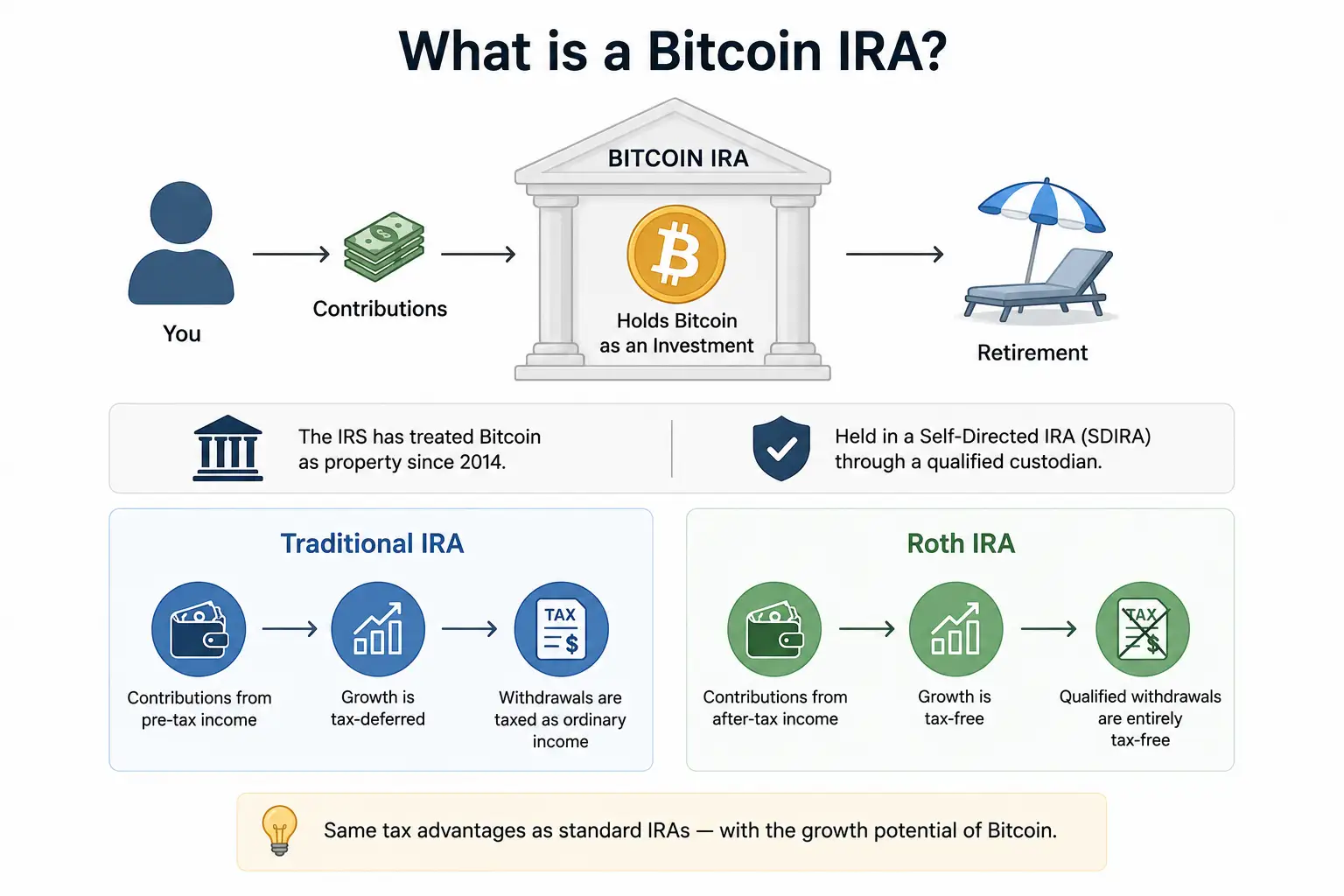
A Bitcoin IRA is a retirement account that holds Bitcoin as an investment, with the same tax treatment as a standard individual retirement account. In a Traditional IRA, contributions come from pre-tax income and withdrawals are taxed as ordinary income. In a Roth IRA, contributions come from after-tax income and qualified withdrawals are entirely tax-free. The IRS has treated Bitcoin as property since 2014, meaning it fits inside a self-directed IRA (SDIRA) using a qualified custodian, the same structure used to hold real estate or private equity inside an IRA.
Bitcoin IRA vs crypto IRA: why the distinction matters
A Bitcoin IRA holds only Bitcoin. A crypto IRA holds a broader mix of digital assets. The distinction matters more than it may appear. The Commodity Futures Trading Commission treats Bitcoin as a commodity, giving it a clearer regulatory classification than most altcoins. The SEC has named more than 67 alternative cryptocurrencies as potential unregistered securities in enforcement actions since 2023, and many of those tokens appear in crypto IRA product lineups. Bitcoin-only IRAs from providers like Swan and Unchained carry less regulatory risk than accounts holding a broad basket of altcoins. What Bitcoin is and why it holds a distinct position in the crypto market is explained in the guide to what is Bitcoin.
Bitcoin IRA vs regular crypto investing: the tax difference
Every time you sell Bitcoin, swap one coin for another, or spend crypto in a taxable account, you trigger a capital gains tax event. If you bought Bitcoin at $30,000 and sell at $90,000, you owe tax on the $60,000 gain at either short-term or long-term capital gains rates, depending on how long you held it. Inside a Bitcoin IRA, none of those trades trigger a taxable event. You can buy at $30,000, sell at $90,000, rebuy at $75,000, and sell again at $120,000, all without owing any tax until you withdraw from a Traditional IRA or never if you withdraw from a Roth. This is the core reason active Bitcoin traders and long-term holders both find IRA structures attractive.
Bitcoin IRA vs Bitcoin ETF in a standard IRA: cost and custody trade-off
Since January 2024, you can buy spot Bitcoin ETF shares in any standard brokerage IRA without opening a new account. ETFs like IBIT from BlackRock or FBTC from Fidelity charge expense ratios of around 0.20-0.25% per year. A self-directed Bitcoin IRA typically charges a combination of a platform fee and a 1-2% trading fee that adds up to more on an annual basis. For a passive long-term holder who buys Bitcoin and does not trade, the ETF route is cheaper and simpler.
The self-directed IRA route makes sense in three cases: you want to own actual Bitcoin rather than a fund share, you want the option to withdraw as Bitcoin rather than cash, or you want a self-custody arrangement where you hold your own keys. ETF shares can only be liquidated as cash. A self-directed Bitcoin IRA can, in some cases, distribute actual Bitcoin directly to you at retirement age. How Bitcoin differs from other crypto assets in terms of custody and ownership is covered in the guide to Bitcoin vs crypto.
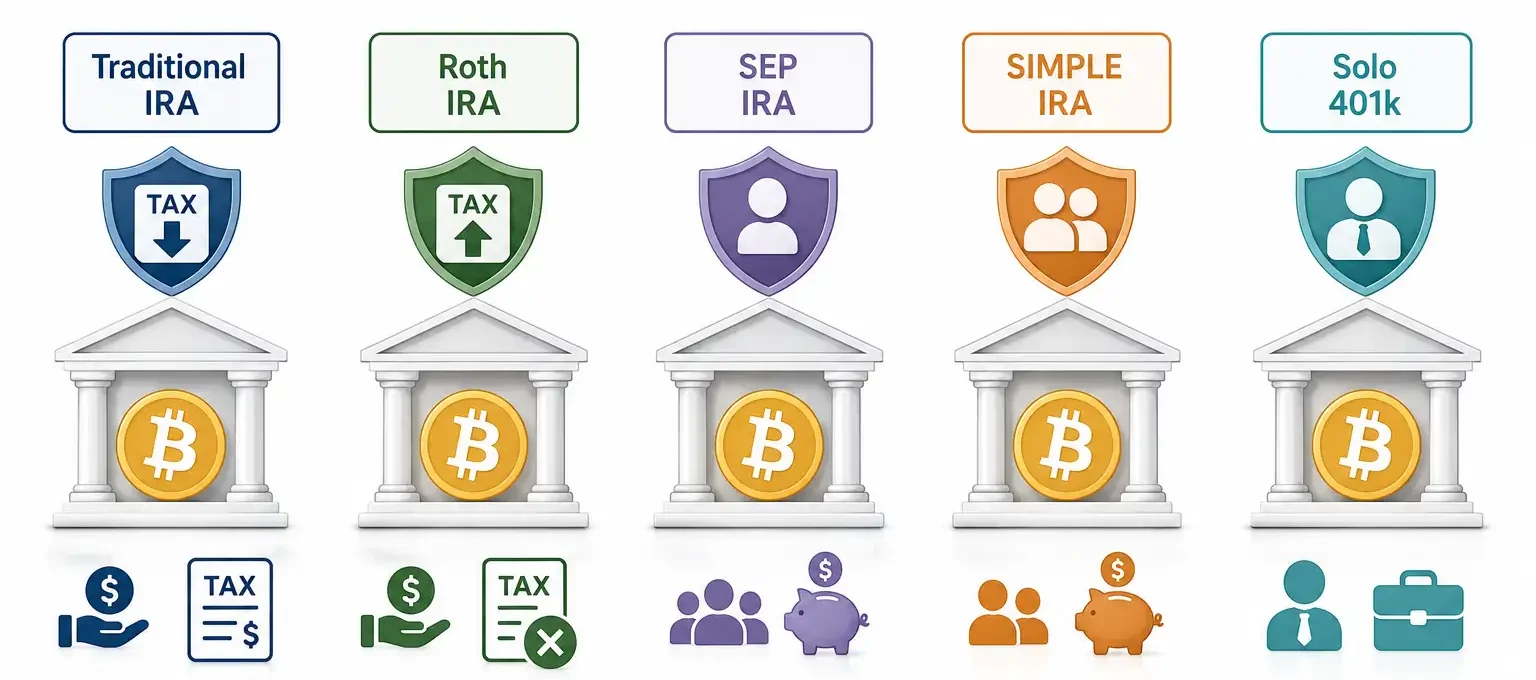
Bitcoin IRA account types: Traditional, Roth, SEP, SIMPLE, and Solo 401k
The tax structure of your Bitcoin IRA matters as much as which provider you choose. The same Bitcoin held in a Traditional IRA vs a Roth IRA can produce very different outcomes depending on your tax bracket now and in retirement.
Bitcoin Traditional IRA: tax-deferred growth and the RMD problem
A bitcoin Traditional IRA takes contributions from pre-tax income. You get a tax deduction in the year you contribute, and your Bitcoin grows without triggering capital gains while it stays in the account. You pay ordinary income tax on withdrawals at whatever tax rate applies in the year you take them. For Bitcoin specifically, the tax-deferred growth means you never owe tax on the appreciation until you withdraw, potentially decades later.
The catch with a Traditional IRA and Bitcoin is the Required Minimum Distribution rule. Starting at age 73, the IRS requires you to take minimum distributions from a Traditional IRA each year, calculated based on your account balance and life expectancy. If your Bitcoin is worth significantly more at 73 than when you contributed, those forced withdrawals mean selling Bitcoin at whatever price exists at the time, which may or may not align with a favorable point in the market cycle. You cannot skip RMDs to wait for a better price. This is a genuine structural risk of holding volatile assets in a Traditional IRA that does not apply to Roth.
Bitcoin Roth IRA: tax-free growth and why it suits Bitcoin
A bitcoin Roth IRA takes contributions from after-tax income. You get no deduction today, but qualified withdrawals in retirement are completely tax-free, including all gains. For an asset with Bitcoin’s potential for appreciation, this is a powerful advantage. Consider a concrete example: $10,000 invested in a bitcoin Roth IRA that grows to $500,000 over 20 years means zero tax on $490,000 in gains at withdrawal. The same growth in a taxable account would produce a significant capital gains bill, possibly at the highest long-term rate depending on your income.
Roth IRAs also have no Required Minimum Distributions. You are never forced to sell Bitcoin from a Roth IRA during your lifetime, which means you can hold through market downturns without a mandatory sale. Qualified withdrawals require the account to be at least 5 years old and the account holder to be at least age 59½. Income limits apply to Roth IRA contributions: in 2026, the phase-out begins at $146,000 for single filers and $230,000 for married filing jointly. For high earners above those limits, a backdoor Roth conversion is a widely used alternative. A bitcoin Roth IRA is generally the preferred structure for long-term holders who expect Bitcoin to appreciate significantly. How Bitcoin’s supply structure supports long-term appreciation through halvings is explained in the guide to Bitcoin halving.
SEP IRA and SIMPLE IRA: higher limits for business owners
A SEP IRA (Simplified Employee Pension) allows self-employed individuals and small business owners to contribute up to $66,000 per year or 25% of compensation, whichever is lower. That is far above the standard $7,000 annual limit for Traditional and Roth IRAs. A SEP IRA is funded entirely by the employer, contributions are tax-deductible, and the account follows Traditional IRA tax rules at withdrawal. Several Bitcoin IRA providers, including iTrustCapital, Swan, and BitcoinIRA, support SEP IRA structures.
A SIMPLE IRA (Savings Incentive Match Plan for Employees) applies to businesses with fewer than 100 employees. Contribution limits for 2026 are $16,000, rising to $19,500 for those 50 and older. SIMPLE IRAs require employer matching contributions. BitcoinIRA is one of the few crypto IRA providers that explicitly supports SIMPLE IRA accounts.
Solo 401k and Checkbook Control: maximum flexibility for the self-employed
A Solo 401k, also called an individual 401k or a bitcoin 401k in crypto contexts, is available to self-employed individuals with no full-time employees other than a spouse. Contribution limits for 2026 reach $69,000 (or $76,500 for those 50 and older) when combining employee and employer contributions, making it one of the highest-limit retirement vehicles available. Providers such as Broad Financial and Rocket Dollar support Solo 401k accounts that include Bitcoin and other crypto.
Checkbook Control is a structure that some Solo 401k and self-directed IRA users set up through a dedicated LLC. Instead of routing every transaction through a custodian, the IRA or 401k owns an LLC, and the LLC holds a checking account you control directly. This lets you move and invest funds without waiting for custodian processing. It requires careful legal setup to avoid IRS prohibited transaction rules, and any personal use of the funds would immediately disqualify the retirement account. Used correctly, it gives self-employed investors the most direct access to their retirement funds for alternative investments including Bitcoin.
Best Bitcoin IRA providers reviewed
The six providers below cover the major use cases in 2026. Fees, custody model, supported coins, and account types vary enough that the right choice depends heavily on what you are trying to accomplish.
iTrustCapital: best overall Bitcoin IRA
iTrustCapital consistently ranks as the best overall Bitcoin IRA provider from publications including Investopedia, Business Insider, Benzinga, and Digital Trends. The platform charges $0 in annual or monthly account fees and a clean 1% fee on every crypto transaction, making its cost structure easy to understand before you commit. Gold trades at $125 per ounce and silver at $3.95 per ounce within the same account.
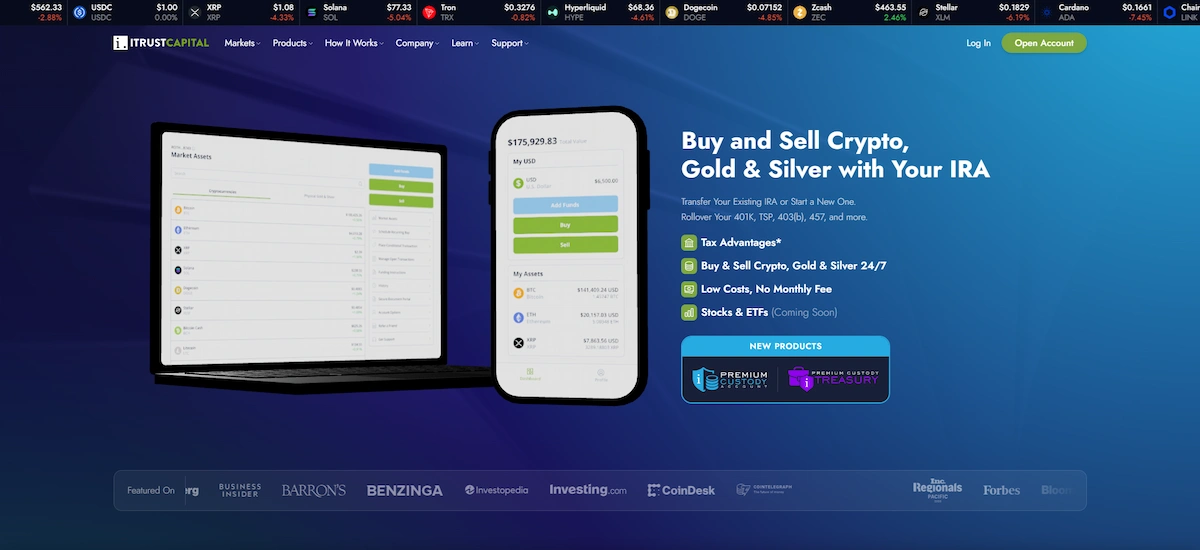
The platform supports more than 90 cryptocurrencies alongside physical gold and silver, all within a single self-directed IRA. Assets are held off-balance-sheet by institutional custodians including Coinbase Custody and Fireblocks, meaning your holdings are not treated as iTrustCapital’s own assets. The platform reports more than $16 billion in transactions across 200,000-plus accounts, and it is available in all 50 states including Puerto Rico. The minimum to open an account is $1,000. iTrustCapital also supports rollovers from 401(k), 403(b), 457, TSP, and pension accounts. New accounts that fund $1,000 or more receive a $100 bonus. How Bitcoin fits within a broader crypto diversification picture is explained in the guide to what is crypto.
Fidelity Crypto IRA: best for existing Fidelity users
Fidelity is the only major mainstream brokerage that offers a direct crypto IRA holding actual digital assets rather than fund shares. The account supports four cryptocurrencies: Bitcoin, Ethereum, Solana, and Litecoin. Custody is handled by Fidelity Digital Assets, with the majority of assets held in offline storage and a portion in online wallets for transaction processing. Fidelity offers Traditional, Roth, and Rollover IRA account types.

The trading fee is 1%, but it is structured as a spread rather than an explicit fee line, meaning you buy at a slightly higher price and sell at a slightly lower price than the current market. This can result in somewhat worse execution than a transparent percentage fee. Fidelity’s crypto IRA is not available in all US states, so checking eligibility before applying is worth doing. For anyone already managing their retirement savings at Fidelity who wants limited Bitcoin and Ethereum exposure without opening an account at a new provider, the fidelity bitcoin IRA is the simplest path. Fidelity also gives access to every spot Bitcoin ETF for users who prefer the fund route.
Unchained IRA: best for Bitcoin self-custody
Unchained IRA is the only Bitcoin IRA provider that gives account holders actual control over their private keys through a multisig vault structure. Most Bitcoin IRA providers hold your keys on your behalf through a custodian. Unchained uses a 2-of-3 multisig setup where you hold one key, Unchained holds one key, and a third key is held by a neutral party. This means neither Unchained nor any single custodian can unilaterally move your Bitcoin, and you have genuine self-custody participation in a compliant IRA structure.

The fee model is a flat $250 per year regardless of account size, which is competitive for large balances compared to percentage-based models. Trading costs 1.50% per transaction with a $2,000 minimum per trade. Optional services include a $895 concierge onboarding package and a $500 per month Signature Membership with dedicated support. Unchained covers Bitcoin only. The account holds the highest Google review rating among Bitcoin IRA providers. How cold storage and private key control work in practice is explained in the guide to cold wallets for crypto.
Swan IRA: best Bitcoin-only IRA with no minimum
Swan IRA partners with Equity Trust, one of the largest self-directed IRA custodians in the country with more than $65 billion in assets under custody and 50-plus years of experience. Swan holds Bitcoin only, which aligns with its founding philosophy that Bitcoin is the only crypto asset worth holding for long-term savings. There is no minimum investment, no setup fee, no Roth conversion fee, and no closure or transfer fee. The annual fee is 0.24% of assets (billed as 0.02% monthly with a $20 floor), and the trading fee is 1% to buy or sell.

Swan IRA is available in all 50 states, including New York and Texas, which some providers do not support. It does not currently support SEP or SIMPLE IRA types directly, though holders of those accounts can transfer to a Traditional IRA at Swan. For a long-term Bitcoin saver who wants the lowest possible barrier to entry, no minimum requirement, and a provider with no hidden fees, Swan is the strongest Bitcoin-only option.
BitcoinIRA: best for coin selection and 24/7 trading
BitcoinIRA launched in 2017 as one of the first platforms to offer a Bitcoin retirement account product, giving it the longest track record in the market. The platform supports more than 80 cryptocurrencies and allows 24/7 buying and selling, including on weekends when traditional markets are closed. Digital assets are custodied by BitGo Trust, a regulated trust company with $250 million in insurance coverage against theft, hacking, and misuse.

The fee structure is higher than most competitors: a 2% trading fee plus a 0.08% monthly maintenance fee. For a $100,000 account with moderate trading activity, the annual cost will typically exceed that of iTrustCapital or Swan. BitcoinIRA supports Traditional, Roth, SEP, and SIMPLE IRA types as well as Solo 401(k) accounts, giving it the broadest IRA type coverage on this list. The platform also offers auto-rebalancing and crypto bundle products for investors who want a diversified crypto portfolio in a single IRA.
Alto Crypto IRA: best for altcoin diversity
Alto Crypto IRA offers access to more than 60 cryptocurrencies through a Coinbase Custody integration, making it one of the more affordable starting points for investors who want a broad crypto mix. The account fee is $10 per month or $100 per year (which includes two free months), plus a 2% trading fee. Cash held in the account is protected by FDIC insurance up to $250,000, which is relevant if you are holding fiat between trades.
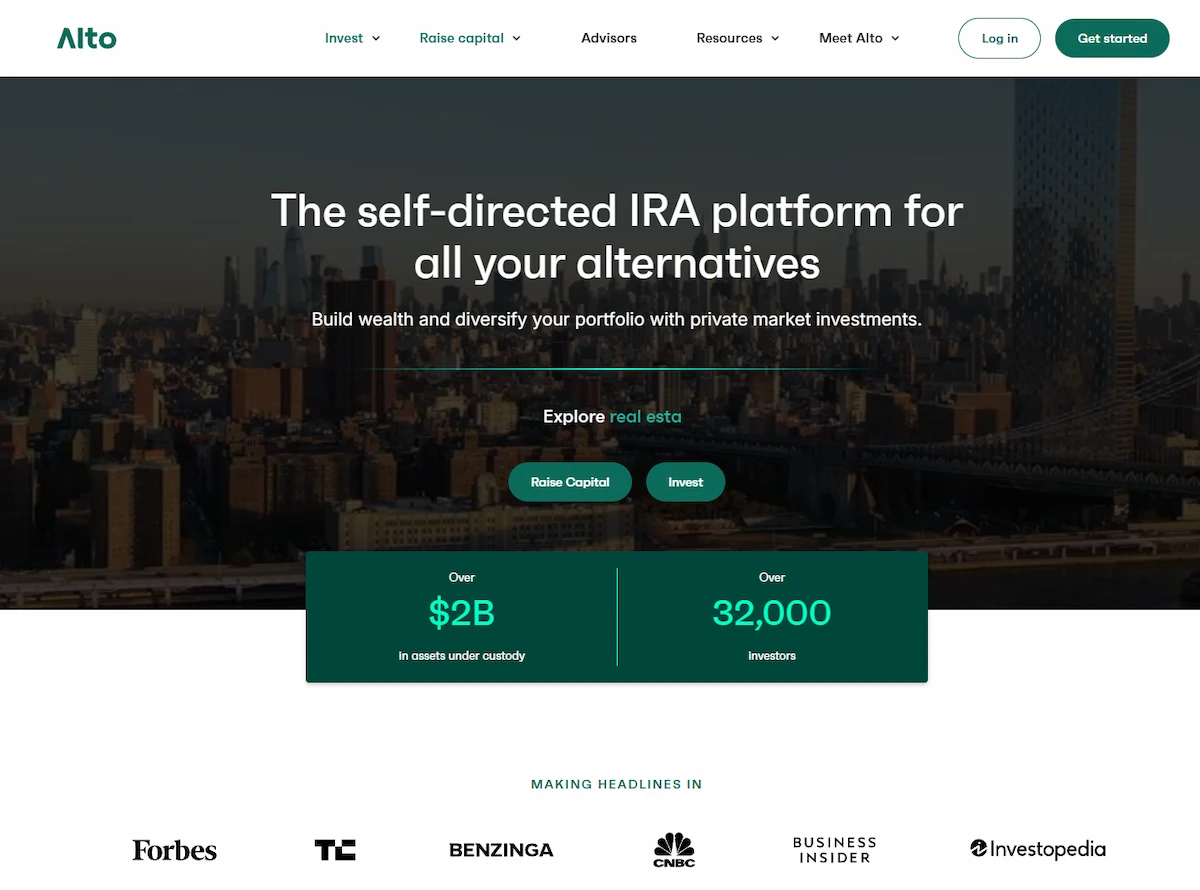
One important consideration for Alto users: the SEC has named more than 67 alternative cryptocurrencies as potential unregistered securities in enforcement actions. Many of those tokens are available through Alto’s IRA. Investors holding a broad altcoin basket in any crypto IRA should be aware that regulatory reclassification of those assets could affect their status within the account structure. Sticking to Bitcoin and Ethereum reduces that exposure significantly.
Bitcoin IRA fees: three categories that matter
Bitcoin IRA pricing is less straightforward than it looks because providers split charges across three different fee buckets. Looking at any one number in isolation gives a misleading picture of actual annual cost. The three buckets are: ongoing platform fees (annual or monthly charges just for having the account), trading fees (per-transaction percentage on every buy and sell), and optional onboarding or additional service costs. A provider with $0 platform fees and a 2% trading fee costs more than a provider with a $250 annual fee and a 1% trading fee for any active account.
| Provider | Annual / monthly fee | Trading fee | Setup fee | Min investment | Insurance |
|---|---|---|---|---|---|
| iTrustCapital | $0 | 1% | $0 | $1,000 | Institutional (Coinbase/Fireblocks) |
| Fidelity Crypto | $0 | 1% (spread) | $0 | None | Fidelity backing |
| Unchained IRA | $250/year flat | 1.50% | $895 optional | $2,000/trade | Self-custodial |
| Swan IRA | 0.24%/year | 1% | $0 | None | Equity Trust institutional |
| BitcoinIRA | 0.08%/month | 2% | $0 | None | $250M (BitGo Trust) |
| Alto Crypto IRA | $10/month or $100/year | 2% | $0 | None | $250K FDIC (cash only) |
| BitIRA | Not disclosed | 5% purchase / $0 sell | Not disclosed | $5,000 | Equity Trust |
BitIRA’s 5% purchase fee is one of the highest on the market and makes it one of the most expensive options for any active buyer. Fidelity’s spread-based model looks like a 1% fee but can result in execution at worse-than-market prices depending on liquidity conditions. Always model your likely annual cost based on your expected trading frequency, not just the lowest headline number.
Bitcoin ETF IRA vs self-directed Bitcoin IRA: which fits you?
The right choice between a Bitcoin ETF IRA and a self-directed Bitcoin IRA depends primarily on what you plan to do with the account. For a passive investor who wants Bitcoin exposure without managing custody or trading, the ETF route is cheaper and easier to set up in an account you may already have.
| Factor | Bitcoin ETF in standard IRA | Self-directed Bitcoin IRA |
|---|---|---|
| Annual cost | 0.20-0.25% expense ratio | 1-2% trading + platform fees |
| Setup | No new account needed | New custodian required |
| Custody | Fund manager holds Bitcoin | IRA custodian or you (self-custodial) |
| Withdraw as actual Bitcoin | No, cash only | Yes (with some providers) |
| Self-custody option | No | Yes (Unchained) |
| Coin selection beyond Bitcoin | Bitcoin only | 1 to 90+ depending on provider |
| Best for | Passive, long-term holders | Active traders, self-custody seekers |
Bitcoin ETFs you can buy in a standard IRA today
Every major US brokerage that supports IRA accounts also supports the spot Bitcoin ETFs approved in January 2024. You can buy these in any existing IRA without opening a new account or working with a specialized custodian.
| ETF | Issuer | Expense ratio | Ticker |
|---|---|---|---|
| iShares Bitcoin Trust | BlackRock | 0.25% | IBIT |
| Fidelity Wise Origin Bitcoin Fund | Fidelity | 0.25% | FBTC |
| ARK 21Shares Bitcoin ETF | Ark/21Shares | 0.21% | ARKB |
| Bitwise Bitcoin ETF | Bitwise | 0.20% | BITB |
| VanEck Bitcoin ETF | VanEck | 0.20% | HODL |
The cheapest options by expense ratio are BITB and HODL at 0.20% annually. IBIT from BlackRock has attracted the most assets and offers strong liquidity. All five are backed by actual Bitcoin held in institutional custody, so the underlying exposure is identical regardless of which you choose.
Which major brokerages support Bitcoin in an IRA?
| Brokerage | Direct Bitcoin IRA | Bitcoin ETF IRA | Notes |
|---|---|---|---|
| Fidelity | Yes (BTC, ETH, SOL, LTC) | Yes | Not all states; custody via Fidelity Digital Assets |
| Schwab | No | Yes | ETF only; no direct crypto IRA |
| Vanguard | No | No | Does not support either option currently |
| E*TRADE | No | Yes | ETF only |
| Robinhood | No | Yes | ETF only |
| IBKR | No | Yes | ETF only |
Fidelity is the only major mainstream brokerage offering a direct crypto IRA in 2026. Every other large brokerage supports Bitcoin ETFs in an IRA but not direct Bitcoin custody. Vanguard is the outlier that supports neither, reflecting its longstanding focus on index funds rather than alternative assets.
How to set up a Bitcoin IRA: step by step
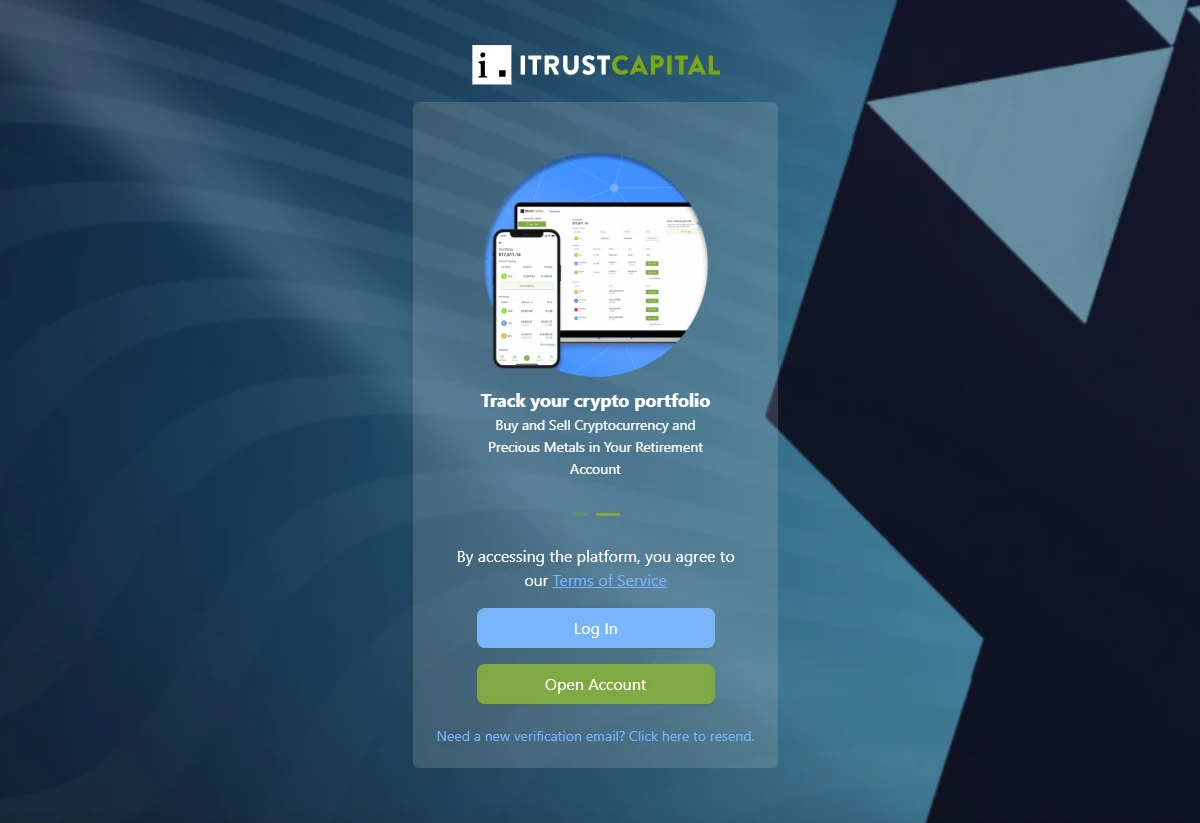
Opening a Bitcoin IRA takes longer than opening a standard brokerage account, primarily because of identity verification and the custodian setup process. Most providers complete the process within one to five business days.
- Choose your IRA type. Decide between Traditional, Roth, SEP, or another structure based on your tax situation and contribution goals. If unsure, a tax professional can help compare the after-tax outcomes for your specific income level and retirement timeline.
- Choose your provider. Match the provider to your priorities: low fees (iTrustCapital, Swan), self-custody (Unchained), coin selection (BitcoinIRA, Alto), or familiar brand (Fidelity).
- Open and verify your account. Complete the application, provide government-issued ID, and pass identity verification. Most providers complete verification within 24 hours.
- Fund the account. Options include a new cash contribution up to the annual limit, a direct rollover from an existing 401(k) or IRA, or an IRA-to-IRA trustee transfer from another provider.
- Buy Bitcoin. Once funded, place your purchase through the provider’s platform. Most platforms execute at or near the current market price plus their trading fee.
- Monitor and manage. You can trade within the account without triggering capital gains. Keep records of your cost basis for when you eventually take withdrawals, because those are taxable events for Traditional IRAs.
How to roll over a 401k or existing IRA to Bitcoin
Rolling an existing 401k rollover or traditional IRA into a Bitcoin IRA is tax-free and penalty-free when done correctly. The rollover amount does not count against your annual IRA contribution limit, meaning you can move a large employer retirement account balance into a Bitcoin IRA in a single transaction. The process typically takes one to three weeks from start to finish.
Direct rollover vs indirect rollover: the 60-day rule
A direct rollover sends funds straight from your old plan custodian to your new Bitcoin IRA custodian, with the money never touching your hands. This is the recommended approach because it avoids withholding and eliminates the risk of accidentally triggering a taxable distribution. The old custodian may require a letter of acceptance from the new custodian before releasing funds.
An indirect rollover sends the funds to you first. You then have 60 days to deposit those funds into the new IRA. The old plan is required to withhold 20% of the distribution for estimated taxes, so if your 401k had $100,000, you would receive $80,000 and would need to come up with the other $20,000 out of pocket to complete a full rollover. If you miss the 60-day window or cannot fund the full amount, the shortfall is treated as a taxable distribution with a 10% early withdrawal penalty if you are under 59½. The direct rollover avoids all of these complications and is the standard recommendation from every major provider.
IRA-to-IRA transfer: moving to a Bitcoin IRA without the 60-day clock
Moving from one IRA to another, for example from a Fidelity Traditional IRA holding stocks to an iTrustCapital Bitcoin IRA, is handled as a trustee-to-trustee transfer rather than a rollover. In a trustee-to-trustee IRA transfer, the funds move directly between custodians and never touch your personal accounts. There is no 60-day deadline, no 20% withholding, and no limit on how many transfers you can make in a year. This is the simplest way to move an existing IRA balance into a Bitcoin IRA. Contact the new provider to initiate the transfer outgoing authorization; they will handle the paperwork with the existing custodian.
Are Bitcoin IRAs safe and regulated?
The IRS has recognized Bitcoin as property since 2014, and self-directed IRAs that hold alternative assets including Bitcoin have a long regulatory history predating crypto. A Bitcoin IRA held through an IRS-approved custodian is a legal and regulated structure. What is not regulated by the IRS is the investment itself: Bitcoin remains highly volatile, and no government agency guarantees its value or protects against market losses. IRS prohibited transaction rules also apply: you cannot use IRA-held Bitcoin for personal benefit before a qualifying distribution, and violations can disqualify the entire account with immediate tax consequences.
Custody models: cold storage and multisig explained
Every reputable Bitcoin IRA provider holds the majority of customer assets in cold storage, meaning the private keys are kept offline and cannot be accessed through an internet connection. A subset of assets may be held in online wallets for processing transactions, but major providers keep this to a small fraction of total holdings. Multisig custody requires multiple private key holders to approve any transaction, so a single compromised key cannot drain the account. Coinbase Custody, Fireblocks, BitGo Trust, Fidelity Digital Assets, and Equity Trust all use institutional-grade cold storage and multisig setups for the Bitcoin held on behalf of IRA customers. Keeping your own seed phrase securely stored is equally important for the self-custodial Unchained model, where you hold one of the multisig keys directly. Best practices for storing a seed phrase offline are covered in the guide to crypto seed phrase storage.
Insurance coverage across Bitcoin IRA providers
Insurance amounts and what they cover vary significantly across providers. The key distinction is between crime insurance, which covers theft and hacking, and FDIC protection, which covers only cash deposits at insured banks.
- iTrustCapital: Institutional coverage through Coinbase Custody and Fireblocks; assets held off-balance sheet
- BitcoinIRA: $250 million insurance through BitGo Trust (theft, hacking, and misuse)
- Unchained IRA: User holds one key in multisig; risk is distributed rather than insured by a single party
- Swan IRA: Institutional coverage through Equity Trust
- Alto Crypto IRA: FDIC protection up to $250,000 for cash balances only; crypto is not FDIC-insured
- Fidelity: Covered by Fidelity’s own institutional security; no explicit dollar amount published
What happens if a Bitcoin IRA provider fails?
The critical factor determining what happens to your Bitcoin if a provider becomes insolvent is whether your assets are held off-balance-sheet in segregated accounts or on-balance-sheet as part of the provider’s own assets. Off-balance-sheet custody means your Bitcoin is legally yours, held in trust, and cannot be claimed by the provider’s creditors if the company fails. On-balance-sheet treatment, where customer assets are commingled with company assets, is what caused customer losses when exchanges like FTX collapsed in 2022.
Every provider on this list uses off-balance-sheet, segregated custody structures, which means a provider’s financial failure should not directly threaten your Bitcoin holdings. The practical process would involve the custodian transferring your assets to another qualified custodian or distributing them to you directly. FDIC does not protect cryptocurrency. Asking a provider directly whether customer assets are held off-balance-sheet in a qualified custodian trust is a reasonable verification step before opening an account. The broader differences between custodial and non-custodial arrangements are covered in the guide to custodial vs non-custodial wallets.
Bitcoin IRA tax rules and contribution limits
The tax treatment of a Bitcoin IRA depends on the account type and your actions within the account. Understanding both the benefits and the constraints is necessary before contributing.
2026 IRA contribution limits
| Account type | 2026 limit (under 50) | 2026 limit (age 50+) | Notes |
|---|---|---|---|
| Traditional IRA | $7,000 | $8,000 | Income deduction limits may apply |
| Roth IRA | $7,000 | $8,000 | Income limits apply; phase-out begins at $146K single / $230K married |
| SEP IRA | $66,000 | $66,000 | Or 25% of compensation, whichever is lower |
| SIMPLE IRA | $16,000 | $19,500 | Employer match required |
| Solo 401k | $69,000 | $76,500 | Combined employee + employer contributions |
Rollovers from existing 401(k) or IRA accounts do not count toward these annual contribution limits. A rollover of any size is permitted on top of the annual limit.
No capital gains tax on trades inside a Bitcoin IRA
Every trade inside a bitcoin IRA, whether buying, selling, or swapping between assets, is not a taxable event while the assets remain in the account. This is the primary tax advantage over holding Bitcoin in a taxable account. Consider a specific example: you buy Bitcoin at $50,000 inside your IRA, it rises to $150,000, you sell and hold cash, then rebuy at $110,000. In a taxable account, the sale at $150,000 triggers a $100,000 capital gain. In the IRA, no tax is owed until you take a withdrawal, and in a Roth IRA, no tax is ever owed on that gain. The annual block reward that drives Bitcoin’s supply and affects its long-term price dynamics is explained in the guide to Bitcoin block reward.
Withdrawal rules and Required Minimum Distributions
Withdrawals from a Traditional Bitcoin IRA before age 59½ are subject to a 10% penalty plus ordinary income tax on the full withdrawal amount. After age 59½, withdrawals are taxed as ordinary income with no penalty. Roth IRA withdrawals of contributions (not gains) can be taken at any age without penalty. Roth earnings can be withdrawn tax-free after age 59½ and the 5-year rule is met.
Traditional IRAs require Required Minimum Distributions starting at age 73. The RMD amount is calculated each year based on your account balance and IRS life expectancy tables. For a Bitcoin IRA, this means selling a calculated portion of your Bitcoin each year regardless of market conditions. If Bitcoin is in a bear market when an RMD is due, you are required to sell at the lower price. Roth IRAs have no RMDs, making them generally more flexible for long-term Bitcoin holdings. Some self-directed IRA providers allow in-kind Bitcoin distributions rather than cash, meaning you can receive the actual Bitcoin rather than selling it first, but this is not available at all providers.
Who should open a Bitcoin IRA and who should not
A Bitcoin IRA is not the right structure for everyone. The fee overhead and long-term lock-in make it most valuable in specific situations.
Bitcoin IRA is likely a good fit if you:
- Hold Bitcoin as a long-term investment and want to defer or eliminate capital gains taxes
- Trade Bitcoin actively and want to avoid triggering taxable events on each trade
- Are self-employed with a high income and want to use a SEP IRA or Solo 401k for larger contributions
- Want to roll over a 401(k) from a former employer into a tax-advantaged Bitcoin position
- Want actual Bitcoin ownership at retirement, including the option to withdraw as BTC rather than cash
- Are a Bitcoin maximalist who wants self-custody even within a retirement structure (Unchained IRA)
Bitcoin IRA is probably not a good fit if you:
- Have a small starting balance where annual fees represent a high percentage of your investment
- Need access to your funds before age 59½, since early withdrawals trigger a 10% penalty
- Are satisfied with Bitcoin ETF exposure through a brokerage you already use, which costs significantly less
- Are not comfortable with volatility in a retirement account you plan to draw down on a fixed schedule
- Are comparing providers who market “IRS-approved” or “IRA-approved” crypto investments. No such classification exists. These are marketing terms, not legal designations, and providers using this language should be approached with skepticism.
Frequently asked questions
What is the best Bitcoin IRA in 2026?
iTrustCapital is the best overall Bitcoin IRA for most investors in 2026, based on its combination of zero platform fees, a transparent 1% trading fee, 90-plus asset options, and institutional custody through Coinbase and Fireblocks. It has received the best overall designation from Investopedia, Business Insider, and Benzinga independently. For Bitcoin-only investors, Swan IRA offers strong value with no minimum and flat, transparent fees. For self-custody, Unchained IRA is the only option that lets you hold your own keys within a compliant IRA structure.
Can I roll over my 401k into a Bitcoin IRA?
Yes. A 401k rollover to a Bitcoin IRA is tax-free and penalty-free when done as a direct rollover, where funds transfer directly between custodians without passing through your personal accounts. The process typically takes one to three weeks. The rollover amount does not count toward the annual IRA contribution limit, so you can roll over any size balance on top of your regular annual contributions. Most Bitcoin IRA providers, including iTrustCapital, Swan, and BitcoinIRA, have dedicated rollover teams to guide the process.
Is a Bitcoin Roth IRA better than a Traditional IRA for Bitcoin?
For most long-term Bitcoin holders, a bitcoin Roth IRA is the more favorable structure because it produces entirely tax-free withdrawals on all gains, has no Required Minimum Distributions, and lets you keep Bitcoin in the account for as long as you live without forced sales. A Traditional IRA makes sense if you are in a high tax bracket now and expect to be in a lower bracket in retirement, or if your income exceeds the Roth IRA phase-out limits and you have not set up a backdoor Roth. For Bitcoin specifically, the RMD requirement in a Traditional IRA creates a risk of forced sales at inopportune times that the Roth avoids entirely.
What is the minimum to open a Bitcoin IRA?
Swan IRA has no minimum investment requirement and no minimum trade size for new accounts. iTrustCapital requires $1,000 to open an account. Unchained IRA has no account minimum but requires a $2,000 minimum per trade. BitIRA requires a $5,000 initial deposit. Fidelity and Alto have no stated minimums. For investors starting with a small balance, Swan and iTrustCapital offer the most accessible entry points.
Is a Bitcoin IRA safe?
A Bitcoin IRA through a reputable provider with off-balance-sheet, segregated custody is structurally safe from provider insolvency. Your Bitcoin is legally yours, held in trust by an IRS-approved custodian, and cannot be claimed by the provider’s creditors if the company fails. Reputable providers use cold storage and multisig custody to protect against hacking. Insurance coverage ranges from $250 million at BitcoinIRA through BitGo Trust to institutional arrangements at iTrustCapital and Swan. What is not safe is the Bitcoin itself: the asset is volatile and can lose significant value. No IRA structure protects against market risk.
Can I hold Bitcoin directly in a Fidelity IRA?
Yes, Fidelity offers a direct crypto IRA that holds actual Bitcoin, Ethereum, Solana, and Litecoin. Custody is handled by Fidelity Digital Assets with the majority of assets in offline storage. The trading fee is 1%, applied as a spread rather than an explicit charge. The fidelity bitcoin IRA supports Traditional, Roth, and Rollover account types. It is not available in all US states, and new applicants should confirm eligibility at the time of application. Fidelity also offers access to all spot Bitcoin ETFs for users who prefer the fund route over direct custody.
Can I withdraw actual Bitcoin from a Bitcoin IRA?
Whether you can withdraw actual Bitcoin rather than cash depends on your provider. Self-directed IRA providers, including Unchained and Swan, allow in-kind Bitcoin distributions, meaning you receive the Bitcoin itself when you take a qualifying distribution rather than a cash equivalent. Bitcoin ETF IRAs at standard brokerages only allow cash withdrawal because you own fund shares, not Bitcoin directly. For investors who plan to use their retirement Bitcoin as an actual Bitcoin holding rather than liquidating it for fiat, confirming that your provider supports in-kind distributions is an important step before committing to a particular platform.
Sources
- Best Bitcoin IRAs in 2026, TokenTax
- 3 Best Bitcoin IRAs for 2026, Bitbo