Bitcoin dominance is the percentage of the total cryptocurrency market capitalization that Bitcoin represents. If the entire crypto market is worth $3 trillion and Bitcoin accounts for $1.7 trillion of that, Bitcoin dominance sits at roughly 57%. Every other coin, token, and stablecoin in existence makes up the remaining 43%.
Traders and investors watch this number because it tells them something that price charts alone cannot: where capital is actually moving. Is money flowing into Bitcoin, or is it rotating into altcoins? That single question shapes portfolio decisions, risk management, and timing across the entire market.
This guide covers what Bitcoin dominance is, how the formula works, how to read the BTC.D chart, the four scenarios that matter for trading decisions, how dominance behaves across market cycles, and where the metric falls short.
What Is Bitcoin Dominance
Bitcoin dominance (BTC.D) measures Bitcoin’s share of the total value of the cryptocurrency market. It does not measure Bitcoin’s price, its trading volume, or how many people are buying it. It measures one thing: how much of the entire market’s value belongs to Bitcoin compared to everything else combined.

Think of the global crypto market as a single pie. BTC.D tells you exactly how large Bitcoin’s slice is. When that slice grows, capital is concentrating in Bitcoin. When it shrinks, money is moving into altcoins, stablecoins, or newer projects.
This matters for a straightforward reason. In traditional finance, investors rotate between growth assets and defensive assets depending on their confidence in the market. In crypto, Bitcoin plays the role of the defensive, established asset. When uncertainty rises, capital moves toward Bitcoin. When confidence returns and risk appetite picks up, money flows outward into altcoins chasing higher returns. BTC.D tracks that rotation in real time.
How Bitcoin Dominance Is Calculated
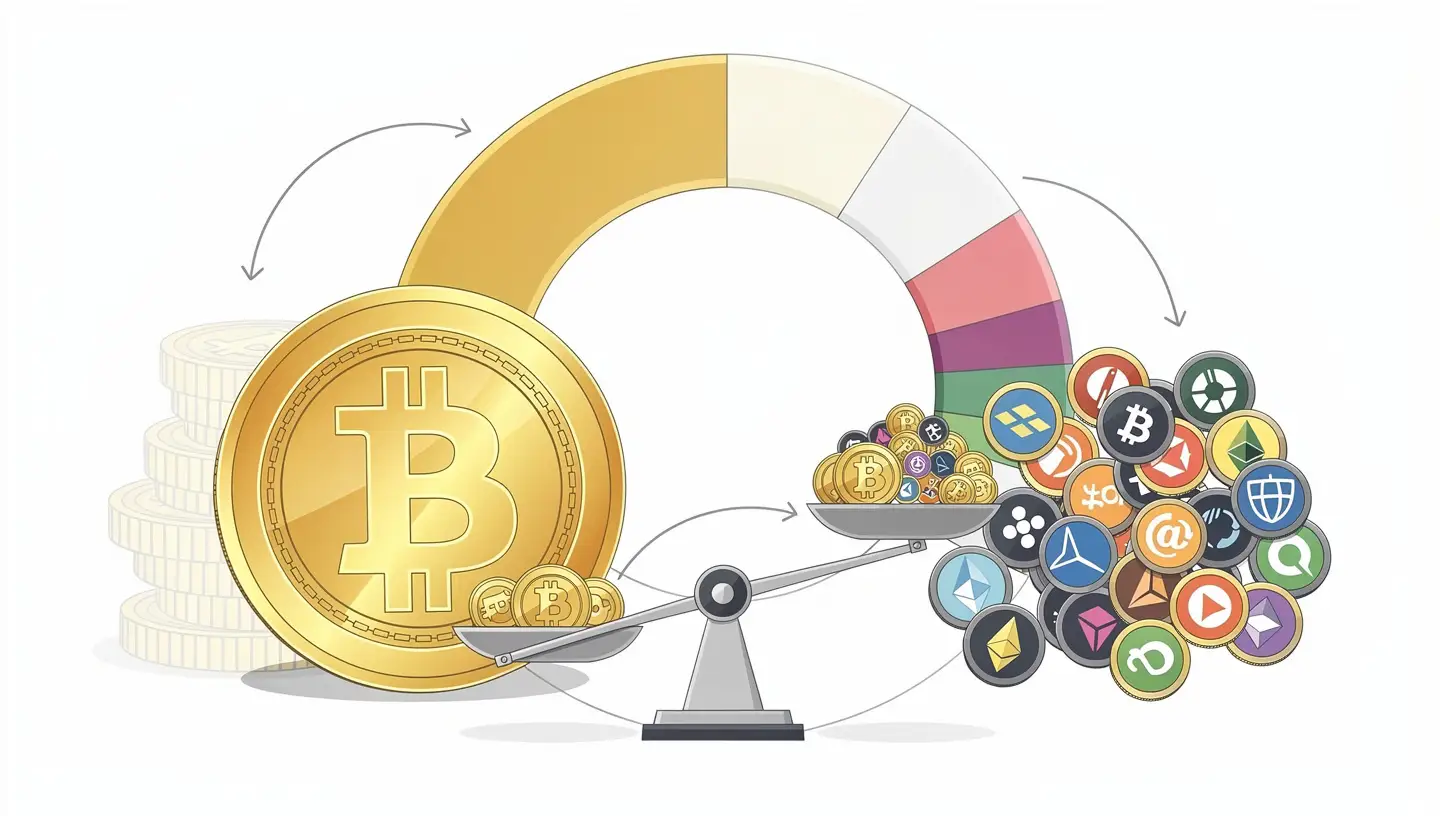
The formula is simple:
Bitcoin Dominance (%) = (Bitcoin Market Cap / Total Crypto Market Cap) x 100
Market capitalization for any cryptocurrency is calculated by multiplying its current price by the number of coins in circulating supply. For Bitcoin, you take the current BTC price and multiply it by the number of bitcoins that have been mined and are actively available on the market. The same calculation runs across every other cryptocurrency. Add all of those market caps together and you get the total crypto market cap.
For example: if Bitcoin’s market cap is $1.6 trillion and the total crypto market cap is $2.8 trillion, Bitcoin dominance is 57.1%.
One important detail: dominance changes constantly as prices move, not just when Bitcoin’s price changes. If altcoin prices fall sharply while Bitcoin holds steady, Bitcoin dominance rises even though Bitcoin itself did nothing. This asymmetry is one reason the metric is useful and also one reason it can be misread.
Why BTC.D Is Not the Same as Bitcoin’s Price
This is one of the most common points of confusion. Bitcoin’s price and Bitcoin dominance move independently of each other and sometimes in opposite directions.
Bitcoin’s price can rise sharply while dominance falls, if altcoins are rising faster. Bitcoin’s price can fall while dominance rises, if altcoins are falling harder. A green candle on the BTC.D chart does not mean Bitcoin’s price went up. It means Bitcoin grew its share of the total market relative to everything else.
Reading both charts together gives you a much clearer picture of what is actually happening than reading either one alone.
Bitcoin Dominance History: From 100% to Today
The history of Bitcoin dominance is the history of how the cryptocurrency market expanded from a single asset into a market of thousands. Each major shift in dominance corresponds to a specific market event or structural change in the industry.
2009-2016: Bitcoin Held the Entire Market
When Bitcoin launched in January 2009, its dominance was 100% by definition. There was no other cryptocurrency in existence. Early alternatives like Namecoin and Peercoin had negligible liquidity and posed no real challenge to Bitcoin’s position. Bitcoin held above 90% dominance through most of this period simply because it was the only asset with meaningful adoption and trading volume.
Litecoin launched in 2011, Ripple in 2012, Dogecoin in 2013. Each new coin chipped away at Bitcoin’s share, but the impact remained small until Ethereum changed the picture entirely.
2017: The ICO Boom and the First Big Drop
The most dramatic single-year shift in Bitcoin dominance history happened in 2017. Ethereum’s ERC-20 token standard allowed anyone to launch a cryptocurrency without building a blockchain from scratch. This triggered the Initial Coin Offering boom, where thousands of projects raised billions of dollars by selling new tokens to retail investors.
Capital flooded into these new projects. Bitcoin dominance fell from roughly 85% in January 2017 to below 40% by January 2018, the first major altcoin season on record. The market had experienced its first real structural diversification. Understanding how Bitcoin differs from other cryptocurrencies helps explain why capital still anchors back to BTC after every altcoin cycle.
2018-2019: Bear Market Pushes Dominance Back to 70%
The bear market that followed the 2017 ICO boom wiped out the majority of the tokens created during that period. Most projects lost 90% or more of their value. Many disappeared entirely. As retail investors pulled back from speculative altcoins and institutions began treating Bitcoin as the primary entry point into crypto, Bitcoin dominance climbed back toward 70% by mid-2019.
This period established a pattern that has repeated since: when the market turns bearish, capital concentrates back into Bitcoin as the most established and liquid asset. Altcoins bear the brunt of sell-offs first and hardest.
2020-2021: DeFi, NFTs and the Second Major Drop
The COVID-19 pandemic triggered a wave of economic stimulus that eventually found its way into risk assets, including crypto. But the more significant driver of Bitcoin dominance falling again was the rise of decentralized finance (DeFi). Platforms like Uniswap, Aave, and Compound offered yield farming and liquidity mining, attracting billions in capital to Ethereum-based tokens.
Simultaneously, NFTs brought a new class of buyer into the market, stablecoins grew from a niche tool to a core part of crypto infrastructure, and memecoins like Dogecoin and Shiba Inu captured attention from mainstream media. Bitcoin dominance fell from roughly 70% in early 2020 to approximately 40% by mid-2021 as capital spread across this expanding set of assets.
2022-2023: Crypto Winter and the Recovery
The crypto winter of 2022 was triggered by rising interest rates, the collapse of the Terra/Luna ecosystem in May 2022, and the FTX bankruptcy in November 2022. Over $40 billion in market cap evaporated in the Terra collapse alone.
What made this bear market different from 2018-2019 was that Bitcoin dominance did not recover as sharply, never exceeding 50% during the downturn. This reflected a more mature market where even in a crisis, capital did not concentrate entirely back into Bitcoin. Stablecoins absorbed much of the defensive positioning that Bitcoin had captured in the previous cycle.
2024-2025: Institutional Capital and Where Dominance Stands Now
The approval of spot Bitcoin ETFs in the United States in January 2024 marked a structural shift. Institutional investors who had previously had limited access to Bitcoin gained a regulated, familiar vehicle. This drove significant capital into Bitcoin specifically, not into the broader crypto market, pushing dominance back toward the 55-60% range.
The Bitcoin halving in April 2024 reinforced this by reducing the rate of new Bitcoin supply entering the market. As of 2025, Bitcoin dominance fluctuates in the 55-60% range, reflecting both institutional preference for Bitcoin and the continued growth of the altcoin market. For a deeper look at how supply reduction affects Bitcoin’s position, the mechanics of the Bitcoin block reward explain the underlying supply structure.
How to Read the Bitcoin Dominance Chart
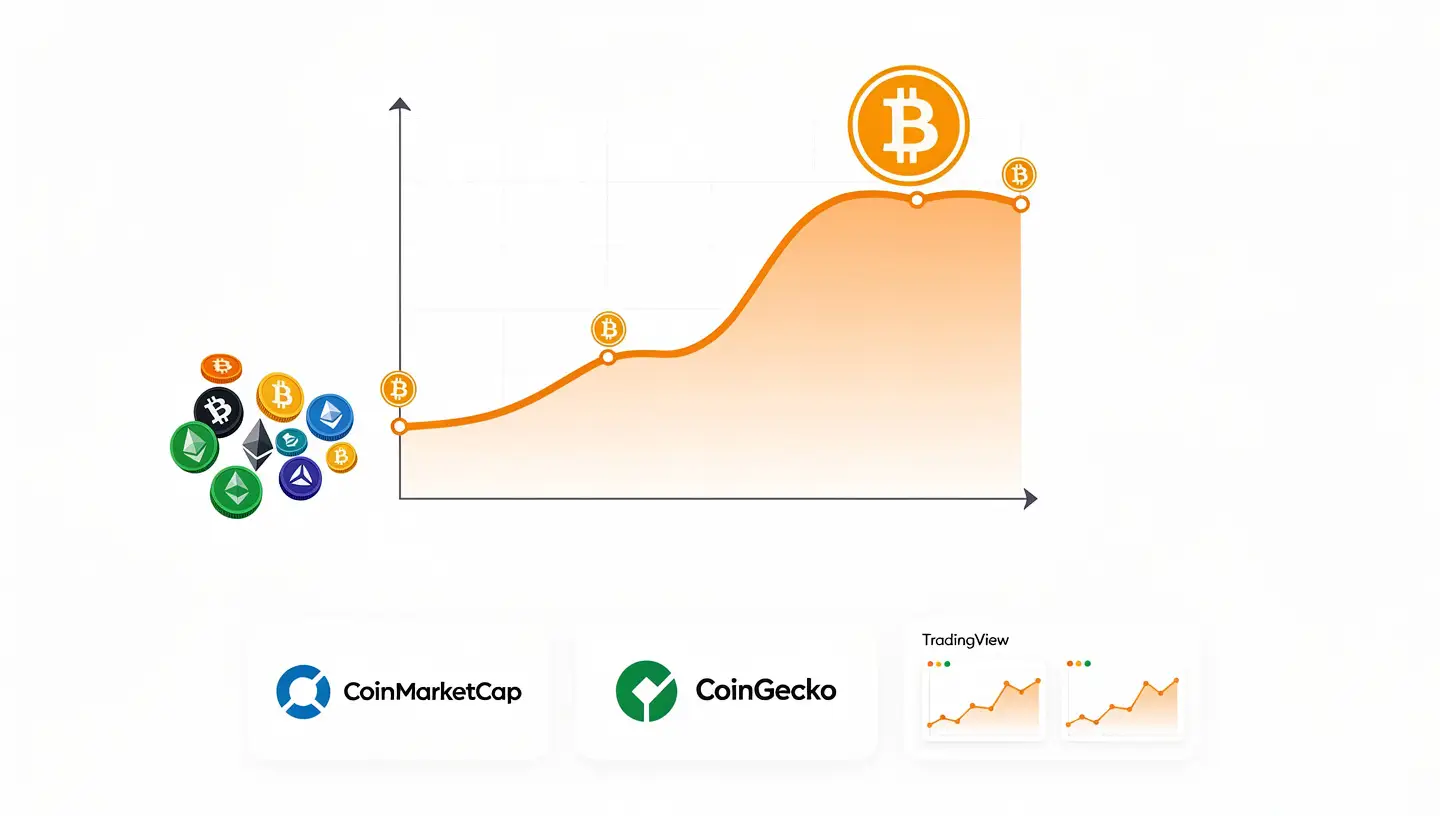
The BTC.D chart displays Bitcoin’s market share as a percentage over time. Time runs along the horizontal axis, dominance percentage along the vertical. Unlike a price chart, there is no absolute target or ceiling that represents “up” being good. What matters is the direction and context of the movement.
Where to Find the BTC.D Chart
The three main platforms for tracking Bitcoin dominance live are CoinMarketCap, CoinGecko, and TradingView. Each shows the BTC.D chart with adjustable timeframes from 24 hours to all-time history. TradingView allows overlaying other indicators on top of the dominance chart, which is useful for traders combining BTC.D with RSI or volume data.
Why CoinMarketCap and CoinGecko Show Different Numbers
If you check Bitcoin dominance on CoinMarketCap and then check CoinGecko, you will likely see different percentages. The reason is methodology, specifically how each platform handles stablecoins.
CoinMarketCap includes stablecoins like USDT and USDC in the total market cap calculation. Because stablecoins represent a large and growing portion of the market, their inclusion lowers Bitcoin’s apparent dominance. CoinGecko offers a view that excludes stablecoins, which produces a higher dominance number for Bitcoin.
Neither is wrong. They are answering slightly different questions. The important thing is to use the same platform consistently when tracking changes over time, so you are comparing the same methodology to itself rather than mixing numbers.
Rising Dominance: What It Means
When Bitcoin dominance rises, capital is moving toward Bitcoin relative to the rest of the market. This typically happens in one of two situations.
First, during periods of uncertainty or declining prices, investors sell altcoins and move into Bitcoin as the most established and liquid asset. This is often called capital flight from altcoins. Second, during early bull markets, Bitcoin tends to lead the move upward before capital rotates into altcoins, causing dominance to rise initially even in a positive market environment.
Rising dominance alongside falling total market cap is generally a bearish signal for altcoins. Rising dominance alongside rising total market cap often signals the early phase of a bull cycle before the altcoin rotation begins.
Falling Dominance: What It Means
When Bitcoin dominance falls, capital is rotating into altcoins. Investors are taking profits from Bitcoin or deploying new capital into smaller projects chasing higher percentage returns. This is the environment that produces altcoin season, when a broad range of altcoins outperform Bitcoin over a sustained period.
Falling dominance in a rising total market is the classic altcoin season setup. Falling dominance in a declining total market is more complex: it can mean stablecoins are absorbing the outflows rather than altcoins gaining genuine momentum.
Flat Dominance: The Signal Everyone Ignores
When the BTC.D chart moves sideways for an extended period, it signals that neither Bitcoin nor altcoins are gaining ground relative to the other. The market is in balance or in a state of uncertainty where no clear rotation is happening.
Flat dominance periods are worth watching closely because they often precede a sharp move in one direction. A breakout upward signals renewed preference for Bitcoin. A breakdown downward signals the start of altcoin momentum. Traders who identify the flat range early can position ahead of the move.
Sudden Spikes and Drops: How to Tell Panic from Trend
A sudden spike in Bitcoin dominance on a short timeframe, such as a single day or week, typically reflects panic selling in altcoins rather than genuine conviction in Bitcoin. When markets crash sharply, altcoins tend to fall faster and harder than Bitcoin, mechanically pushing dominance up without any active buying of Bitcoin.
A gradual, sustained rise in dominance over weeks or months reflects genuine capital rotation and is a more meaningful signal. The same logic applies to drops. A sudden dominance drop may reflect a single large altcoin event, like a major token launch or exchange listing, rather than a structural shift in where capital is going.
BTC.D vs Bitcoin Price: The Four Scenarios That Actually Matter
Reading BTC.D in isolation is less useful than reading it alongside Bitcoin’s price. The combination of where dominance is moving and where Bitcoin’s price is moving produces four distinct scenarios, each with a different implication for the broader market.
| Scenario | BTC.D | Bitcoin Price | What It Means | Implication for Altcoins |
|---|---|---|---|---|
| 1 | Rising | Rising | Bitcoin is leading a bull market. Capital is entering crypto through Bitcoin first. | Altcoins may lag or underperform Bitcoin. Early bull market phase, rotation into altcoins has not started yet. |
| 2 | Rising | Falling | Market is in a risk-off phase. Investors are selling altcoins and moving into Bitcoin as a safer position. | Altcoins are falling faster than Bitcoin. Bearish for the broad market. |
| 3 | Falling | Rising | Classic altcoin season setup. Bitcoin is rising but altcoins are rising faster, pulling capital away from BTC. | Altcoins outperforming Bitcoin. High-risk, high-return environment. Rotation is in full effect. |
| 4 | Falling | Falling | Broad market sell-off. Capital is leaving crypto entirely, likely moving into stablecoins or fiat. | Altcoins falling faster than Bitcoin. Dominance falls not because altcoins are doing well but because stablecoins are absorbing the exits. |
Scenario 3 is what most traders are watching for when they talk about altcoin season. Scenario 2 is the most damaging for altcoin holders. Scenario 4 is often misread as bullish for altcoins when it is actually the worst environment of the four.
Bitcoin Dominance and Market Cycles
Bitcoin dominance does not move randomly. It follows recognizable patterns tied to the broader crypto market cycle, and understanding those patterns gives investors a framework for reading where the market might be heading.
Bitcoin Dominance in Bull Markets
Bull markets typically follow a two-phase pattern in terms of Bitcoin dominance. In the first phase, Bitcoin leads the move upward. New capital entering the market tends to go into Bitcoin first because it is the most recognized and accessible asset. During this phase, BTC.D rises or holds steady even as the total market cap increases.
In the second phase, as confidence grows and Bitcoin’s gains attract attention, investors begin rotating profits into altcoins seeking larger percentage returns. This is when dominance starts falling and altcoin season begins. The transition between these two phases is one of the most closely watched signals in crypto trading.
To understand what drives new capital into Bitcoin specifically during these periods, the fundamentals of Bitcoin’s design and scarcity play a central role.
Bitcoin Dominance in Bear Markets
Bear markets compress the entire crypto market but they compress altcoins harder. When prices fall broadly, smaller and less liquid assets fall furthest and fastest. Bitcoin, as the most liquid and most established asset, typically retains more of its value in relative terms.
This mechanical dynamic pushes BTC dominance higher during market downturns even when Bitcoin itself is falling in absolute price. Investors who understand this pattern reduce altcoin exposure when dominance starts rising during a declining market, rotating into Bitcoin or stablecoins to preserve capital.
The relationship between Bitcoin and altcoin performance during downturns is closely tied to understanding how crypto markets function at a structural level.
Bitcoin Dominance and the Halving Cycle
The Bitcoin halving reduces the rate at which new Bitcoin enters supply roughly every four years. Historically, the halving has been followed by a period of Bitcoin price appreciation that then triggers a broader bull market, eventually leading to an altcoin season and a corresponding fall in Bitcoin dominance.
The 2020 halving was followed by Bitcoin reaching new all-time highs in late 2020, then a broad altcoin rally through 2021 that dropped dominance below 40%. The 2024 halving followed a similar early pattern, with Bitcoin ETF inflows keeping dominance elevated for longer than previous cycles before the typical rotation began.
This halving-to-dominance-drop pattern is not guaranteed to repeat identically, but it provides a rough roadmap for how capital tends to flow across a full crypto market cycle.
How Traders Use Bitcoin Dominance
BTC.D is most useful as a macro indicator that sits alongside price charts rather than replacing them. Traders who use it effectively treat it as a lens for understanding where the market is in its cycle, not as a buy or sell signal on its own.
Portfolio Rebalancing Based on Dominance
One practical use of Bitcoin dominance is portfolio rebalancing. When dominance climbs above historical averages, it signals that Bitcoin is outperforming the broader market. A portfolio holding a significant weight in altcoins during this period is likely underperforming. Shifting allocation toward Bitcoin aligns the portfolio with where capital is actually flowing.
When dominance drops below historical averages and the total market cap is rising, altcoins are gaining momentum. This is when diversifying into quality altcoins has historically produced stronger returns. The key word is quality: altcoin season lifts many assets, but projects with genuine use cases tend to hold their gains better when the cycle turns.
For anyone managing crypto across different wallet types, understanding the mechanics of how to sell crypto at different market phases is a practical extension of this rebalancing approach.
Using BTC.D Alongside Other Indicators
Bitcoin dominance works best when combined with other market indicators rather than used in isolation. The most common pairings are:
- Total market cap: Confirms whether dominance is moving due to Bitcoin strength or altcoin weakness.
- RSI on the BTC.D chart: Identifies overbought or oversold conditions in dominance itself, helping time rotations.
- Trading volume: A dominance move with high volume is more meaningful than one with thin volume.
- Fear and Greed Index: Extreme fear often coincides with rising dominance. Extreme greed often precedes a dominance drop as retail capital chases altcoins.
No single indicator tells the full story. BTC.D is one piece of a larger puzzle.
Key Levels on the BTC.D Chart: 40%, 50%, 60%, 70%
Traders track specific percentage levels on the BTC.D chart as historical support and resistance zones:
- 70%: Has historically marked a ceiling for Bitcoin dominance in the current market structure. When dominance approaches 70%, it has tended to reverse, signaling that altcoin rotation is due. This level was last tested in 2019.
- 60%: A level associated with Bitcoin-led markets where altcoins are underperforming. Breaking above 60% with sustained momentum is a strong signal of Bitcoin preference over altcoins.
- 50%: The psychological midpoint. Bitcoin holding above 50% means it accounts for more than half the entire crypto market. Falling below 50% has historically preceded periods of strong altcoin performance.
- 40%: Has historically marked a floor and a point of extreme altcoin speculation. When dominance falls to 40%, the altcoin market is typically in a late-stage rally phase, and a reversion back toward Bitcoin tends to follow.
Limitations of Bitcoin Dominance as a Metric
Bitcoin dominance is a useful tool, but it has real limitations that are worth understanding before relying on it.
Stablecoin distortion: The growing market cap of stablecoins like USDT and USDC mechanically reduces Bitcoin dominance without reflecting any actual shift in investor preference. As stablecoin adoption grows, raw Bitcoin dominance numbers will trend lower over time regardless of whether Bitcoin is gaining or losing ground against altcoins specifically.
New token launches: Every new token that lists on an exchange and accumulates market cap dilutes Bitcoin dominance slightly. A wave of new token launches, even with small individual market caps, can push dominance down without meaningful capital leaving Bitcoin.
Data source differences: As noted earlier, different platforms produce different dominance numbers based on which assets they include. A one-percentage-point difference between platforms is not a signal; it is a methodology difference.
It is a lagging indicator in some conditions: Bitcoin dominance reflects what has already happened in terms of price movement, not what is about to happen. By the time dominance has clearly broken a trend, much of the move may already be priced in.
Does not identify which altcoins to buy: Falling dominance tells you that capital is moving into altcoins as a group. It does not tell you which ones. Most of the gains in any altcoin season are concentrated in a small number of assets. BTC.D narrows the market phase but not the specific opportunity.
For investors holding crypto in self-custody, decisions around when to rebalance also involve understanding how assets are stored and moved. The distinction between custodial and non-custodial wallets affects how quickly you can act on dominance signals, particularly during fast-moving market rotations.
Two external references used in preparing this guide:
- CoinGecko: Bitcoin Dominance Chart (live data)
- ATAS: What Is Bitcoin Dominance and How to Use It for Crypto Trading
Frequently Asked Questions
What is a good Bitcoin dominance percentage?
There is no single percentage that is universally “good.” Context determines what any dominance level means. A reading above 60% generally signals a Bitcoin-led market where altcoins are underperforming. A reading below 50% tends to accompany periods of strong altcoin performance. Most traders treat the 50-60% range as a neutral zone and watch the direction of movement more than the absolute number.
Does high Bitcoin dominance mean the price will go up?
Not necessarily. High Bitcoin dominance means Bitcoin holds a large share of the total crypto market cap, but it does not predict whether Bitcoin’s price will rise or fall from that point. Dominance can be high while Bitcoin’s price is falling, if altcoins are falling even faster. Price direction and dominance direction are related but separate signals that need to be read together, not interchangeably.
What happens to altcoins when Bitcoin dominance rises?
When Bitcoin dominance rises, altcoins are typically losing ground relative to Bitcoin. In a declining market, this usually means altcoins are falling in absolute price terms. In a rising market, it means Bitcoin is appreciating faster than altcoins. Either way, rising dominance is generally a signal to reduce exposure to altcoins and increase Bitcoin allocation until the trend reverses.
Where can I track Bitcoin dominance live?
The three main options are CoinMarketCap (coinmarketcap.com/charts), CoinGecko (coingecko.com/en/charts/bitcoin-dominance), and TradingView where you can search the ticker BTC.D. TradingView offers the most flexibility for technical analysis, allowing you to overlay indicators and compare BTC.D with other charts on the same screen.
Is Bitcoin dominance the same as Bitcoin market cap?
Bitcoin market cap is the total value of all Bitcoin in circulation, calculated as price multiplied by circulating supply. Bitcoin dominance is that number expressed as a percentage of the entire crypto market. Market cap is an absolute number in dollars. Dominance is a relative number. Bitcoin’s market cap can grow in dollar terms while its dominance falls, if the rest of the crypto market grows faster.
What does it mean when Bitcoin dominance is at 50%?
When BTC dominance sits at 50%, Bitcoin accounts for exactly half the total value of the cryptocurrency market. The remaining 50% is distributed across all other cryptocurrencies combined. Historically, the 50% level has acted as a psychological threshold. Bitcoin holding above it signals continued market leadership. Sustained movement below 50% has often preceded periods of strong altcoin performance. For context on Bitcoin’s foundational role in the market, the guide on what BTC is in crypto explains why this threshold carries so much weight.
Can Bitcoin dominance predict altcoin season?
Bitcoin dominance is one of the most commonly used indicators for identifying conditions that have historically preceded altcoin seasons, but it is not a precise timing tool. The typical setup is: Bitcoin dominance falls below a key level (often 50%) while the total crypto market cap is rising. This combination suggests capital is rotating out of Bitcoin into altcoins across the board. However, altcoin season can be short, uneven across different sectors, and concentrated in a small number of assets even when dominance falls broadly.