When you set up a self-custody crypto wallet, you are handed a set of 12 or 24 words and told to write them down. This is your seed phrase, and it is simultaneously the most important thing in your crypto setup and the most commonly mishandled. Lose it and your funds are gone permanently. Hand it to the wrong person and your funds are gone just as quickly. There is no customer support call you can make, no account recovery process to follow. How you store your seed phrase is the single most important security decision you will make as a crypto holder.
- Your seed phrase is the only backup to your entire crypto wallet and everything in it
- Write it down the moment you create a new wallet, before you do anything else
- Never store it digitally in any form: no cloud storage, no email, no screenshots
- Metal beats paper for long-term physical durability
- Multiple copies in separate locations protect against fire, flood, and theft
- No legitimate wallet provider will ever ask you for your seed phrase
What is a seed phrase?
A seed phrase, also called a recovery phrase or mnemonic phrase, is a randomly generated sequence of 12 or 24 words that serves as the master backup for a crypto wallet. It is produced by the wallet during setup and follows the BIP-39 standard, which means the words come from a fixed list of 2,048 possible words and can be read by any compatible wallet, not just the one that generated them.
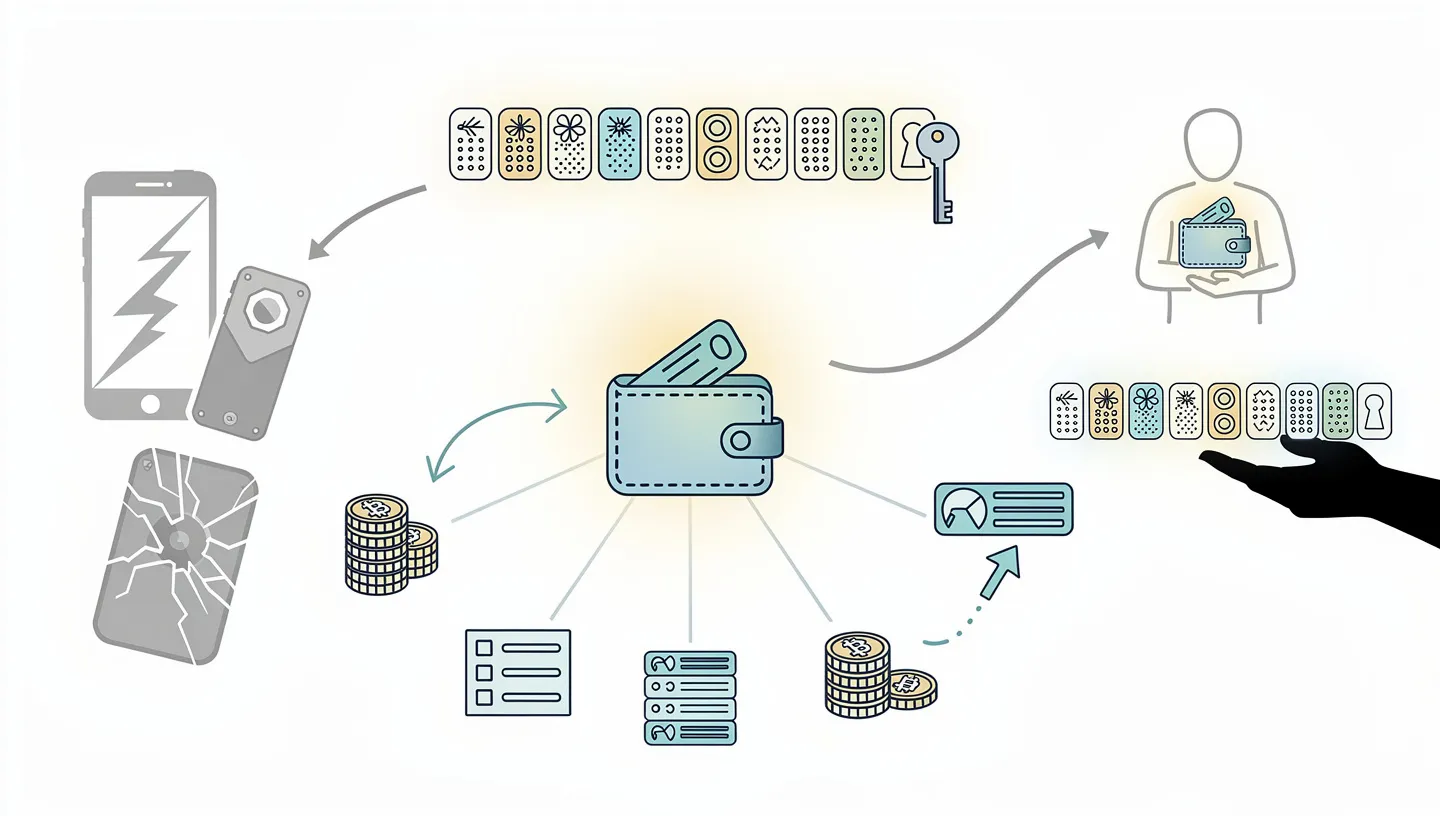
Every wallet address, every transaction you have ever made, every coin balance associated with your wallet can be regenerated from this one set of words. If your phone is lost, your hardware wallet breaks, or you forget your PIN, your seed phrase restores everything. That power works in both directions: whoever holds those words controls everything in that wallet.
Seed phrase vs private key: what is the difference?
A private key is a single cryptographic code tied to one specific wallet address. A seed phrase is a level above that. It is the master key that generates all the private keys for an entire wallet, including every address the wallet has ever created. Lose a private key and you lose access to one address. Lose your seed phrase and you lose access to everything. For a broader explanation of how wallets and private keys work together, the guide on what a cold wallet is covers the mechanics in plain terms.
Why seed phrase storage matters more than anything else
In traditional banking, forgetting your password is an inconvenience. You call the bank, verify your identity, and get back in. In crypto, there is no equivalent process. The wallet software does not know who you are. The blockchain does not care. If you lose access to your wallet and have no seed phrase backup, your funds are permanently inaccessible. Not difficult to recover. Gone.
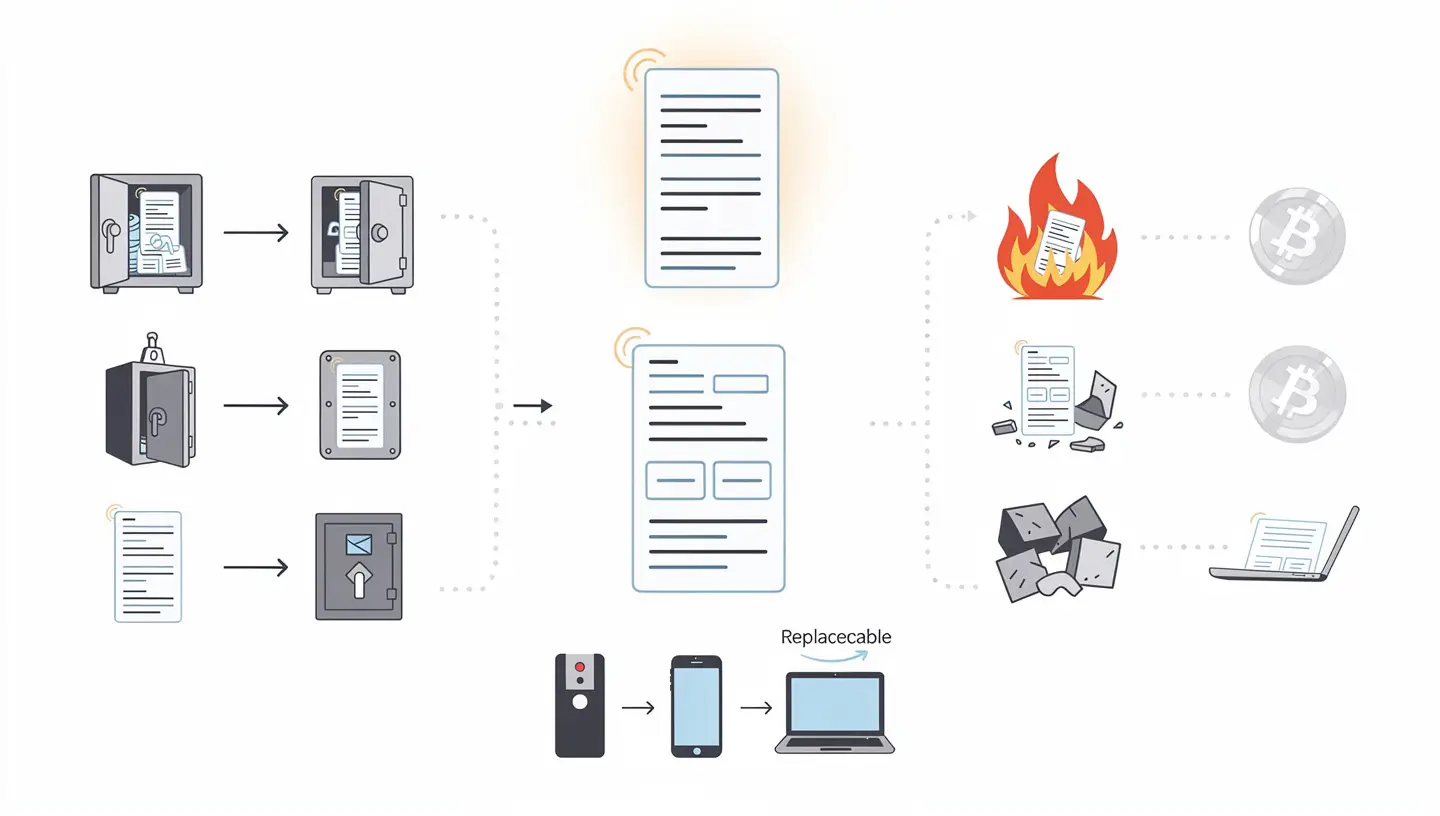
This is not a theoretical risk. It has been estimated that somewhere between 3 and 4 million Bitcoin are permanently lost, much of it due to lost or destroyed seed phrases and private keys. The seed phrase is the single point of failure in the entire system. Everything else, your hardware wallet, your PIN, the wallet software, can be replaced. The seed phrase cannot.
The rules before you store anything
Every guide on this topic lists the same core principles because they are not negotiable. Before choosing a storage method, these rules apply regardless of what you decide to do.
Back up immediately
The moment you create a new wallet, write down your seed phrase before you do anything else. Before you send any funds. Before you configure any settings. Self-custody wallet providers do not save your seed phrase and cannot retrieve it for you. If you lose access to the wallet before recording the phrase, the funds sent to it are effectively gone.
Never share it with anyone
Your seed phrase gives complete control over every coin in the wallet to whoever holds it. No legitimate wallet provider, no exchange, no support agent will ever ask for it. If you receive a message, email, or prompt asking for your seed phrase, it is a scam. No exceptions. Be careful with phishing attempts that disguise themselves as wallet software updates or official communications from known companies. The most common way crypto is stolen is not through technical hacking but through users handing over their seed phrase voluntarily after being deceived.
Never enter it into any internet-connected device
Computers and smartphones connected to the internet are vulnerable to malware and spyware. A hacker who gains access to your device can scan files, read clipboard contents, and capture keystrokes. Even entering your seed phrase once on an internet-connected device to “check” it creates a window of exposure. If you are using a hot wallet, the seed phrase was generated on a connected device, which is one of the reasons hot wallets carry more risk for large holdings than hardware wallets do.
What not to store your seed phrase on
The following are all places where people commonly store seed phrases and all are methods that carry serious risk:
- Cloud storage (Google Drive, iCloud, Dropbox): if your account is compromised, your seed phrase is gone. Cloud services have been breached before and will be again
- Email or text message: email accounts are regularly hacked, and messages can be intercepted. Sending your seed phrase to yourself over any network puts it at risk
- Screenshots or photos on your phone: photos sync to cloud services automatically on most devices. A photo of your seed phrase is effectively cloud storage
- Online password managers (LastPass, 1Password): LastPass was breached in 2022. Any online service can be breached. Your seed phrase should never sit in a database controlled by a third party
- Notes app or text file on a computer: these files are readable by any malware that accesses your device and are often backed up to cloud services without you noticing
- Your memory alone: memorizing your seed phrase is useful as a secondary measure, but it should never be your only backup. Human memory is fallible, and one wrong word in the wrong position means a completely different wallet
Paper backup: the simplest starting point
Writing your seed phrase on paper with a pen is the most accessible backup method. Every wallet, hardware or software, comes with a recovery sheet for exactly this purpose. Paper backup requires no special tools and can be done in seconds. For someone who is new to self-custody or holding a small amount, it is a reasonable starting point.
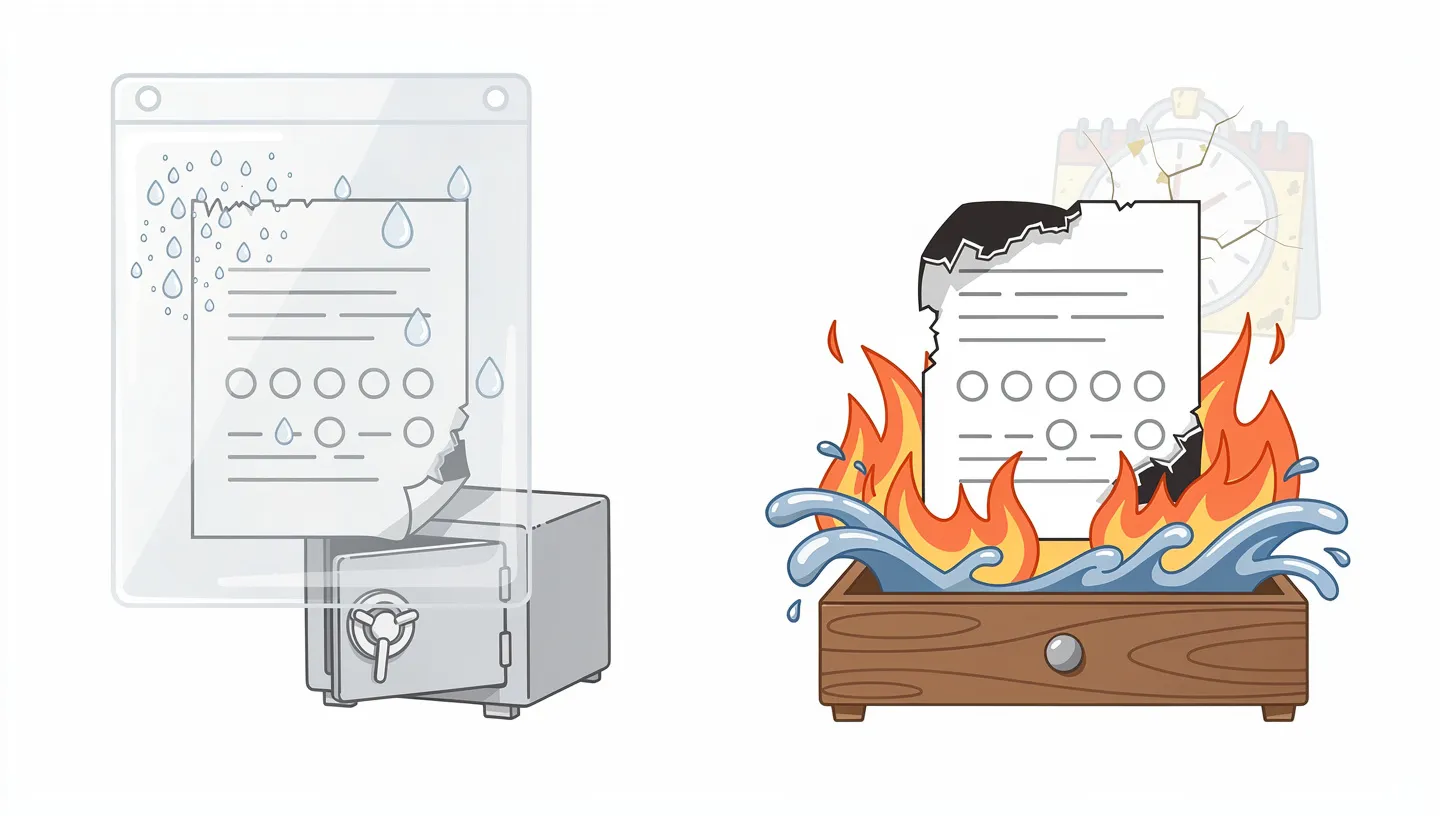
The problem with paper is durability. Paper is flammable, it degrades over time, and water can make ink illegible. A house fire destroys it. A flood ruins it. A piece of paper stored in a drawer for ten years may still be perfectly readable, or it may not. If you use paper, at minimum laminate it to add some water resistance, and store it inside a fireproof container rather than loose in a drawer. Paper is acceptable as a temporary solution or a secondary copy. It should not be your only long-term backup for any significant amount of crypto.
Metal backup: the right choice for long-term storage
Metal backup tools store your seed phrase on steel or titanium, making the backup resistant to fire, water, and physical damage that would destroy paper. A metal backup stored in a safe can realistically last decades without degradation. If you hold any meaningful amount of crypto for the long term, metal is the appropriate storage medium.
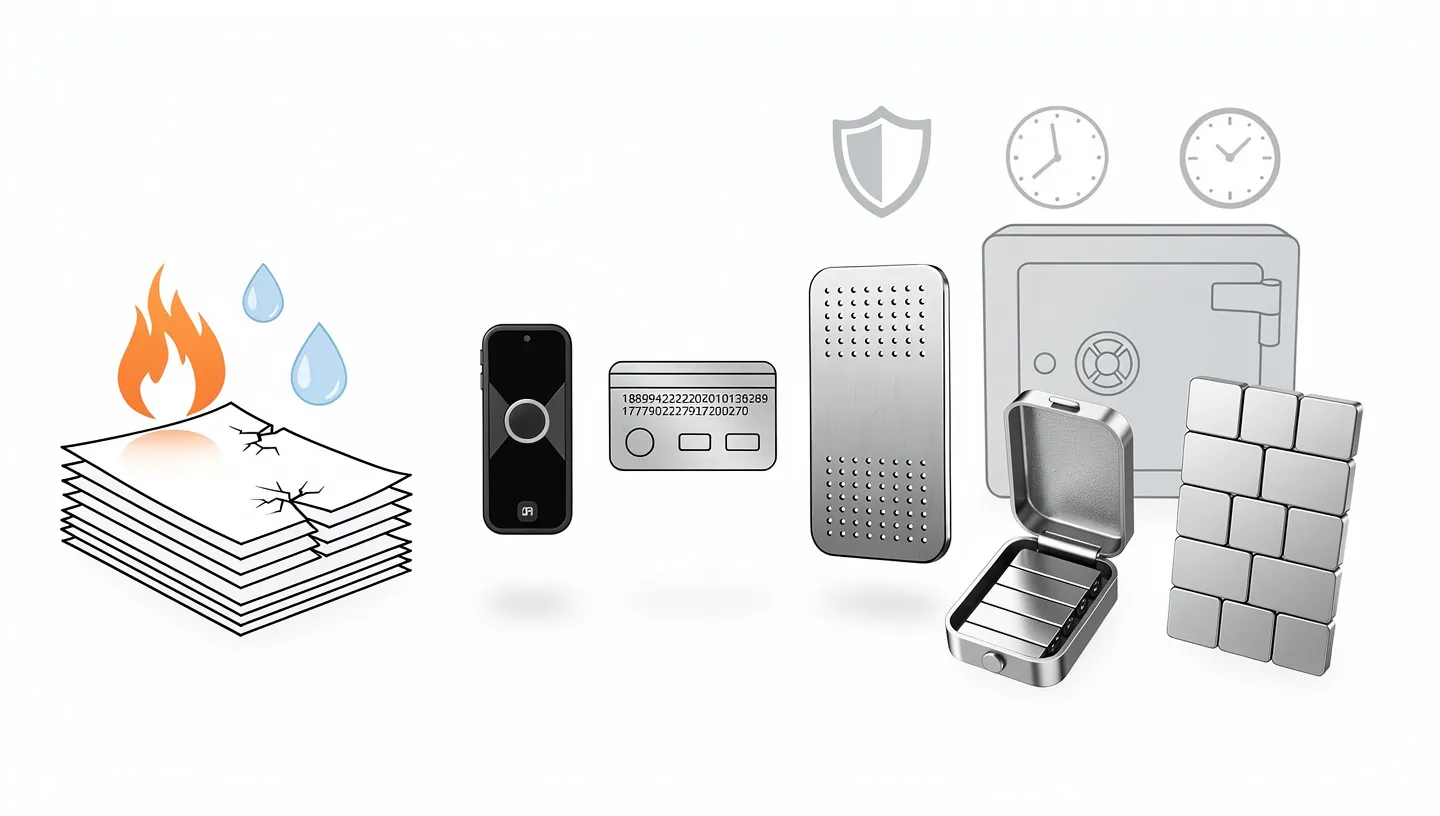
There are three main types of metal backup products on the market, each with different trade-offs.
Metal tiles
Products like the Billfodl use small individual metal tiles stamped with letters that you slide into a steel frame and lock in place. The main advantage is reusability: if you generate a new wallet with a new seed phrase, you disassemble the tiles and rebuild the backup. The tiles can also be disassembled deliberately if you need to destroy a copy. The trade-off is that fire or heat can warp the frame and potentially dislodge tiles, though the materials are generally rated to temperatures that exceed most house fires.
Steel plates with engraving
Products like CryptoTag Zeus use a punch tool to stamp or engrave words directly into a flat steel or titanium surface. This creates a more permanent record than tile systems because the words are physically indented into the metal. Fire cannot move or displace letters. The trade-off is that destroying this type of backup requires grinding down the entire surface. If you ever need to get rid of a copy, that is considerably more work.
Capsule solutions
Products like the Cryptosteel Capsule use small letter tiles loaded into a steel tube around a central rod, which holds them in place. This combines the reusability of tile systems with the structural integrity of a capsule that resists warping. The capsule format also keeps the tiles contained if a fire does warp the housing slightly. All three types are significantly more durable than any paper backup and are worth the cost for anyone holding crypto long-term.
Where to store your seed phrase backup
The physical material you write on matters, but so does where you keep it. A metal backup sitting on your desk is not safer than a paper backup in a fireproof safe. The goal is to keep your seed phrase physically secure against both theft and environmental damage.
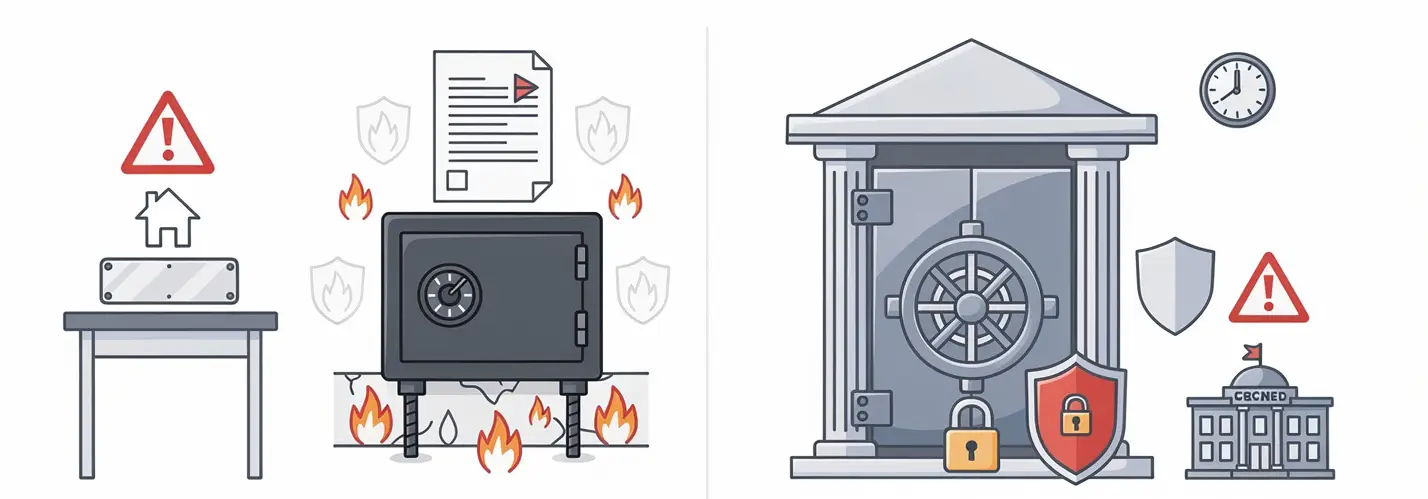
Home safe
A fireproof home safe is one of the most practical storage locations for a seed phrase backup. A safe that is bolted to a wall or floor is harder to remove than a portable lockbox. A wall-mounted safe requires destroying part of the wall to remove it, which significantly raises the difficulty for a thief. Choose a safe with at minimum a UL-rated fire resistance of 350 degrees Fahrenheit for at least 30 minutes. Many house fires burn hotter and longer, so a higher rating gives more margin. For guidance on what makes a hot wallet different from cold storage options and why the distinction matters for security, that guide explains the full trade-off.
Bank safety deposit box
A safety deposit box at a bank puts your seed phrase in a vault that is physically secure and protected from fire and flood. It removes the backup from your home entirely, which protects against a home burglary. The trade-off is that access is limited to banking hours, and in some jurisdictions the contents of a deposit box can be frozen or seized in legal proceedings. For most individual holders using a single-signature wallet, this risk is low. For those using multisig, keeping one key in a deposit box is a reasonable distribution.
Secondary off-site location
A second copy stored at a different physical location, a trusted family member’s home, a second property, or a secure location you have regular access to, protects against a single catastrophic event destroying both copies. A fire or flood at your home takes out your home safe copy. A second copy stored elsewhere means you still have access. The two locations should be far enough apart that the same disaster could not reasonably reach both.
Multiple copies: how many and why
More copies mean more resilience against loss. They also mean more potential exposure to theft. There is a trade-off, and the right number depends on how much crypto you hold and how much you trust the people who might encounter those copies.
For most individual holders, two copies in two separate locations is the right balance. One at home in a fireproof safe, one off-site in a safety deposit box or a second trusted location. Three copies is reasonable for larger holdings if you have secure locations for all three. Beyond three, each additional copy adds more theft risk than resilience value for most situations. The copies should be on durable material, preferably metal, stored in locked containers, and not co-located with your hardware wallet. Keeping the device and the backup together means someone who finds one finds both.
What to do if you lose your seed phrase
If you lose your seed phrase but still have access to your wallet device or software, act immediately. Transfer your funds to a new wallet with a new seed phrase that you have already backed up properly. Do not wait. The moment you realize your backup is missing or compromised, move everything out. A seed phrase that has been exposed, even potentially, is no longer safe to rely on.
If you have lost both your seed phrase and access to your wallet, there is no recovery path. The funds are permanently inaccessible. This is not a flaw in crypto, it is the design: without a central authority holding your credentials, there is also no central authority to appeal to when they are lost. The only protection is a proper backup made before the loss occurred.
Advanced options for larger holdings
The methods above are sufficient for most crypto holders. For those holding larger amounts or seeking a higher level of security, several advanced approaches are worth knowing about.
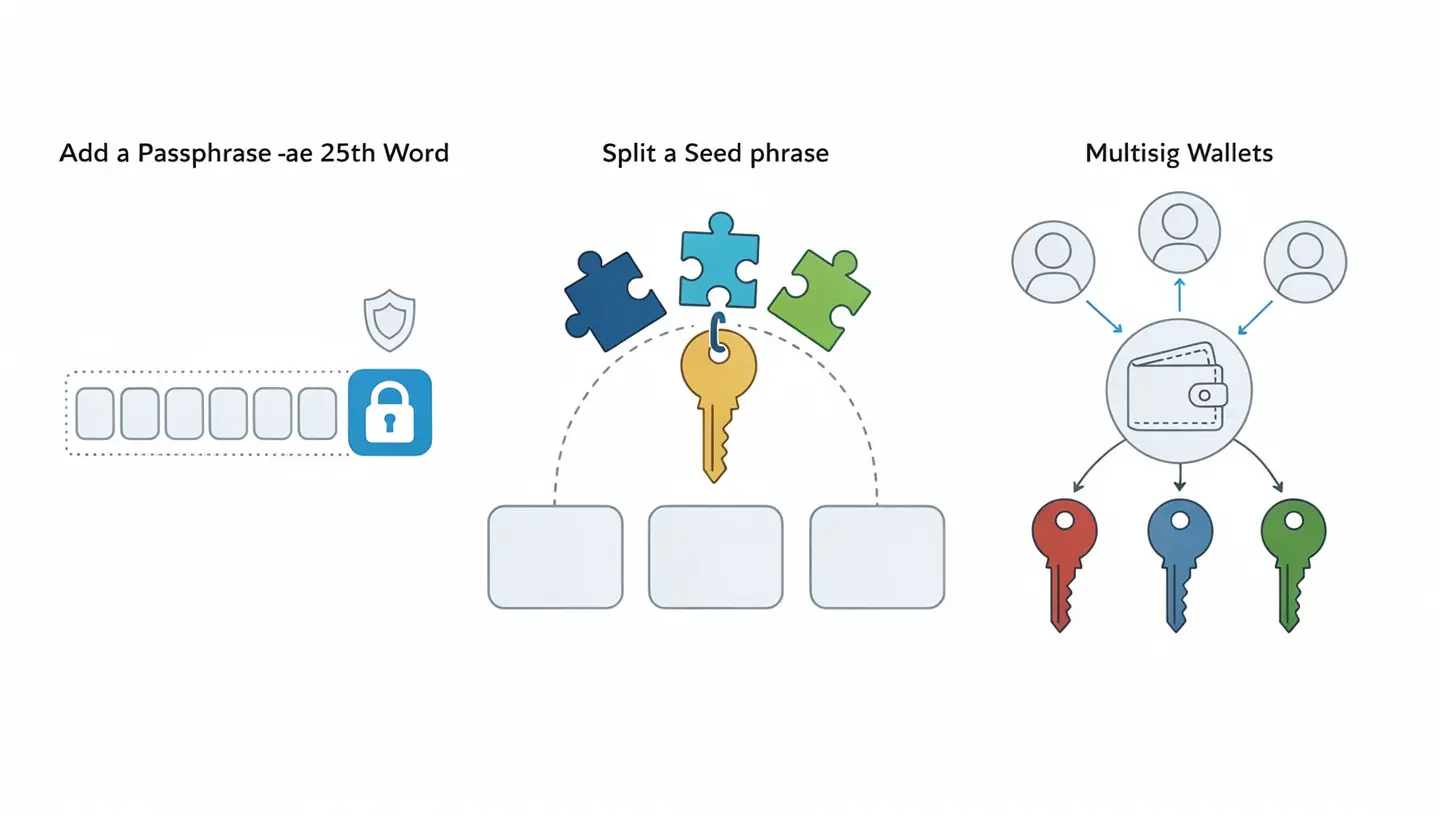
Adding a passphrase (the 25th word)
The BIP-39 standard supports an optional passphrase, sometimes called the 25th word, that is added to your seed phrase when accessing the wallet. With a passphrase enabled, someone who finds your seed phrase cannot access your wallet without also knowing the passphrase. This creates a hidden wallet: the same seed phrase with a different passphrase produces a completely different set of addresses. The passphrase must be stored separately from the seed phrase, and it must be stored with the same care. If you lose the passphrase, you lose access to the funds in the hidden wallet just as surely as losing the seed phrase itself.
Splitting your seed phrase
Splitting a seed phrase into parts and storing each part in a different location is a way to ensure that no single location holds enough information to reconstruct the wallet. A simple split, such as storing words 1-12 in one place and 13-24 in another, is better than keeping it all in one place, but it is weaker than it appears: someone who finds half of a 24-word seed phrase has significantly narrowed the search space for the other half. A more robust approach is Shamir’s Secret Sharing (SSS), which mathematically divides the secret into shares where a minimum threshold, for example 2 of 3 shares, is required to reconstruct it. Either way, splitting adds complexity and requires careful documentation of the scheme so you or a trusted person can reassemble it correctly.
Multisig wallets
A multisig wallet requires signatures from more than one private key to authorize a transaction. A 2-of-3 multisig, for example, uses three keys and requires any two of them to sign. This means losing one key does not mean losing access to the funds, and a single compromised key is not enough to steal them. Each key has its own seed phrase, which all need to be backed up. Services like Unchained and Casa offer multisig setups where they hold one of the keys as a backup of last resort. For a broader explanation of the hardware wallet options that underpin most advanced setups, the guide on cold wallets covers the types and their trade-offs.
Planning for inheritance and emergencies
If you hold any amount of crypto and want it to be accessible to your family in the event of your death or incapacitation, planning is needed. A seed phrase stored in a place only you know about, with no instructions left for anyone else, is effectively lost the moment you are gone.
The right approach is not to hand your seed phrase directly to a family member, which creates ongoing security risk. Instead, leave clear written instructions on where the backup is stored and how to use it to restore a wallet. Store those instructions in a sealed envelope with a lawyer, in a will, or in a location your next of kin can access. Consider having a trusted person practice restoring a wallet using a separate test seed phrase with a small balance, so they are not learning the process for the first time under pressure. Check local laws: in some jurisdictions, the contents of a will become public record, so avoid including the seed phrase itself in any document that could be made public.
Frequently asked questions about crypto seed phrase storage
What is the safest way to store a seed phrase?
The safest method is a metal backup, such as a steel plate or capsule, stored in a fireproof home safe with a second copy in a separate secure location such as a bank safety deposit box. This protects against both digital theft and physical damage. Never store your seed phrase in any digital format.
Can I store my seed phrase in a password manager?
No. Online password managers are controlled by third parties and have been breached before. LastPass suffered a major breach in 2022 that exposed encrypted user vaults. Any service that stores your data on a server is a potential target. Your seed phrase should exist only as a physical backup, completely offline.
What happens if I lose my seed phrase?
If you still have access to your wallet device, transfer your funds immediately to a new wallet with a new seed phrase you have already backed up. If you have lost both your seed phrase and access to your wallet, the funds are permanently inaccessible. There is no recovery process and no authority to contact.
Is it safe to take a photo of my seed phrase?
No. Photos on a smartphone typically sync automatically to cloud storage services like iCloud or Google Photos. Even if you disable automatic sync, the photo exists on a device connected to the internet. A digital photo of your seed phrase carries the same risks as any other digital storage method.
Can I memorize my seed phrase instead of writing it down?
Memorization can be a useful additional layer but should never be your only backup. Human memory is unreliable over years and decades, particularly under stress or illness. A single word remembered incorrectly or in the wrong order generates a completely different wallet. Always keep at least one physical offline backup in addition to any memorization.
How many copies of my seed phrase should I keep?
Two copies in two separate physical locations is the right starting point for most holders. One in a fireproof home safe, one off-site in a bank deposit box or a second trusted location. For larger holdings, a third copy in a third location adds further resilience. More than three copies starts to increase theft risk faster than it increases resilience for most individuals.
What is the difference between a seed phrase and a private key?
A private key controls one specific wallet address. A seed phrase is the master backup that generates every private key across the entire wallet, including all addresses the wallet has ever created. Losing a private key means losing access to one address. Losing a seed phrase means losing access to everything.
Should I split my seed phrase for extra security?
A simple split, such as words 1-12 in one location and 13-24 in another, reduces the risk of a single stolen copy but is not as secure as it appears. Shamir’s Secret Sharing provides a mathematically stronger approach by dividing the secret into shares where a minimum number, for example two of three, must be combined to reconstruct it. Either approach adds complexity and requires careful documentation so the backup can be reassembled correctly.
Will my wallet provider ever ask for my seed phrase?
Never. No legitimate wallet provider, exchange, or support team will ever ask for your seed phrase. Any message, email, or website prompt asking for your seed phrase is a scam. This is the most common method used to steal crypto from people who store their own keys.
Sources: Ledger Academy: How to Keep Your Seed Phrase Secure | Bitcoin Magazine: The Infosec Basics: How to Keep Your Bitcoin Seed Phrase Secure