Cryptocurrency is a form of digital money that runs on a decentralized network of computers. There is no bank processing your payments and no government issuing new coins. Instead, thousands of computers around the world follow the same set of rules, record every transaction on a shared database, and collectively keep the whole system running. This guide covers exactly how that works, from the moment you send a payment to the way new coins are created and stored.
What is cryptocurrency?
Cryptocurrency is a digital currency that exists only as entries in a database. You cannot hold it in your hand. What you own is a record on a public ledger that says a certain amount of coins belongs to your address. That record is secured by mathematics, not by a bank or a government, and it can only be changed if you use the private key that belongs to your address.

The word “cryptocurrency” comes from cryptography, the branch of mathematics used to secure data. Every transaction is protected by cryptographic algorithms that make it practically impossible to forge or alter. The decentralized part means the database is not stored in one place or controlled by one company. Thousands of independent computers hold identical copies of it, and they all have to agree before any new transaction is added.
Crypto vs traditional money
Traditional currencies, known as fiat currencies, are issued by governments and managed by central banks. A central bank can increase the money supply at any time. Cryptocurrencies work differently: the supply rules are written into the software and enforced by the network. No individual or institution can change them without the agreement of the majority of participants.
| Feature | Cryptocurrency | Fiat currency |
|---|---|---|
| Issued by | Network protocol (software rules) | Central bank or government |
| Supply | Fixed or algorithmically controlled | Unlimited, set by monetary policy |
| Transactions | Peer-to-peer, no intermediary | Processed through banks |
| Record keeping | Public blockchain, anyone can verify | Private bank ledgers |
| Inflation control | Coded into the protocol | Decided by central banks |
Why is it called “crypto”?
“Crypto” is short for cryptography, the system of encoding information so that only the intended party can read it. Every wallet address, every transaction signature, and every block on the blockchain is secured through cryptographic functions. Without cryptography, anyone could forge transactions and claim ownership of coins that belong to someone else. The math makes that computationally impossible.
How does the blockchain work?
The blockchain is the foundation that makes cryptocurrency possible. It is a public database, sometimes called a distributed ledger, that holds a permanent record of every transaction ever made on that network. The first Bitcoin block was added on January 3, 2009. Every block added since then is chained to the one before it, all the way back to that first block.
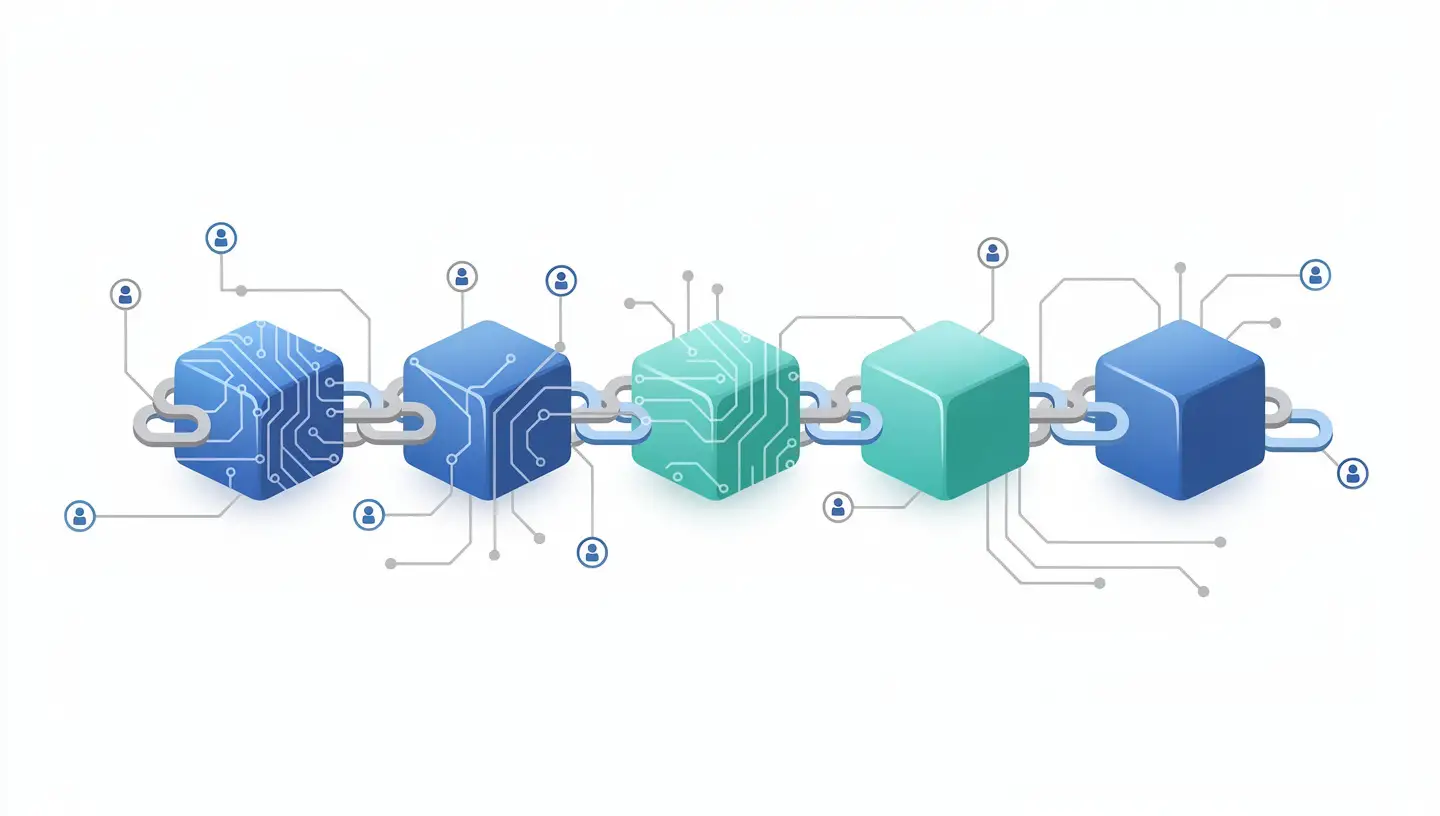
What makes a blockchain different from a normal database is that no single person controls it. Thousands of computers around the world each hold a full copy, and they all follow the same rules to decide which new blocks are valid. If someone tried to alter an old transaction, every computer on the network would reject the change because their copy of the database would no longer match.
What is a block?
A block is a batch of transactions grouped together and added to the chain at the same time. Each block contains three main things: a list of recent transactions, a timestamp recording when it was created, and a hash. A hash is a fixed-length string of characters generated from the block’s data. Change even one character in the block and the hash changes completely, making tampering detectable immediately.
Each block also contains the hash of the block that came before it. That link is what forms the chain. You cannot change an old block without changing its hash, which then breaks the connection to every block that followed it. The network detects this instantly and rejects the altered version.
How blocks form a chain
When a new block is created, it carries a reference to the previous block’s hash. Every block in existence is therefore mathematically linked to every block before it, going back to the very first one. The further back a transaction sits in the chain, the more blocks have been added on top of it, and the harder it becomes to alter. A transaction buried under six blocks of confirmations would require redoing all six blocks of computational work while the rest of the network keeps adding new ones. In practice this makes the blockchain immutable: the record of past transactions does not change.
Who holds the blockchain?
The blockchain is held by a network of computers called nodes. Anyone can download the software and run one. Each node stores a complete copy of the blockchain and independently verifies every transaction and block it receives. If a node receives a block that breaks the rules, it rejects it. No single node has authority over the others. The network reaches agreement by the majority of nodes accepting a block as valid. This is what makes the system decentralized: there is no central server that can be shut down or corrupted.
How a crypto transaction actually works
When you send cryptocurrency to another person, there is no bank in the middle approving the payment. The network itself handles verification, and the process follows the same steps every time, whether you are sending $10 or $10 million.
Public keys and private keys
Every crypto wallet has two mathematically linked codes. The public key generates your wallet address, the string of characters you share when you want to receive funds. Think of it like an email address: anyone can send to it. The private key is the secret code that proves you control the coins at that address and authorizes outgoing transactions. Think of it like a password, except one that cannot be reset if lost. If someone else gets your private key, they can take everything in your wallet. If you lose it without a backup, your coins are gone permanently.
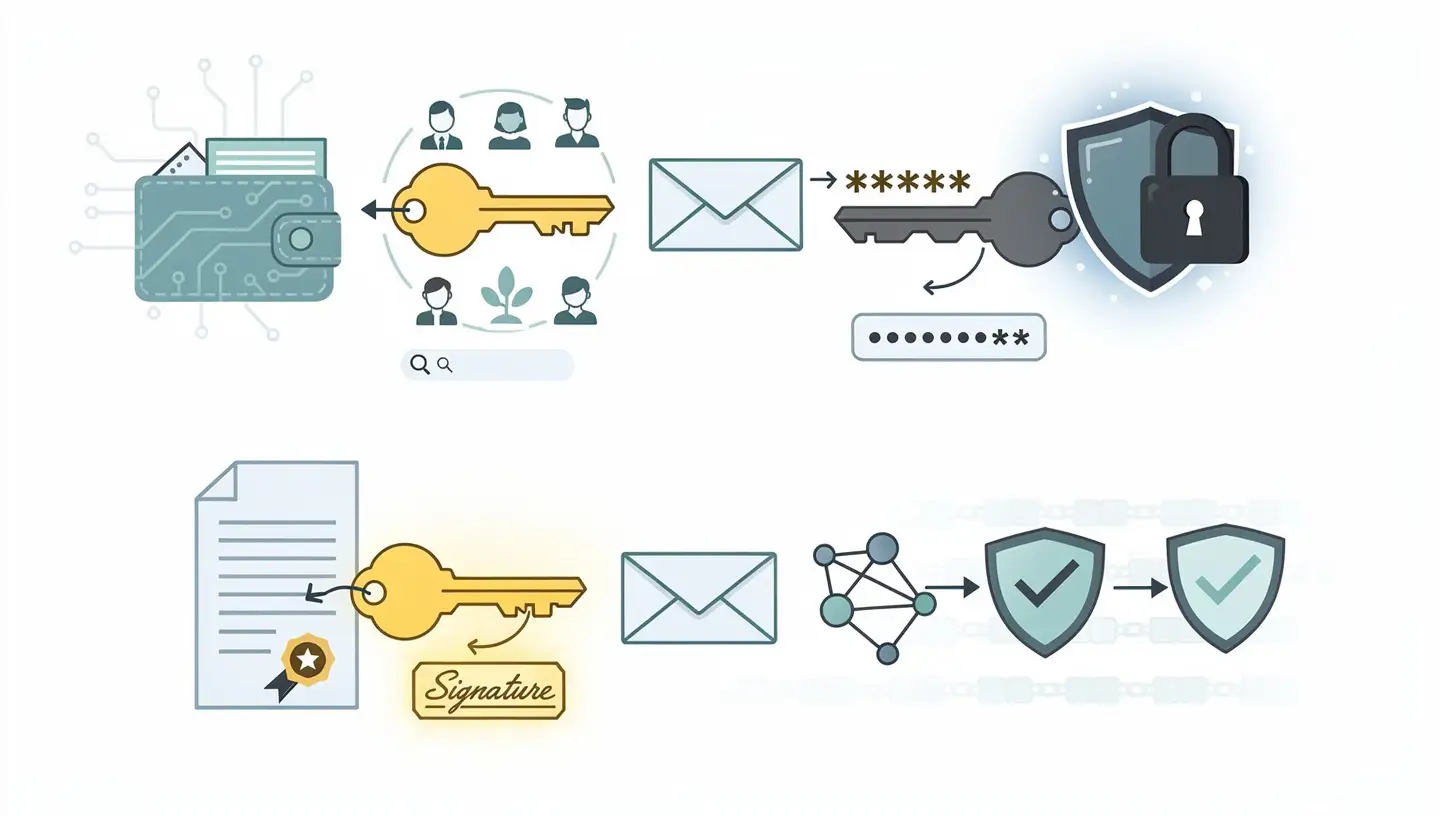
When you send a transaction, your wallet software uses your private key to create a digital signature. The network uses your public key to verify that signature without ever seeing the private key itself. This is how the network confirms you authorized the transaction without requiring you to reveal your secret.
From send to confirmed: step by step
Here is what happens between the moment you hit send and the moment the recipient’s balance updates:
- You broadcast the transaction. Your wallet sends the transaction details to nearby nodes: the amount, the recipient address, your digital signature, and a transaction fee.
- The transaction enters the mempool. The mempool is a waiting area for unconfirmed transactions. Miners and validators look here for transactions to include in the next block.
- A miner or validator picks it up. They select transactions from the mempool, usually prioritizing higher fees, and bundle them into a block candidate.
- The block is added to the chain. Once the block passes the network’s validation rules, it is added to the blockchain. The transaction now has one confirmation.
- More blocks follow. Each new block added on top adds another confirmation. For Bitcoin, six confirmations, roughly one hour, is the standard for large transactions to be considered final.
How new coins are created
Cryptocurrency is not printed. New coins enter circulation as a reward to the computers that validate transactions and secure the network.
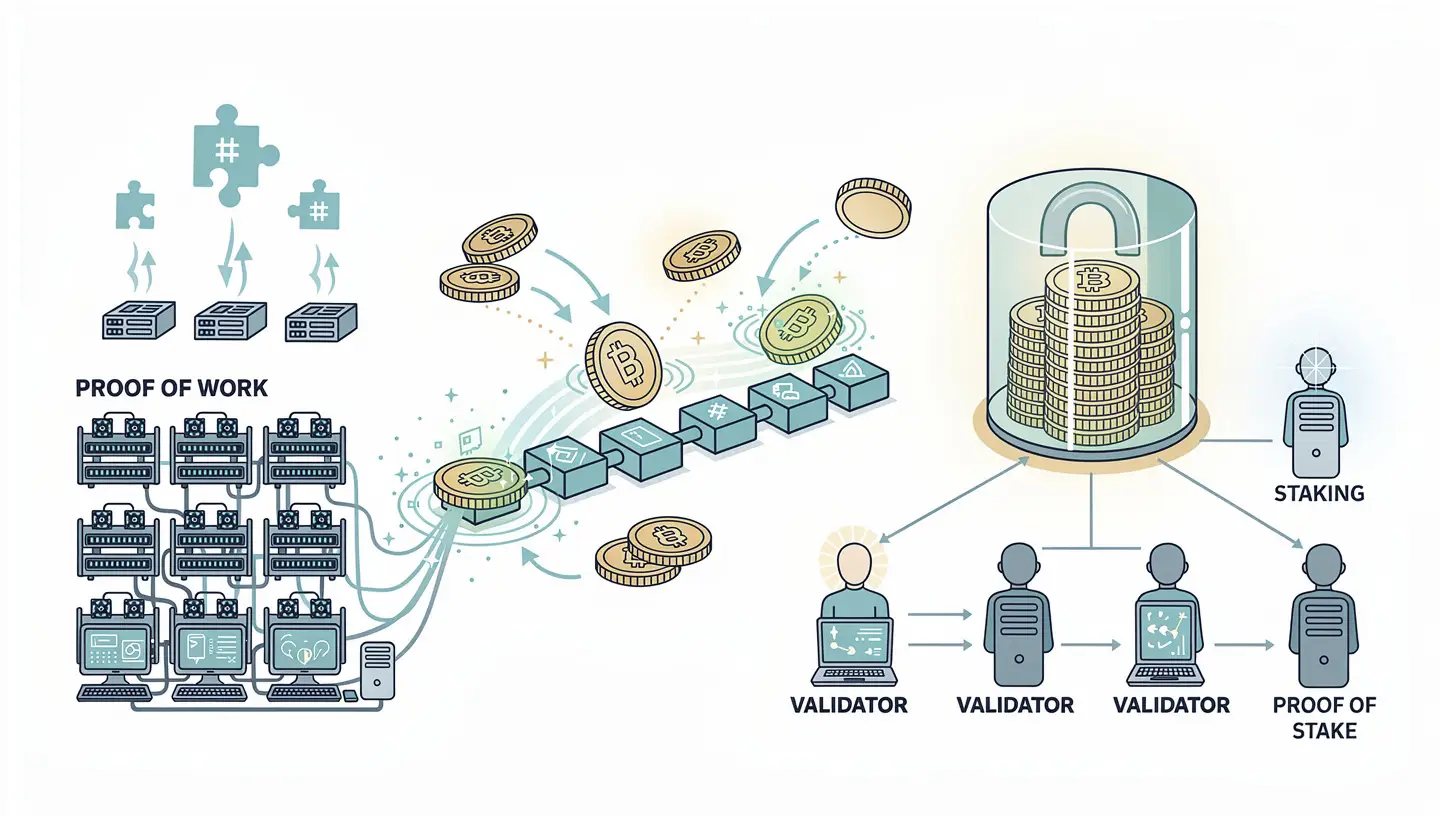
The method used depends on which consensus mechanism the network runs on. The two most common are proof of work and proof of stake.
Proof of work
Proof of work is the system Bitcoin uses. Miners compete to solve a computational puzzle. The puzzle requires running the block’s data through a hashing algorithm billions of times until the output meets a specific target set by the network. There is no shortcut: the only way to find the answer is brute force computation. The first miner to solve it earns the block reward, currently 3.125 BTC per block following the April 2024 halving. For the full history of how that reward has changed at each cycle, the Bitcoin halving dates guide covers every event since 2009.
Proof of work requires significant electricity. That cost is intentional: it makes attacking the network expensive. To rewrite the blockchain, an attacker would need to redo the computational work behind every block they want to change, while the rest of the network keeps adding new ones ahead of them.
Proof of stake
Proof of stake replaces computational competition with financial commitment. Instead of miners, the network uses validators. To become a validator, you lock up, or “stake,” a certain amount of cryptocurrency as collateral. The network randomly selects validators to propose and confirm new blocks, weighted by how much they have staked. If a validator tries to approve fraudulent transactions, the network takes their staked coins, a penalty called slashing. Ethereum switched from proof of work to proof of stake in September 2022. Proof of stake uses far less energy than proof of work, though critics argue it gives more influence to those who already hold large amounts of the currency.
Crypto wallets explained
A crypto wallet does not store your coins the way a physical wallet stores cash. Your coins never leave the blockchain. What the wallet stores is your private key, the proof of ownership that lets you authorize transactions. Lose the private key and you lose access to your coins. The wallet is the tool that manages those keys and constructs transactions on your behalf.
Most wallets also generate a seed phrase, a sequence of 12 or 24 words that can recreate your private key on any compatible wallet if your device is lost or broken. How you store that seed phrase matters as much as how you store the coins themselves. The guide on seed phrase storage covers the safest methods.
Hot wallets
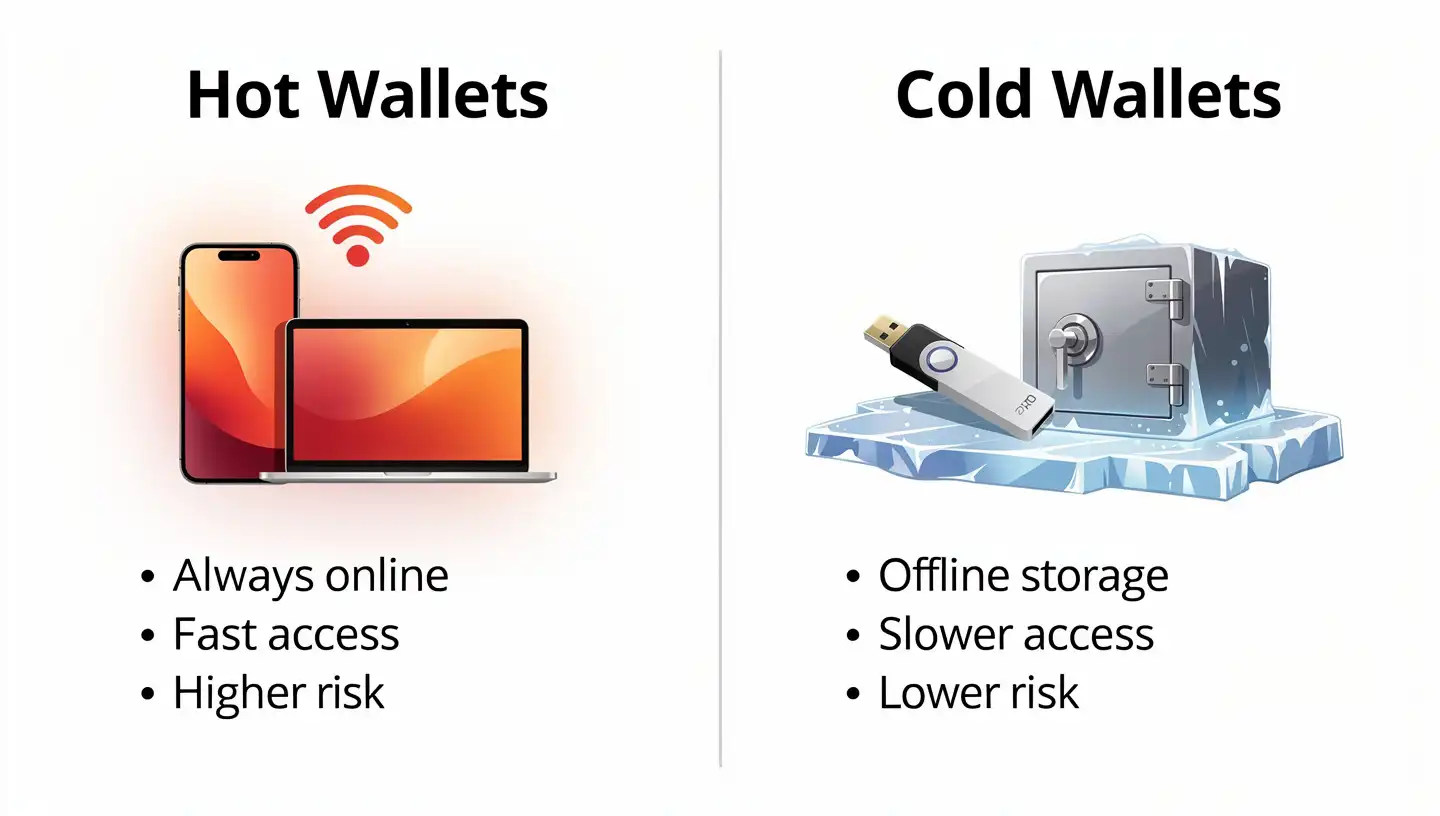
A hot wallet is connected to the internet. It is usually a mobile app, a browser extension, or a desktop program. Hot wallets are convenient: you can send and receive coins quickly without any physical device. The tradeoff is that anything connected to the internet can potentially be accessed remotely. They are a reasonable choice for smaller amounts you use regularly, similar to keeping some cash in your pocket rather than a safe. For a full breakdown of how they work and what the risks are, the guide on what a hot wallet is covers both.
Cold wallets
A cold wallet, also called a hardware wallet, stores your private key on a physical device that is never connected to the internet under normal use. When you want to send a transaction, you connect the device, sign the transaction on the device itself so the private key never touches an internet-connected computer, then broadcast the signed transaction. Ledger and Trezor are the two most widely used brands. Cold wallets are the standard recommendation for anyone holding a significant amount for the long term. The guide on what a cold wallet is explains the setup in full.
Custodial vs non-custodial wallets
When you buy cryptocurrency on an exchange, the exchange holds the private key on your behalf. This is called a custodial wallet. It is convenient and has account recovery options, but it means you are trusting the exchange with your funds. If the exchange is hacked or goes bankrupt, your coins could be at risk.
A non-custodial wallet means you hold the private key yourself. No company can freeze your funds or lose them on your behalf. The responsibility for security is entirely yours. The phrase common in crypto circles is “not your keys, not your coins.” For a direct comparison of both options, the guide on custodial vs non-custodial wallets covers the tradeoffs in full. If you already hold coins on Coinbase and want to move to self-custody, the step-by-step walkthrough on how to move crypto from Coinbase to a cold wallet covers the exact process.
Types of cryptocurrency
Bitcoin was the first cryptocurrency, launched in 2009. Since then, thousands of others have been created, each with different purposes, technical designs, and levels of adoption.

Most fall into a few broad categories.
Coins vs tokens
A coin is a cryptocurrency that runs on its own blockchain. Bitcoin runs on the Bitcoin blockchain. Ether runs on the Ethereum blockchain. A token is built on top of an existing blockchain rather than having its own. Most tokens run on Ethereum and use its infrastructure while serving a specific function within a particular application. Coins and tokens behave differently in terms of transaction fees, security, and how they are issued.
Stablecoins
Stablecoins are cryptocurrencies designed to hold a fixed value, usually pegged 1:1 to the US dollar. USDC and USDT are the two largest by trading volume. They are used for transferring dollar value quickly across borders without volatility, for earning yield on platforms that pay interest, and as a safe harbor when other crypto prices fall. They still run on blockchains and require wallets, but their price does not fluctuate the way Bitcoin or Ethereum does.
What can you do with cryptocurrency?
Bitcoin was used to buy two pizzas in 2010. In 2026 the range of uses is considerably broader:
- Payments: send money to anyone in the world without a bank, in minutes, at a fraction of what international wire transfers cost
- Investing and saving: buy and hold Bitcoin or other cryptocurrencies as a long-term store of value
- Trading: buy and sell across hundreds of exchanges, 24 hours a day, seven days a week
- DeFi: earn interest by lending your crypto, provide liquidity to trading pools, or borrow against your holdings without a bank involved
- NFTs: buy, sell, and verify ownership of digital assets recorded on a blockchain
- Remittances: send money internationally at a fraction of traditional transfer costs
- Retail purchases: a growing number of merchants accept crypto directly, and crypto debit cards let you spend it anywhere Visa or Mastercard is accepted
What crypto is not well suited for, at least on the main Bitcoin network, is small everyday purchases. Network fees fluctuate with demand and can rise sharply during busy periods. Layer 2 networks built on top of the main blockchains address this, but adoption is still developing.
How to buy and store crypto safely
Buying cryptocurrency for the first time involves three steps: choosing where to buy, funding your account, and deciding where to store what you buy.
Choosing an exchange
A cryptocurrency exchange is the most straightforward way to buy crypto. You create an account, verify your identity with a government ID, deposit money from your bank account, and purchase at the current market price. Coinbase, Kraken, and Binance are among the most widely used. When comparing exchanges, the main factors are their security track record, the fees charged per transaction, which coins they list, and whether they operate legally in your country. The guide to the best crypto exchanges in the US compares the top platforms side by side.
Moving crypto off an exchange
Leaving large amounts on an exchange carries risk. Exchanges have been hacked before, and if one freezes withdrawals or goes bankrupt, access to your funds is not guaranteed. The standard practice for anyone holding more than a small amount is to withdraw to a self-custody wallet. If you later want to sell from a hardware wallet, the guide on how to sell crypto from a cold wallet explains how to do that without compromising security.
Is crypto safe?
The Bitcoin blockchain itself has never been successfully hacked since it launched in 2009. The underlying protocol, the cryptography, and the consensus mechanism have held up against years of attempts. The security of the base layer is strong. The risks in crypto come from elsewhere: the exchanges and wallets people use to access it, and the mistakes people make managing their own keys.
Risks you should know about
- Volatility: Bitcoin has dropped 50 to 80 percent from its peak prices multiple times. If you cannot tolerate that possibility, large allocations are not appropriate
- Lost private keys: if you lose your private key and your seed phrase, your coins are gone with no recovery option
- Exchange failures: exchanges can be hacked, freeze withdrawals, or go bankrupt, as FTX did in November 2022. Funds held on exchanges are not insured the way bank deposits are in most countries
- Scams and phishing: fake exchanges, fake wallets, and impersonation scams are common. Only download wallet software from the official developer’s website and verify every address before confirming a transaction
- Irreversible transactions: a confirmed crypto transaction cannot be reversed. Send to the wrong address and the funds are almost certainly gone permanently
- Regulatory changes: the legal and tax treatment of crypto varies by country and continues to change. Shifts in rules can affect the value or usability of specific cryptocurrencies
Frequently asked questions about how crypto works
What is the difference between Bitcoin and crypto?
Bitcoin is one specific cryptocurrency. Crypto is the broader category that includes thousands of digital currencies and tokens. Bitcoin was the first and remains the largest by market value, but it is one of many. The full breakdown of how they relate is in the guide on the difference between crypto and Bitcoin.
How long does a crypto transaction take?
It depends on the network and the fee you pay. A Bitcoin transaction gets its first confirmation in roughly 10 minutes. Most exchanges and merchants consider a transaction final after 6 confirmations, which takes about an hour. Ethereum is typically faster, often 15 seconds to a few minutes. Paying a higher fee moves your transaction to the front of the queue.
What happens if you send crypto to the wrong address?
In almost all cases the funds are gone permanently. Blockchain transactions are irreversible once confirmed. There is no central authority to appeal to and no way to reverse a confirmed transaction through the protocol. Always double-check the full address before hitting confirm.
What is a gas fee in crypto?
A gas fee is the transaction fee on the Ethereum network. It compensates validators for the computational work required to process your transaction and is denominated in gwei, a fraction of ETH. Gas fees rise during periods of high network activity and fall when the network is quiet. Other networks charge equivalent fees under different names, but the concept is the same.
Is crypto anonymous?
Crypto is pseudonymous, not anonymous. Every transaction is permanently recorded on a public blockchain and traceable by anyone. What is not immediately visible is the real-world identity behind a wallet address. However, when you buy crypto on a regulated exchange, your identity is linked to your wallet through KYC verification. Governments and blockchain analytics firms have tools to trace transactions and have done so successfully in criminal investigations.
What is a smart contract?
A smart contract is a program stored on a blockchain that executes automatically when predefined conditions are met. It runs exactly as coded, with no possibility of downtime, censorship, or third-party interference. Smart contracts are the building blocks of DeFi applications, NFT platforms, and many other services built on Ethereum. Once deployed, the code cannot be changed.
What is DeFi?
DeFi stands for decentralized finance. It refers to financial services, lending, borrowing, trading, earning interest, that run on blockchain networks through smart contracts rather than through banks or brokers. Anyone with a crypto wallet can use them, with no account applications or credit checks. The guide on what DeFi is explains the main protocols and how they work.
How is crypto taxed?
In the United States, the IRS treats cryptocurrency as property, not currency. Selling, trading, or spending crypto is a taxable event subject to capital gains tax. The same principle applies in the UK and most EU countries, though the specific rates differ. Receiving crypto as income through mining, staking rewards, or payment for work is taxed as ordinary income at the time of receipt.
What is staking in crypto?
Staking is the process of locking up cryptocurrency to participate in a proof-of-stake network and earn rewards in return. Validators stake coins as collateral to earn the right to confirm transactions and receive newly issued coins. Individual holders can also stake through exchanges or dedicated platforms to earn a percentage yield on their holdings. The guide on what crypto staking is covers how it works and where the rewards come from.
Does MetaMask support Bitcoin?
MetaMask does not natively support Bitcoin. It is built for Ethereum and Ethereum-compatible networks. To hold and send Bitcoin you need a wallet designed for it. The full answer, including which wallets do support Bitcoin, is in the guide on whether MetaMask supports Bitcoin.
Sources: Kaspersky: What is Cryptocurrency and How Does it Work? | Charles Schwab: What is Cryptocurrency and How Does It Work?