Bitcoin is a cryptocurrency. That is the core of it. Crypto is the broader category. Bitcoin sits within that category as a single, specific coin. The terms bitcoin vs cryptocurrency get used as if they mean the same thing, but they do not. This guide explains exactly what separates them, how Bitcoin fits into the wider market, and why the confusion exists in the first place.
What is cryptocurrency?
Cryptocurrency is a form of digital currency that operates without a central bank or government issuing it. Transactions are secured using cryptography, which is where the name comes from. No financial institution sits in the middle verifying payments. Instead, a decentralized network of computers handles that job.

The record of every transaction lives on a blockchain, which is a shared ledger copied across thousands of computers at the same time. Anyone on the network can verify a transaction, and no single machine controls the record. Payments move directly between users on a peer-to-peer basis, without a bank processing the transfer.
Cryptocurrency has no physical form. There are no notes or coins. Everything exists as entries in that shared ledger. You hold crypto by controlling the private key to a wallet address, not by holding anything tangible. For a full explanation of how this works from the ground up, the guide to what is crypto covers it in detail.
What is Bitcoin?
Bitcoin (BTC) is the first cryptocurrency, created in 2009 by a person or group writing under the name Satoshi Nakamoto. The identity behind that name has never been confirmed. Bitcoin was designed as a payment system that could operate without banks, moving value directly between two parties anywhere in the world.

Bitcoin runs on proof of work, a system where computers, called miners, compete to solve mathematical problems. The first to solve the current problem earns the right to add the next block of transactions to the chain and receives newly created Bitcoin as a reward. That reward halves roughly every four years in an event called the Bitcoin halving, which slows the rate at which new coins enter circulation.
Bitcoin has a hard cap of 21 million coins. No more can ever be created. That fixed supply is built directly into the protocol and cannot be changed without the agreement of the network. It is one of the main reasons many people treat Bitcoin as a store of value rather than a day-to-day spending currency. The scarcity is not a marketing claim. It is a number enforced by every computer running the Bitcoin software. When demand rises and supply cannot grow to meet it, the price has historically moved up. When demand falls, there is no central bank to buy Bitcoin and support the price. The market sets it entirely. The full picture of what Bitcoin is, including how wallets, keys, and transactions work, is in the guide to what is Bitcoin.
Bitcoin is one type of cryptocurrency
The simplest way to understand the difference between crypto and Bitcoin is this: cryptocurrency is a category, and Bitcoin is one item within it. Saying “I invest in crypto” and “I invest in Bitcoin” carry different meanings, in the same way that “I drive a car” and “I drive a Toyota” are not the same statement.

Every Bitcoin is a cryptocurrency. Not every cryptocurrency is Bitcoin. The coins that are not Bitcoin are collectively called altcoins, a term that covers everything from Ethereum and Solana to thousands of smaller projects. Some altcoins have serious technical differences from Bitcoin. Others were created as jokes or experiments. All of them are cryptocurrencies, and none of them are Bitcoin.
Key differences between Bitcoin and other cryptocurrencies
Bitcoin and other cryptocurrencies share the same basic foundation: cryptography, blockchain, and decentralization.
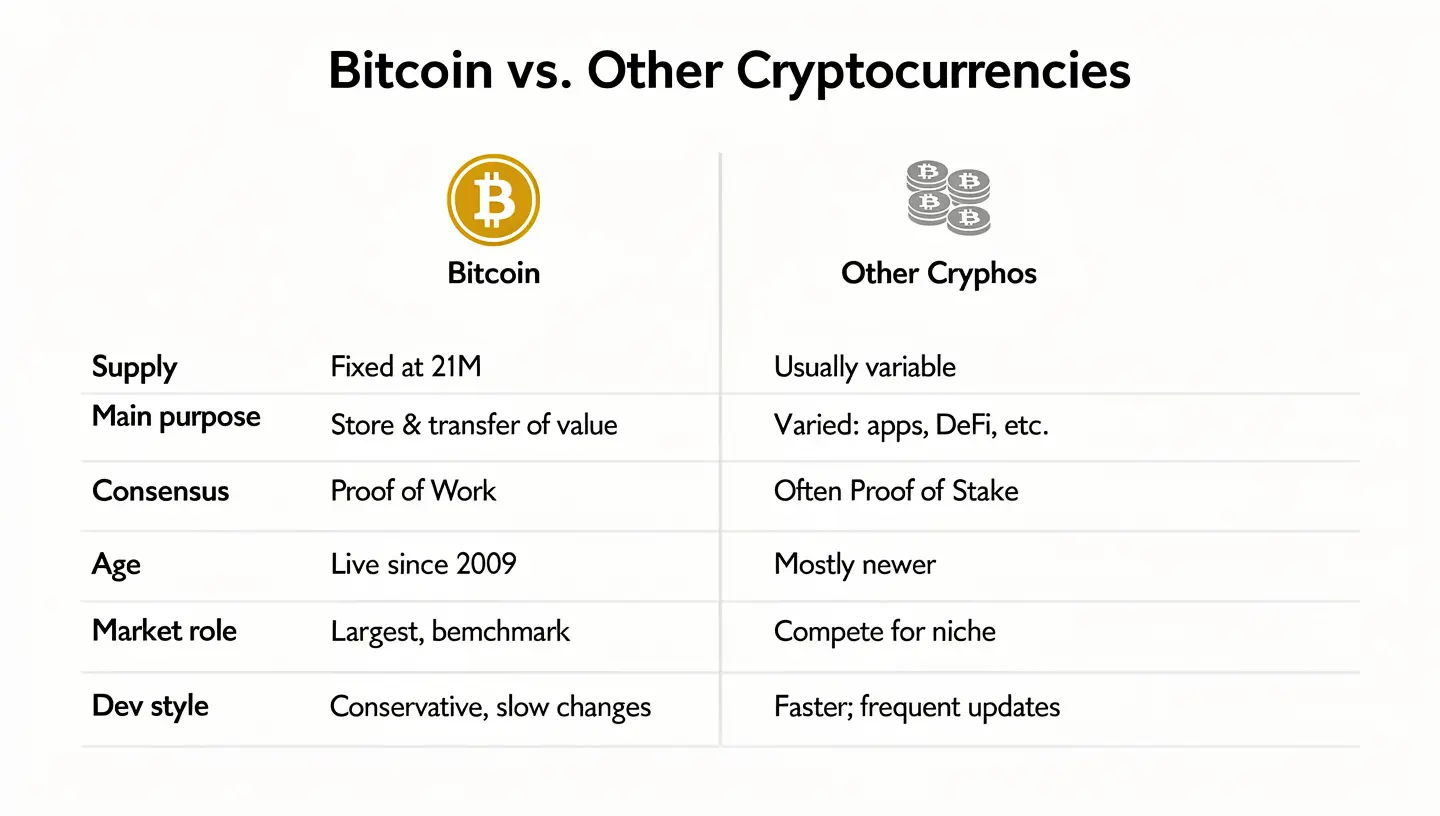
Beyond that, the difference between Bitcoin and cryptocurrency in the broader sense becomes concrete. The table below covers the most important practical points.
| Feature | Bitcoin | Other cryptocurrencies |
|---|---|---|
| Supply | Fixed at 21 million coins, hard cap in the protocol | Varies by coin; many have no fixed cap |
| Primary purpose | Transfer of value; store of value | Varies: smart contracts, payments, governance, speculation |
| Consensus mechanism | Proof of work: miners validate transactions | Often proof of stake or other systems |
| Age and track record | Launched 2009; longest operating history | Most launched 2015 or later |
| Market position | Largest by market cap; reference point for the whole market | Each competes for its own share |
| Developer activity | Conservative, slow-moving by design | Varies widely; many update frequently |
Supply
Bitcoin’s 21 million coin limit is one of its defining characteristics. The protocol was written that way from the start, and the network has never changed it. New Bitcoin enters circulation only through mining block rewards, and those rewards shrink on a set schedule. The current Bitcoin block reward and how it changes over time is covered separately.
Most other cryptocurrencies do not have the same constraint. Ethereum, for example, has no hard cap. Its supply grows as new coins are issued to validators, though a burning mechanism introduced in 2021 destroys a portion of every transaction fee, which can slow or reverse that growth during busy periods. Stablecoins are typically issued on demand, with supply expanding and contracting based on the amount of collateral held.
Purpose and design
Bitcoin was built to do one thing: move value from one person to another without a bank in the middle. It does not support programmable applications natively. It was not designed for smart contracts or decentralized finance. Its simplicity is a deliberate design choice, not a limitation the developers failed to address.
Ethereum, which launched in 2015, was built explicitly to be programmable. Its blockchain can run code, which makes it the foundation for decentralized finance applications, token issuance, and NFTs. Many people call Bitcoin digital gold because of its role as a scarce asset held for the long term. They do not call Ethereum that, because Ethereum is built for a different job.
Consensus mechanism
Bitcoin uses proof of work. Miners run specialized hardware that performs calculations to earn the right to add the next block. The process consumes significant electricity, which is the cost that keeps the network secure. Cheating requires more computing power than the honest participants combined, which is practically unachievable on a network Bitcoin’s size.
Ethereum switched from proof of work to proof of stake in September 2022. Under proof of stake, validators lock up coins as collateral rather than running mining hardware. They are selected to propose and confirm blocks, and dishonest behavior leads to their stake being cut. Several other major cryptocurrencies also use proof of stake or variations of it. The choice of consensus mechanism affects a coin’s energy use, security model, and the economics of participation.
Market position
Bitcoin’s share of the total cryptocurrency market is tracked as Bitcoin dominance, a figure that shows what percentage of all crypto value is held in Bitcoin. When confidence in the broader market is low, dominance tends to rise because investors sell smaller coins and hold Bitcoin. When appetite for risk is high, dominance tends to fall as money moves into altcoins. Understanding what BTC is in crypto and how it functions as the market benchmark is useful context for anyone following prices.
Why do people confuse Bitcoin and crypto?
Bitcoin was the first cryptocurrency, and for several years it was the only one most people had heard of. When Ethereum launched in 2015 and altcoins began to multiply, the media still framed everything through Bitcoin. Headlines read “Bitcoin soars” or “Bitcoin crashes” even when other coins were moving independently. That framing stuck.
The surge in public attention around 2017 brought millions of new people into the market at a time when Bitcoin was still by far the dominant name. By the time they learned that Ethereum or Dogecoin existed, the habit of saying “crypto” and meaning “Bitcoin” was already formed. The two terms became interchangeable in casual speech even though they are not the same thing, and that habit has persisted.
Bitcoin vs other major cryptocurrencies
Comparing Bitcoin to the rest of the market is useful because it shows where the lines are drawn in practice, not just in theory.
Bitcoin vs Ethereum
Bitcoin and Ethereum are both large, well-established cryptocurrencies, but they were built for different purposes and behave differently as assets. Bitcoin has the larger market cap, the longer history, and the simpler protocol. It changes slowly and deliberately. Ethereum has a more active development schedule, supports a much wider range of applications through smart contracts, and has changed its consensus mechanism once already.

The common shorthand is that Bitcoin is digital gold and Ethereum is digital oil: Bitcoin is held as a scarce asset, while Ethereum is consumed to run applications on its network. Neither description is perfectly accurate, but both capture something real about how the two assets are used. They are not competitors in the way that two similar products compete. They are built for different functions and tend to be held for different reasons.
Bitcoin vs stablecoins
Stablecoins are cryptocurrencies designed to hold a fixed value, usually pegged to the US dollar. USDT (Tether) and USDC are the two largest by volume. Unlike Bitcoin, they are not meant to appreciate. Their purpose is to move dollar-equivalent value on a blockchain quickly and cheaply, without the price risk that comes with holding Bitcoin or any other volatile asset.

Stablecoins trade speed and convenience for upside. They do not go up in value, but they also do not drop 30% in a week. Many traders use them as a parking spot between positions, or to send value internationally without converting back to traditional currency first. Bitcoin and stablecoins serve completely different functions and are rarely compared as direct alternatives.
Is Bitcoin better than other cryptocurrencies?
“Better” depends entirely on what you are trying to do. If the goal is to hold a scarce asset with a long track record and the widest recognition, Bitcoin has no close comparison in the cryptocurrency market. Its 15-year operating history without a base-layer security failure, combined with its fixed supply and the size of its network, gives it properties that no altcoin has replicated.
If the goal is to run applications, participate in decentralized finance, or access specific blockchain features, Bitcoin is the wrong tool. It was not built for those things. Ethereum or another programmable blockchain would serve those purposes better. Bitcoin dominance as a market metric reflects this: Bitcoin leads by market cap not because it does everything, but because it does its specific job better than anything else in the market. Nothing on this page is financial advice. Anyone considering a significant position in any cryptocurrency should speak with a qualified financial advisor first.
Frequently asked questions
Is Bitcoin the same as crypto?
No. Bitcoin is one specific cryptocurrency. Crypto is the category that includes Bitcoin, Ethereum, and thousands of other coins and tokens. The relationship is the same as the relationship between a brand and the product it sells: one is the general category, the other is a specific example within it.
What came first, Bitcoin or cryptocurrency?
Bitcoin came first. It launched in January 2009 and was the only functioning cryptocurrency for several years. Satoshi Nakamoto published the Bitcoin whitepaper in October 2008, and the network went live in January 2009 with the mining of the first block. Every other cryptocurrency came after Bitcoin, which is why non-Bitcoin coins are called altcoins, short for alternative coins.
Can you buy crypto without buying Bitcoin?
Yes. Most major exchanges let you buy any listed cryptocurrency directly. You can open an account on a crypto exchange and buy Ethereum, Solana, or any other listed coin without touching Bitcoin at all. Bitcoin is not a gateway to other cryptocurrencies. Each can be purchased independently.
Why is Bitcoin worth more than other cryptocurrencies?
Bitcoin’s price per coin is the highest in the market, and its total market cap is the largest, but those two facts have different explanations. The price is partly a function of the fixed supply of 21 million coins and the demand to hold them. The market cap reflects the total value the market assigns to all Bitcoin in existence. Other coins can have a lower individual price but a comparable or larger total supply, which affects where their market cap lands relative to Bitcoin.
Does how you store crypto differ between Bitcoin and other cryptocurrencies?
The mechanics of storage are similar across most cryptocurrencies: you need a wallet that holds the private keys to your holdings. The main distinction is compatibility. Not all wallets support all coins. Hardware wallets from manufacturers like Ledger and Trezor support Bitcoin and most major altcoins, but it is worth checking before you buy. One notable case: MetaMask does not support Bitcoin natively, because it was built for Ethereum and EVM-compatible networks. If you hold both Bitcoin and Ethereum, you will likely need different wallet software for each.
The split also matters when you think about long-term security. Bitcoin holders who move their coins off an exchange typically use a hardware wallet dedicated to Bitcoin. Ethereum holders using DeFi applications often keep funds in a software wallet like MetaMask for regular access, alongside a hardware wallet for larger amounts they are not actively using. The storage habits differ because the use cases differ. A full breakdown of how storage works across both coin types, including the difference between hot and cold storage, is in the guide to cold wallets for crypto.
Is Bitcoin a good investment compared to other crypto?
Bitcoin has a longer track record and a simpler risk profile than most altcoins, which is why many cautious investors who want cryptocurrency exposure start there. Altcoins can outperform Bitcoin during certain market conditions, but they also carry more risk: smaller market caps, less liquidity, more concentrated ownership, and in many cases shorter histories. Volatility is high across the board. None of this is investment advice. The right answer depends on your situation, time horizon, and how much loss you can absorb.