Cryptocurrency is digital money that runs without a bank or government in the middle. You can send it to anyone in the world, hold it in a digital wallet, or trade it on an exchange. No bank approves the transaction. No government issues the currency. The network handles it automatically. That is the short version. The longer version is below.
What is crypto?
Crypto, short for cryptocurrency, is a form of digital currency that uses cryptography to secure transactions and control the creation of new units. Unlike the dollar or the euro, no central bank prints it and no single institution controls it. The rules are written into the software, and the software runs on thousands of computers at the same time.
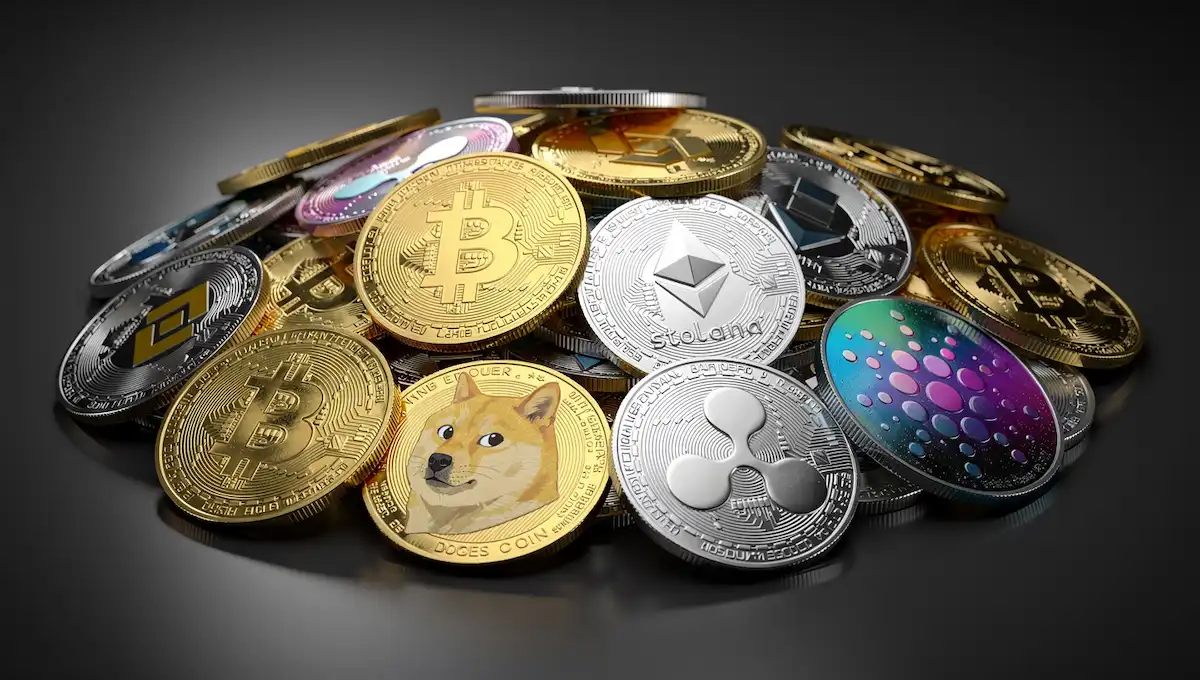
The name comes from the cryptography underneath it. Every transaction is locked with advanced mathematical encryption. That is what makes it hard to forge, hard to reverse, and hard to tamper with after the fact.
Bitcoin was the first cryptocurrency, launched in 2009. Today there are thousands of them. Most share the same core idea: a currency that works outside the traditional financial system, without requiring anyone to trust a bank or a government to keep the records honest.
How does crypto work?
When you send crypto to someone, that transaction does not go through a bank. It gets broadcast to a network of computers spread across the world. Those computers check whether the transaction is valid, group it with other transactions, and lock the whole batch into a block. That block gets added to a chain of previous blocks. That chain is the blockchain.
Every computer on the network keeps a full copy of the blockchain. If one computer tries to change an old transaction, the rest of the network sees a different record and rejects it. The only way to rewrite history would be to control the majority of the network simultaneously, which is practically impossible on large, established cryptocurrencies.
Transactions are recorded publicly. Anyone can look them up. But the names behind the addresses are not visible by default, only the wallet addresses themselves.
What is blockchain?
A blockchain is a distributed ledger, meaning a database that is copied and shared across thousands of computers rather than stored in one place. Each new batch of transactions becomes a block. Each block includes a reference to the one before it, forming a chain going all the way back to the first transaction ever recorded.
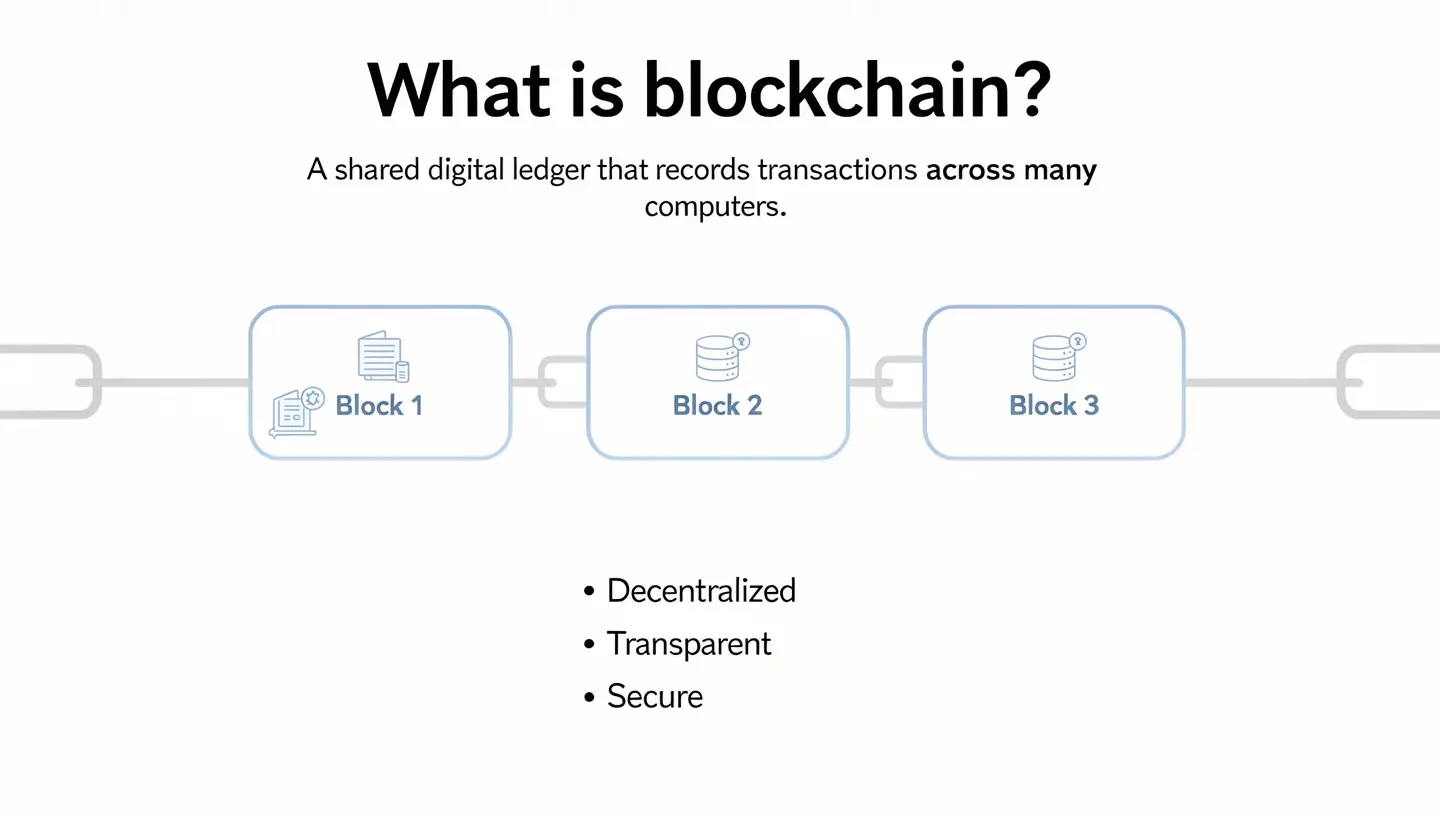
That chain structure is what makes it hard to alter. Change one block and every block after it becomes invalid. The nodes on the network, the computers running the software, would immediately reject the altered version because it does not match their copy. The blockchain does not need a trusted authority because the math and the network structure do the job instead.
What is crypto mining?
Crypto mining is the process by which new transactions are verified and new coins are created. Miners are computers that compete to solve a complex mathematical problem. The first one to solve it gets to add the next block to the chain and earns a block reward, a fixed amount of newly created cryptocurrency, plus the fees from all the transactions in that block.
Mining requires real computing power and a lot of electricity. That is deliberate. The cost of mining is what keeps the network honest: cheating would cost more than it would pay. Bitcoin uses this system, called proof of work. Other cryptocurrencies, including Ethereum since 2022, use proof of stake instead, which replaces mining rigs with validators who lock up coins as collateral.
Types of cryptocurrency
Not all cryptocurrencies are the same. Some are built to transfer money. Some are built to run software. Some are jokes that became worth billions. Here are the main categories a beginner will run into.
Bitcoin
Bitcoin (BTC) is the original cryptocurrency, created in 2009 by a person or group using the name Satoshi Nakamoto. Nobody knows who that is. Bitcoin was designed as a peer-to-peer payment system, a way to send money directly to someone without a bank in the middle.

Bitcoin has a hard cap of 21 million coins. No more can ever be created. That fixed supply is one reason many people treat it as a store of value rather than a spending currency. New Bitcoin is released through mining, but the reward halves roughly every four years in an event called the Bitcoin halving. Over time, those halvings slow the creation of new coins until eventually the last one is mined.
Bitcoin remains the largest cryptocurrency by market cap and the one most institutional investors and governments pay attention to. You can read a full breakdown in the guide to what is Bitcoin.
Ethereum
Ethereum (ETH) launched in 2015. It uses the same blockchain model as Bitcoin but adds something Bitcoin was never designed to do: run programs. Those programs are called smart contracts, pieces of code that execute automatically when their conditions are met, with no middleman needed.

That programmability made Ethereum the foundation for decentralised finance (DeFi), NFTs, and a large share of the crypto applications built in the last decade. The currency used on the Ethereum network is called Ether, though most people call it Ethereum. It is the second-largest cryptocurrency by market cap.
Altcoins and stablecoins
Every cryptocurrency that is not Bitcoin is generally called an altcoin. That covers thousands of projects. Some are serious, some are speculative, some built to serve a specific use case on a particular blockchain.

Stablecoins are a separate category. They are cryptocurrencies pegged to a stable asset, usually the US dollar, so their price does not swing the way Bitcoin or Ethereum does. USDC and Tether (USDT) are the most widely used. They are not investments in the usual sense. They are more like digital cash, useful for moving money quickly or parking funds on an exchange without converting back to dollars.
What is crypto used for?
The original idea was simple: digital payments without a bank. Send money anywhere in the world, to anyone with a wallet address, in minutes, without asking anyone’s permission. That still works and that is still how many people use it.
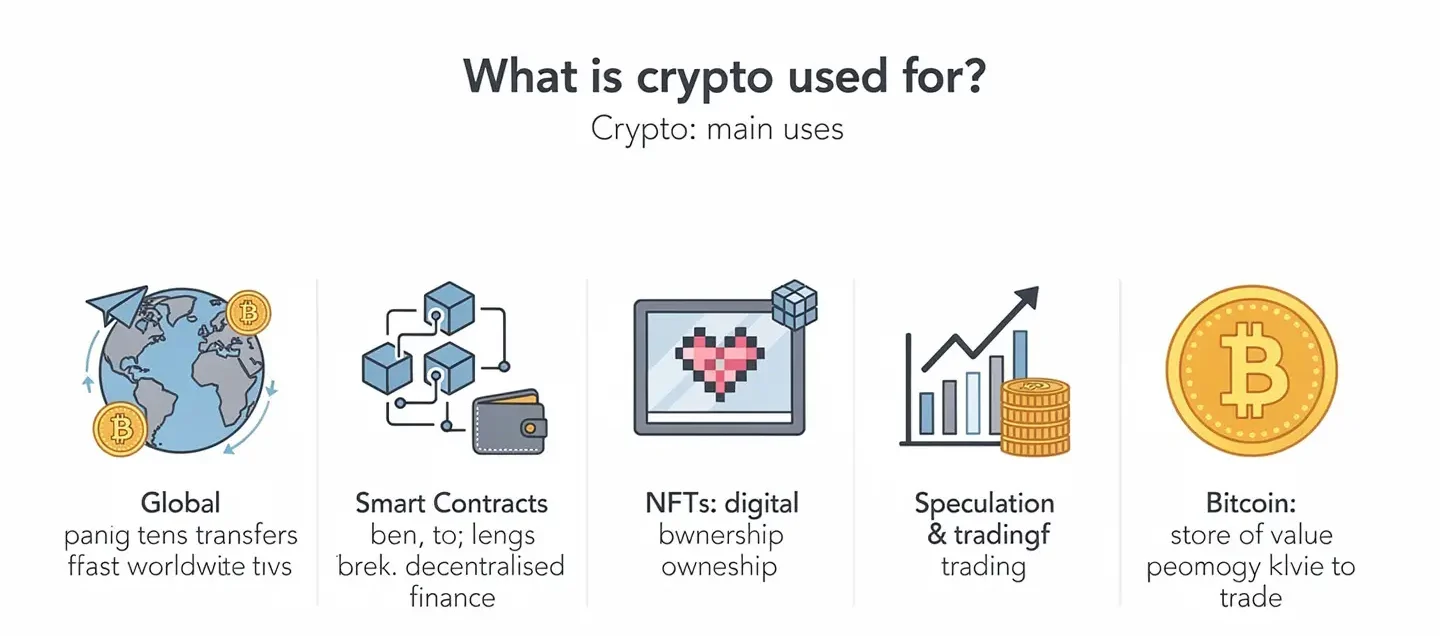
Beyond payments, crypto has developed a range of other uses. DeFi, short for decentralised finance, lets people lend, borrow, and trade directly through smart contracts, without a bank or brokerage in the middle. You connect your wallet and the protocol handles the rest. NFTs used the same technology to record ownership of digital items on a blockchain, though most of the 2021-2022 hype has faded and practical use cases are still finding their footing.
The largest single use right now is speculation. Most people who buy crypto buy it because they expect the price to go up. That is honest and it is how a lot of markets work. But it is worth separating that from the question of what the technology actually does.
Bitcoin specifically is increasingly used as a store of value, meaning a long-term holding rather than a spending currency, similar to how some investors treat gold.
How to buy cryptocurrency
The most straightforward way to buy crypto is through a crypto exchange. An exchange lets you deposit money from your bank account or debit card, buy the cryptocurrency you want, and either keep it on the exchange or move it to your own wallet. The largest exchanges include Coinbase, Kraken, and Binance. Each charges different fees and supports different coins, so it is worth comparing before you sign up.
Here is the basic process:
- Choose an exchange. Look at the fees, the coins available, and the security track record. Regulated exchanges that require identity verification are generally safer than unregulated ones.
- Create and verify your account. Most reputable exchanges require a government-issued ID. This is a legal requirement in most countries, not a choice the exchange makes.
- Deposit funds. Bank transfer is usually the cheapest method. Card payments are faster but often carry higher fees. Most exchanges accept fiat currency, such as dollars, euros, or pounds, which you convert into crypto at the current market rate.
- Place your order. Choose the cryptocurrency, enter the amount, and confirm. The crypto appears in your exchange account within seconds.
- Decide where to keep it. Leaving crypto on an exchange means the exchange holds your private keys. Moving it to your own wallet means you are in control. Both have trade-offs, covered in the next section.
Payment apps like PayPal and Cash App also let you buy crypto without an exchange account, though they give you less flexibility over where you can send it.
How to store crypto safely
Crypto is stored in a crypto wallet. Despite the name, a wallet does not hold coins the way a physical wallet holds cash. What it holds is your private key, the cryptographic proof that you own a particular address on the blockchain. Whoever controls the private key controls the funds.
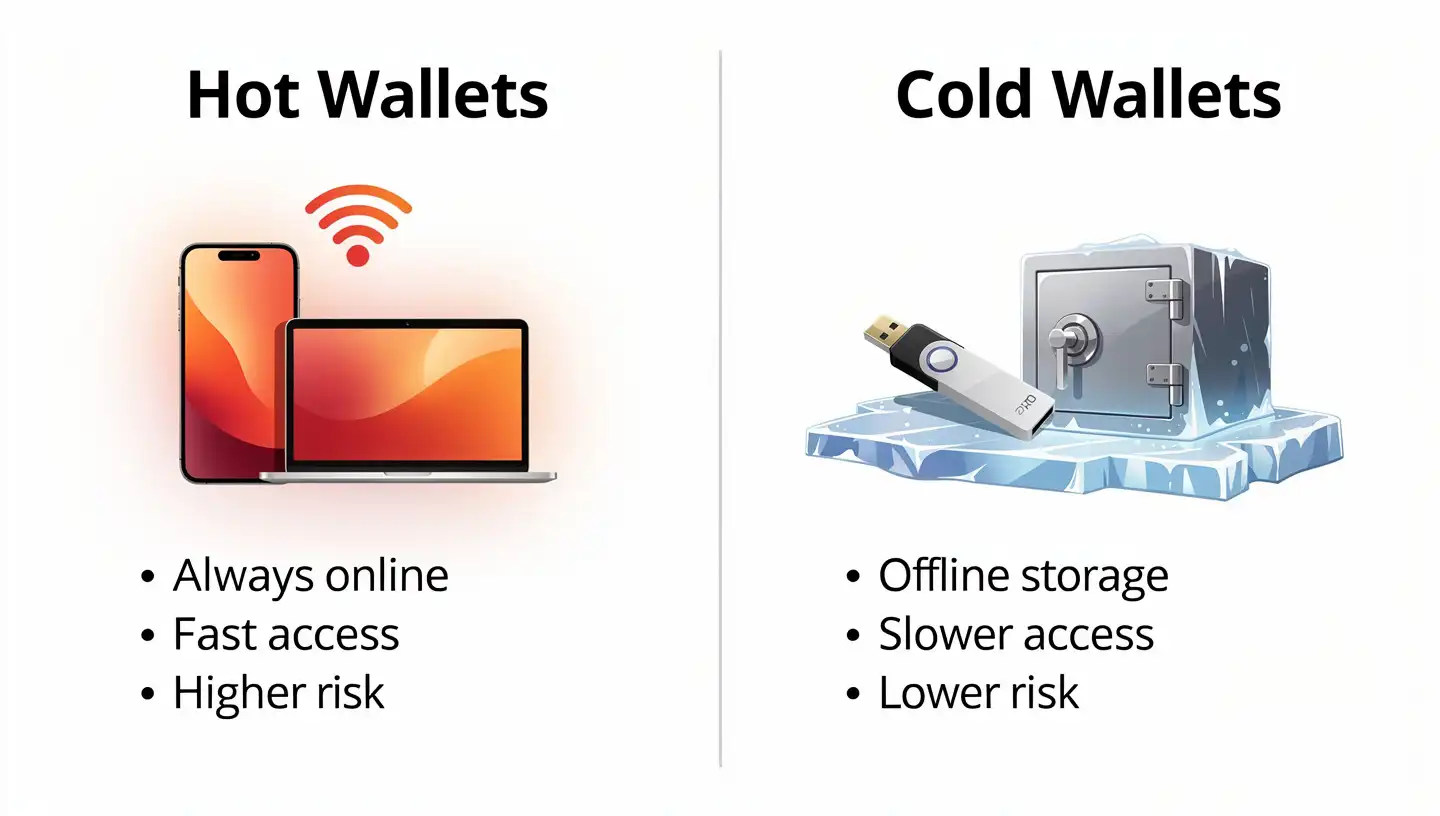
There are two main types of wallet:
| Type | How it works | Best for | Main risk |
|---|---|---|---|
| Hot wallet | Software connected to the internet (app or browser extension) | Regular use, small amounts | Online attacks, malware |
| Cold wallet / hardware wallet | Physical device that stores keys offline | Long-term storage, larger holdings | Physical loss, device failure |
A cold wallet, also called a hardware wallet, keeps your private keys completely offline. It is widely considered the safest way to hold crypto you do not plan to move regularly. When you set one up, you are given a seed phrase: a series of 12 or 24 words that can restore your wallet if the device is lost or damaged. Write it down on paper and keep it somewhere safe. Anyone who gets those words gets your crypto.
Exchanges also hold your crypto for you, which is convenient but means you are trusting them with your private keys. If the exchange is hacked or goes under, access to your funds can disappear with it. A more detailed explanation of how cold storage works and which hardware wallets are worth considering is in the guide to cold wallets for crypto.
If you want to understand the difference between wallets that stay connected to the internet and those that do not, the guide to hot wallets covers the trade-offs, the main software options, and when each type makes sense.
Risks of cryptocurrency
Crypto carries real risks. Understanding them before putting money in is not optional.
Price volatility
Cryptocurrency prices move fast and far. Bitcoin has dropped more than 80% from its peak in previous bear markets and recovered to new highs in later cycles. Ethereum has done the same. Smaller coins have done much worse; many went to zero. Volatility cuts both ways, but the downside is capable of wiping out a large percentage of a position in days or weeks. Anyone who cannot stomach that should think carefully before buying.
Crypto scams and fraud
Crypto scams are widespread. The most common ones follow predictable patterns: fake exchanges that steal deposits, Ponzi schemes dressed up as investment platforms, celebrity impersonators asking you to send funds to receive more back, and romance scams that build trust over weeks before steering victims toward fake trading platforms. If someone you have never met is guiding you toward a specific crypto investment, that is a warning sign. Legitimate investments do not require urgency or secrecy.
Regulation and legal status
Crypto regulation varies significantly by country and is still changing. In the United States, different agencies, including the SEC, the CFTC, and the IRS, treat crypto differently. Some countries have banned it outright. Others, like El Salvador, have made Bitcoin legal tender. The regulatory picture in most places is still unsettled, which creates uncertainty around taxes, reporting requirements, and what happens if a platform you use falls under new rules. Always check what applies in your country before trading.
Is crypto a good investment?
That depends entirely on your situation, including your risk tolerance, your time horizon, and how much you can afford to lose. Crypto is a high-risk, speculative asset class. It has produced large returns for people who bought early and sold at the right time. It has also produced large losses for people who bought at the wrong time or held through a long bear market.
A small position in a diversified portfolio is how many cautious investors approach it. Putting a significant share of savings into a single cryptocurrency is a different kind of bet. If you are unsure, speaking to a qualified financial advisor before buying is the sensible move. Nothing in this article is financial advice.
Frequently asked questions
What is the difference between crypto and Bitcoin?
Bitcoin is one cryptocurrency. Crypto is the broader category that includes Bitcoin, Ethereum, and thousands of others. Saying “crypto” is like saying “stocks”. Bitcoin is one stock in a very large market. A full comparison is in the guide to the difference between crypto and Bitcoin.
Is crypto legal?
In most countries, yes. Buying, holding, and trading cryptocurrency is legal in the United States, the UK, the EU, Canada, and Australia, among others. China has banned it. A few other countries have restrictions or outright bans. Legality and tax treatment are two separate questions. In the US, for example, the IRS treats crypto as property, which means selling it can trigger a capital gains tax even if it is legal to own.
Can you convert crypto to cash?
Yes. You sell your crypto on an exchange for dollars, euros, or another fiat currency and withdraw the proceeds to your bank account. Most withdrawals settle within one to three business days depending on your bank and the platform. Payment apps like PayPal and Cash App also let you sell crypto directly and move the funds to your bank.
What is the safest cryptocurrency for beginners?
No cryptocurrency is safe in the sense of being free from price risk. Bitcoin and Ethereum are the two most established options. They have the longest track records, the largest markets, and the most liquidity. Smaller coins carry more risk because they are less liquid, less tested, and more vulnerable to manipulation. For a first purchase, sticking to the two largest is the most common beginner approach.
How much do I need to start buying crypto?
Most exchanges let you start with as little as $10 or even less. Bitcoin and Ethereum are fractional, meaning you do not need to buy a whole coin. One Bitcoin at $90,000 can be purchased in $50 increments. The minimum is set by the exchange, not the cryptocurrency itself.
What is a crypto seed phrase?
A seed phrase is a sequence of 12 or 24 words generated when you set up a self-custody wallet. It is a human-readable backup of your private key. If you lose access to your wallet, whether from a broken device, deleted app, or damaged hardware wallet, the seed phrase lets you restore everything. Anyone who has those words has full access to your funds. Never store a seed phrase digitally or share it with anyone. A full guide on keeping it safe is in the article on crypto seed phrase storage.
What is the difference between a custodial and a non-custodial wallet?
A custodial wallet is one where a third party, usually an exchange, holds your private keys on your behalf. You log in with a username and password and trust them to keep your funds safe. A non-custodial wallet is one where you hold your own private keys. No company is in between you and your funds. The trade-off is responsibility: if you lose your seed phrase with a non-custodial wallet, there is no customer support to call. Hot wallets, software wallets connected to the internet, are the most common type of non-custodial wallet for everyday use. A full comparison of both wallet structures, including which suits different types of holders, is in the guide to hot wallets.
Most beginners start with a custodial account on an exchange because it is simpler. You do not have to manage keys or worry about seed phrases. The exchange handles security on your behalf. The downside is that you are relying on that exchange to stay solvent, to stay secure, and to remain accessible to you. Several major exchanges collapsed or froze withdrawals in 2022, leaving users unable to access their funds for months or longer. That is why experienced holders typically move significant amounts off exchanges and into their own wallets once they understand how self-custody works. Whether that step is right for you depends on how much you hold and how comfortable you are managing your own keys. The full breakdown of both approaches and how to decide between them is in the article on custodial vs non-custodial wallets.
Sources
This article draws on publicly available information from the following sources:
- Bitcoin: A Peer-to-Peer Electronic Cash System, Satoshi Nakamoto, 2008
- Ethereum Whitepaper, Ethereum Foundation