Bitcoin mining consumes an estimated 175 terawatt-hours (TWh) of electricity per year, comparable to the annual power consumption of countries like Poland or Argentina. That figure represents roughly 0.5% of global electricity demand and is the direct result of proof of work, the consensus mechanism that secures the Bitcoin network by requiring miners to expend real computing power. Understanding where this number comes from, how it is measured, and what it means in context requires looking at several layers of the mining process.
How much electricity does bitcoin mining use?
The most widely cited estimate of bitcoin mining energy consumption comes from the Cambridge Bitcoin Electricity Consumption Index (CBECI), maintained by the Cambridge Centre for Alternative Finance. Their best-guess estimate for 2025 places Bitcoin’s annual electricity consumption at approximately 175.87 TWh. Digiconomist, a separate tracking index, places the figure higher at around 204 TWh. The International Energy Agency estimated total cryptocurrency electricity use at around 110 TWh for 2022, a figure that has grown since.

The range between these estimates is wide and reflects genuine uncertainty in the methodology. All three rely on estimates rather than direct measurement, because the Bitcoin network is decentralized and no single entity can count every watt consumed by every mining machine worldwide. The table below shows the main sources and their current estimates.
| Source | Annual estimate | As of |
|---|---|---|
| CBECI (best guess) | ~175 TWh | 2025 |
| Digiconomist | ~204 TWh | May 2025 |
| IEA (crypto total) | ~110 TWh | 2022 |
| CoinLaw (CBECI-based) | 0.78% of global supply | 2025 |
Bitcoin’s energy consumption does not scale with the number of transactions processed. Unlike a payment network such as Visa, where more transactions mean more processing work, Bitcoin mining continues at the same rate regardless of whether the network processes 100,000 transactions or 1 million in a day. The mining machines run continuously and compete for block rewards independent of transaction volume. This distinction matters when comparing Bitcoin to other systems on a per-transaction basis. A full explanation of what Bitcoin is and how it operates is in the guide to what is Bitcoin.
Why does bitcoin mining use so much energy?
The energy demand is not incidental to how Bitcoin works. It is built into the design.

The mechanism that secures the network, validates transactions, and issues new coins is the same mechanism that consumes the electricity.
Proof of work is the root cause
Bitcoin uses proof of work as its consensus mechanism. Miners compete to solve a cryptographic puzzle by running inputs through the SHA-256 hashing algorithm billions of times per second. Each attempt produces a hash output. Miners change a value in the block header called the nonce and run the algorithm again and again until one produces an output below the current target. The first miner to find a valid hash adds the block to the blockchain and collects the reward.
There is no shortcut. Miners cannot predict which nonce will produce a valid hash. They must generate hashes continuously until one succeeds by chance. The expected time between blocks is 10 minutes. At the current global hashes per second rate, that 10-minute window requires an enormous number of attempts from the combined network. Every one of those attempts consumes electricity. How this fits into the broader structure of how crypto works is covered in the guide to how crypto works.
Mining difficulty and the competitive arms race
As more miners join the network, blocks start arriving faster than the 10-minute target. Every 2,016 blocks, the protocol runs a difficulty adjustment that raises the target threshold, making it harder to find a valid hash. More computing power on the network means higher mining difficulty, which means more hashes are required per block, which means more electricity is consumed to produce the same number of blocks as before.
This dynamic has driven the transition from standard computer processors to graphics cards to purpose-built ASIC miners over Bitcoin’s history. Each generation of hardware produces more hashes per watt than the previous one, but the network difficulty adjusts upward in response, erasing the efficiency gain at the network level. Individual miners become more efficient; the network as a whole consumes more energy as more of them join. Understanding the block reward that incentivizes this competition is explained in the guide to Bitcoin block reward.
ASICs run continuously and cannot throttle down
A Bitcoin ASIC miner, once powered on, runs at full capacity around the clock. It does not reduce output when electricity is expensive or supply is constrained. Modern ASIC machines consume between 3,000 and 7,000 watts continuously. Electricity typically represents 60 to 80% of a mining operation’s total operational costs, making it the single largest expense in the business of mining Bitcoin.
This constant demand creates what is called a baseload requirement. Mining operations add a steady, uninterrupted draw on whatever power grid or energy source they connect to. They do not consume power only when renewable energy is available and pause when it is not. They run at the same rate regardless of whether the sun is shining or the wind is blowing, which has significant implications for how renewable energy integrates with mining operations.
How bitcoin energy consumption is measured
Unlike a factory with a known wattage, Bitcoin mining has no central meter. The network is distributed across hundreds of thousands of machines in dozens of countries. Every published figure for Bitcoin’s electricity use is a calculated estimate, not a direct measurement. Understanding how those estimates are built explains why different sources give very different numbers.
The Cambridge Bitcoin Electricity Consumption Index (CBECI)
The Cambridge Bitcoin Electricity Consumption Index, published by the Cambridge Centre for Alternative Finance, is the most widely referenced methodology in academic and policy discussions. It uses a top-down approach: starting from the total network hash rate, it applies assumptions about the mix of mining hardware efficiency in use across the network to estimate total power demand in gigawatts, then converts that to an annualized TWh figure.
The CBECI publishes three figures: a lower bound based on the assumption that all miners use the most efficient hardware available; an upper bound based on the least efficient hardware that would still be profitable; and a best-guess estimate that sits between those two extremes. The index updates daily as hash rate changes. In 2023, Cambridge issued a significant revision to its model, correcting what it found to be an overestimation in earlier figures. The revised methodology lowered the 2021 consumption estimate by approximately 15 TWh, from 104 TWh to 89 TWh.
Why estimates vary so widely
The difference between an estimate of 87 TWh and one of 240 TWh for the same network in the same period comes down to assumptions about hardware. If a researcher assumes miners are running primarily efficient, recent-generation ASICs, the estimate will be lower. If the researcher assumes a mix of older, less efficient machines are still running because they remain marginally profitable, the estimate will be higher. Neither assumption can be verified directly because miners do not report their hardware configurations publicly.
A second source of confusion is the difference between per-transaction and per-network metrics. Because Bitcoin’s energy consumption does not change based on transaction volume, dividing total energy use by total transactions produces a large number per transaction. Digiconomist uses this metric and arrives at figures around 945 kWh per transaction. This is a useful comparison point but does not mean that processing one more Bitcoin transaction requires 945 kWh of additional energy. The network would consume the same electricity whether that transaction existed or not. How Bitcoin compares to other cryptocurrencies as an asset class is covered in the guide to Bitcoin vs crypto.
How does bitcoin energy use compare?
Absolute numbers like 175 TWh are difficult to interpret without reference points. The comparisons that appear most often in coverage of this topic are against national electricity consumption, against payment networks, and against gold mining.
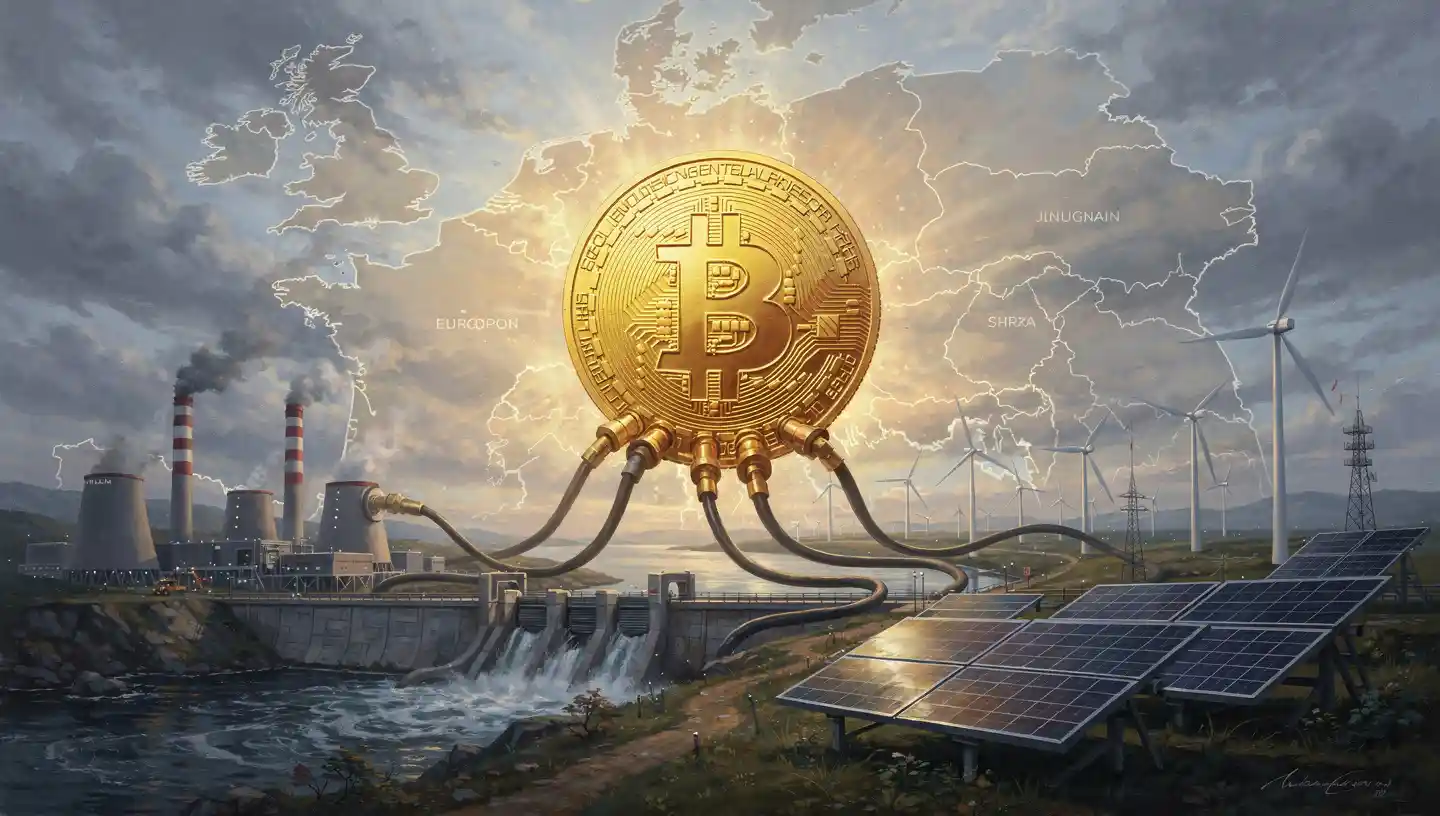
Bitcoin vs countries: which nations use comparable power
Comparing Bitcoin’s annual electricity consumption to national figures gives a sense of scale. The table below uses CBECI estimates alongside publicly available national consumption data.
| Country | Annual electricity consumption |
|---|---|
| Poland | ~172 TWh |
| Argentina | ~130 TWh |
| Norway | ~124 TWh |
| Finland | ~85 TWh |
| Thailand | ~204 TWh |
| Bitcoin (CBECI best guess) | ~175 TWh |
These comparisons place Bitcoin’s consumption in a range broadly similar to mid-sized European countries or large developing economies. They do not account for what Bitcoin’s energy expenditure produces, which is a subject of ongoing debate, but they give a scale reference that the raw TWh figure alone does not. The Bitcoin halving mechanism, which directly affects how much miners earn and therefore how much energy is economically justified, is explained in the guide to Bitcoin halving.
Bitcoin vs VISA: is the comparison fair?
The most commonly cited comparison is Bitcoin vs Visa on a per-transaction basis. Digiconomist calculates that a single Bitcoin transaction carries an energy footprint of approximately 945 kWh, equivalent to the power consumption of an average US household for over 32 days. By contrast, a Visa transaction consumes a fraction of a kilowatt-hour. The ratio is frequently cited as evidence that Bitcoin is incompatibly energy-intensive as a payment system.
The comparison has a significant limitation. Bitcoin’s energy consumption does not change with the number of transactions. The network would consume the same electricity if it processed zero transactions on a given day or one million. Per-transaction energy figures for Bitcoin divide a fixed cost by a variable denominator, which produces a misleading impression that each additional transaction requires that much energy. Visa’s energy consumption does scale with transaction volume, making the metrics structurally different. The comparison remains useful for illustrating the absolute scale difference, but treating it as a direct equivalence understates the complexity. How crypto functions as a technology at the protocol level is covered in the guide to what is crypto.
Bitcoin vs gold mining: carbon and energy
Digiconomist compares Bitcoin mining to gold mining as an alternative reference point, since both are often described as stores of value. Gold mining produces approximately 31 tonnes of CO2 per bitcoin-equivalent value of gold mined. Bitcoin mining produces approximately 694 tonnes of CO2 per mined bitcoin, including transaction fees. On this basis, Bitcoin mining produces significantly more carbon per unit of value than gold mining does.
The comparison is not straightforward either. Gold mining also produces physical byproducts, requires land use, generates chemical waste, and employs large numbers of workers in ways that Bitcoin mining does not. The energy and carbon figures are comparable; the full environmental and economic profiles are not identical. Both comparisons, against Visa and against gold, are useful for illustrating scale rather than for drawing direct conclusions about which is more or less justified as an activity.
Where does bitcoin mining happen?
The geographic location of mining matters because the carbon footprint of electricity varies dramatically from one country to the next. Coal-heavy grids produce far more CO2 per kilowatt-hour than grids powered by hydro or nuclear energy.

The shift after China’s 2021 mining ban
Before 2021, China dominated global Bitcoin mining. In 2019, Chinese operations controlled an estimated 75% of the global hash rate. In May and June 2021, the China mining ban came into effect, ordering all Bitcoin mining operations to shut down. The hash rate fell by approximately 50% within weeks as Chinese facilities went offline. Miners relocated equipment to the United States, Kazakhstan, Russia, and Canada over the months that followed.
By 2025, the United States leads global Bitcoin mining with approximately 37.8% of the network’s hash rate, according to the Cambridge Centre for Alternative Finance. Kazakhstan holds the second position. This geographic shift fundamentally changed the energy mix powering the network. The relationship between Bitcoin as an asset and the mining activity that secures it is covered in the guide to what is BTC in crypto.
How location determines carbon intensity
The same hash rate produces very different carbon footprint figures depending on where it runs. A mining facility powered by hydroelectricity in Canada or a Nordic country may produce close to zero direct CO2 emissions. The same hardware running in Kazakhstan on a coal-heavy grid produces significantly more. Research published in Joule found that the average carbon intensity of electricity consumed by the Bitcoin network increased from approximately 478 gCO2/kWh in 2020 to around 558 gCO2/kWh in August 2021, because the China ban removed miners who had access to seasonal hydroelectric power and replaced them with operations in regions that rely more heavily on coal and natural gas.
This means that the network’s carbon footprint is not a fixed function of its energy consumption. The same 175 TWh consumed in a year when mining is concentrated near renewable energy sources produces a very different CO2 outcome than 175 TWh consumed in a year when mining shifts toward coal-dependent regions. Carbon intensity is as important as total energy consumption when assessing environmental impact.
Bitcoin mining and renewable energy
Renewable energy has become an increasingly important part of the Bitcoin mining industry’s energy mix, driven partly by cost and partly by regulatory and reputational pressure. The data shows meaningful progress but also genuine constraints.
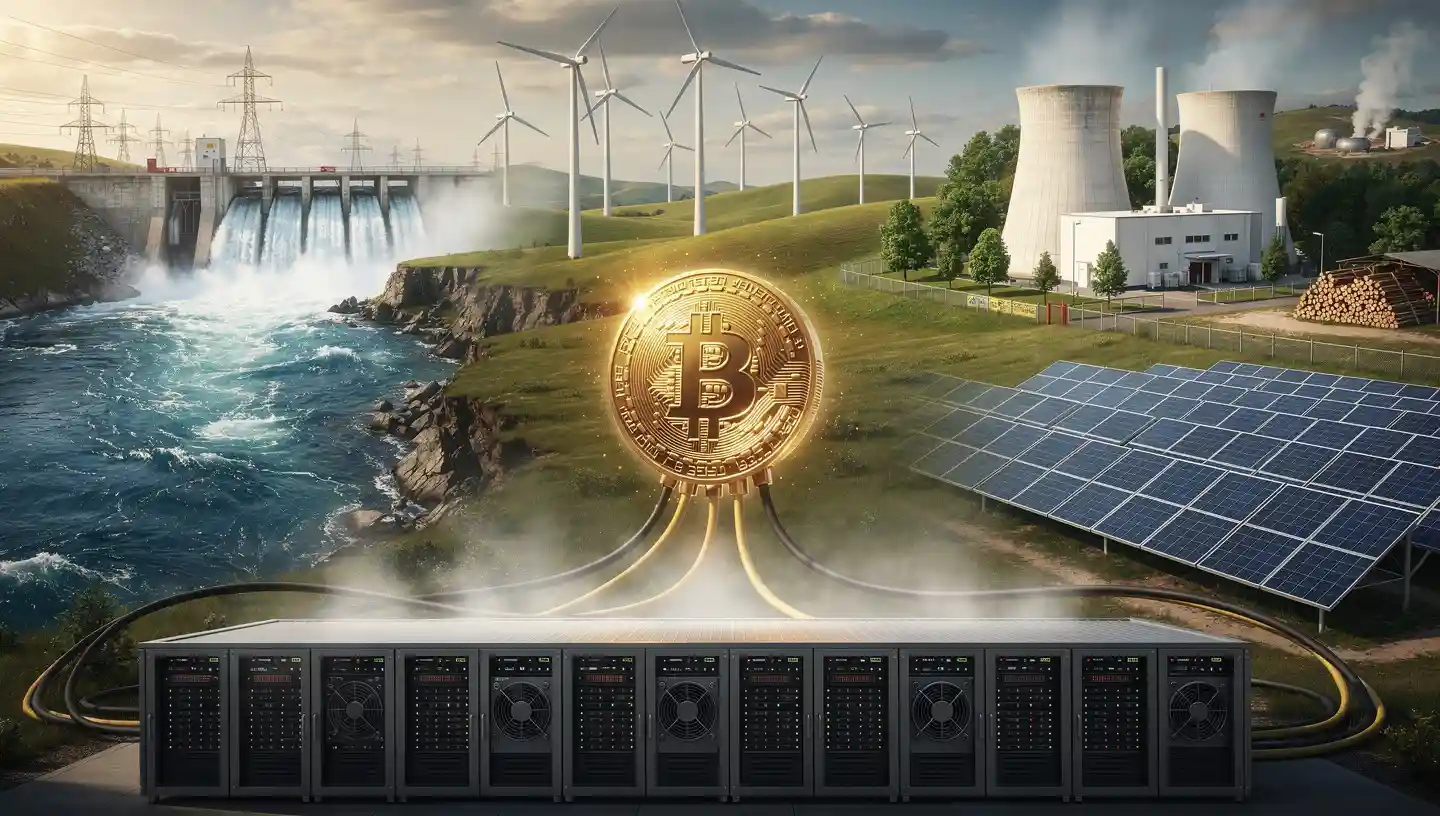
How much mining uses renewables today
ESG analyst Daniel Batten’s research, which has been widely cited in the industry, estimates that approximately 52.4% of Bitcoin mining now runs on renewable energy. The breakdown across energy types is as follows:
- Hydropower: 23.12% of all Bitcoin mining
- Wind energy: 13.98%
- Nuclear energy: 7.94%
- Solar energy: 4.98%
- Other renewables: approximately 2.40%
The CBECI’s own analysis of the energy mix is more conservative, reflecting methodological differences in how renewable usage is attributed. Both the Batten study and Cambridge agree that the renewable share has grown since 2019 and that the trend is continuing, driven by the lower cost of renewable electricity in many mining regions and by new mining operations deliberately siting near hydroelectric and wind assets.
The baseload problem: why renewable energy alone is not enough
The challenge with renewable energy as a complete solution for Bitcoin mining is the nature of renewables themselves. Most renewable sources, including solar and wind, are intermittent: they produce electricity when conditions allow, not on demand. Bitcoin ASIC miners do not operate intermittently. They run at full capacity continuously. A mining operation that connects to a solar installation still needs power at night. If the grid backup at that point draws from fossil fuels, the operation is not fully renewable in practice.
Researchers at Digiconomist, in a peer-reviewed paper in Joule, argue that Bitcoin miners increase the baseload demand on whatever grid they connect to. During periods when renewable generation falls short, miners historically have drawn from fossil fuel sources to maintain operations. This limits how much of the renewable share can be verified as genuinely additive to the energy transition. The Bitcoin network’s security model, which depends on continuous mining activity, is the reason this constraint exists.
Stranded energy and flared gas mining
One argument that proponents of Bitcoin mining make is that miners can use stranded energy, electricity that is generated but cannot be transmitted to population centers because it is produced far from demand or at times when the grid has no capacity to absorb it. Hydroelectric dams in remote areas sometimes produce more power than local grids can use. Solar installations during peak generation hours sometimes produce surplus power that must be curtailed. Bitcoin miners can, in principle, consume this otherwise wasted energy without displacing it from other uses.
A related argument involves flared gas: natural gas that is burned off at oil production sites because it is not economical to capture and transport. Some mining operations have been set up to use this gas to generate electricity on-site, converting what would be a direct methane emission into CO2 by combustion, which has a lower warming impact. The scale of these practices remains small relative to total Bitcoin mining, but the model is technically valid and represents a case where mining may produce a net environmental benefit compared to the alternative of direct methane release. For those who hold bitcoin and want to understand the different options for storing it, the guide to custodial vs non-custodial wallets covers the key distinctions.
The environmental footprint beyond electricity
Electricity consumption and carbon emissions are the most discussed aspects of Bitcoin mining’s environmental impact, but researchers have identified two additional footprints that receive less attention: electronic waste and water consumption.
Carbon emissions
Bitcoin mining’s annual CO2 emissions are estimated at between 98 and 114 million tonnes per year, depending on the source and methodology. Digiconomist’s current estimate is approximately 114 million tonnes CO2, comparable to the annual carbon footprint of the Czech Republic. SolarTech’s 2025 analysis arrives at 98.1 million tonnes, comparable to Qatar. The difference between these figures reflects the uncertainty in both the total electricity consumption estimate and the assumed carbon intensity of the energy mix.
The single largest determinant of Bitcoin’s carbon output is where miners source their power. Two mining operations with identical energy consumption but different energy mixes can have radically different carbon footprints. This is why the geographic distribution of mining matters as much as the total electricity figure when assessing environmental impact.
Electronic waste from obsolete mining hardware
Bitcoin mining generates significant electronic waste as mining hardware becomes obsolete. Digiconomist estimates that the Bitcoin network produces approximately 20.77 kilotonnes of e-waste annually, comparable to the small IT equipment waste produced by the Netherlands. The primary driver is the economics of ASIC hardware: each new generation of machines produces more hashes per watt, making the previous generation less competitive and eventually unprofitable.
An ASIC miner’s useful life before it is displaced by newer, more efficient hardware is typically 18 to 24 months in a competitive mining environment. Unlike general-purpose computers, which can be repurposed for other tasks, mining hardware is purpose-built for SHA-256 hashing. When it is no longer profitable to mine with a given machine, there is no secondary market or alternative use. The hardware becomes waste.
Water consumption
Bitcoin mining consumes water through two pathways. The first is direct cooling: mining facilities use cooling systems that may involve water chillers or evaporative cooling towers. The second is indirect: most of the electricity that powers mining is generated by thermoelectric power plants, which require large amounts of water for steam generation and cooling. Digiconomist estimates total annual water consumption attributable to Bitcoin mining at approximately 3,222 gigaliters, comparable to Switzerland’s total annual water use.
The indirect pathway through thermoelectric power generation accounts for the majority of this figure. When a mining operation uses coal or gas-fired electricity, the water consumed at the power plant to generate that electricity is counted in Bitcoin’s water footprint. Mining operations that use renewable energy sources with lower water requirements, such as wind and solar, have a substantially lower water footprint than those using thermal generation.
Frequently asked questions
How much electricity does bitcoin mining use per year?
The most widely cited estimate is approximately 175 TWh per year, based on the Cambridge Bitcoin Electricity Consumption Index. Digiconomist estimates the figure higher at around 204 TWh. Both are estimates based on hash rate and hardware efficiency assumptions rather than direct measurement. The actual figure lies somewhere in the range of 150 to 240 TWh depending on the methodology used, with most sources converging around 175 TWh for 2025.
Why does bitcoin use so much energy?
Bitcoin uses large amounts of energy because its security model requires it. The proof of work consensus mechanism works by requiring miners to expend computing power and electricity in a mathematical competition. Mining difficulty adjusts every 2,016 blocks to keep average block times near 10 minutes. As more miners join and upgrade to more powerful ASIC hardware, difficulty rises and total network energy consumption increases.
How much CO2 does bitcoin mining produce?
Estimates of Bitcoin mining’s annual CO2 emissions range from approximately 98 to 114 million tonnes per year. The variation depends on assumptions about the carbon footprint of the electricity used. Operations powered by coal-heavy grids produce far more CO2 per kilowatt-hour than those using hydro or wind power. The geographic distribution of mining directly determines the network’s carbon output from year to year.
What percentage of bitcoin mining uses renewable energy?
Research by ESG analyst Daniel Batten estimates that approximately 52.4% of Bitcoin mining currently runs on renewable energy, with hydropower accounting for the largest share at 23.12%, followed by wind at 13.98%. Cambridge’s own estimates are more conservative. The renewable share has grown over time as miners seek lower electricity costs and as new operations locate near renewable energy sources.
Will bitcoin ever use less energy?
Bitcoin’s energy consumption is unlikely to decrease significantly as long as it runs on proof of work. Proof of work is hardcoded into the Bitcoin protocol, and any change would require consensus from the entire network, which Bitcoin’s community has consistently rejected. Hardware efficiency improvements continue, but rising hash rate driven by higher bitcoin prices has historically offset efficiency gains at the network level. The most realistic path to a lower carbon footprint, without reducing total energy use, is continued growth in the renewable energy share of the mining mix.
How does bitcoin energy use compare to VISA?
On a per-transaction basis, Bitcoin consumes dramatically more energy than Visa. Digiconomist estimates approximately 945 kWh per Bitcoin transaction versus a fraction of a kilowatt-hour for a Visa transaction. However, Bitcoin’s energy consumption does not scale with transaction volume. The network consumes the same electricity regardless of whether it processes 100,000 or 1,000,000 transactions per day. Visa’s energy use does scale with volume, making the per-transaction comparison useful for scale illustration but not for measuring the marginal cost of each additional Bitcoin transaction.
Sources
- Cambridge Bitcoin Electricity Consumption Index (CBECI), Cambridge Centre for Alternative Finance
- Bitcoin Energy Consumption Index, Digiconomist