The current bitcoin block reward is 3.125 BTC per block. That figure has been in place since April 20, 2024, when the network reached block height 840,000 and the fourth bitcoin halving automatically cut the previous reward of 6.25 BTC in half. Every block added to the blockchain from that point forward pays the winning miner 3.125 BTC in newly created bitcoin, plus any transaction fees included in that block.
What is the bitcoin block reward?
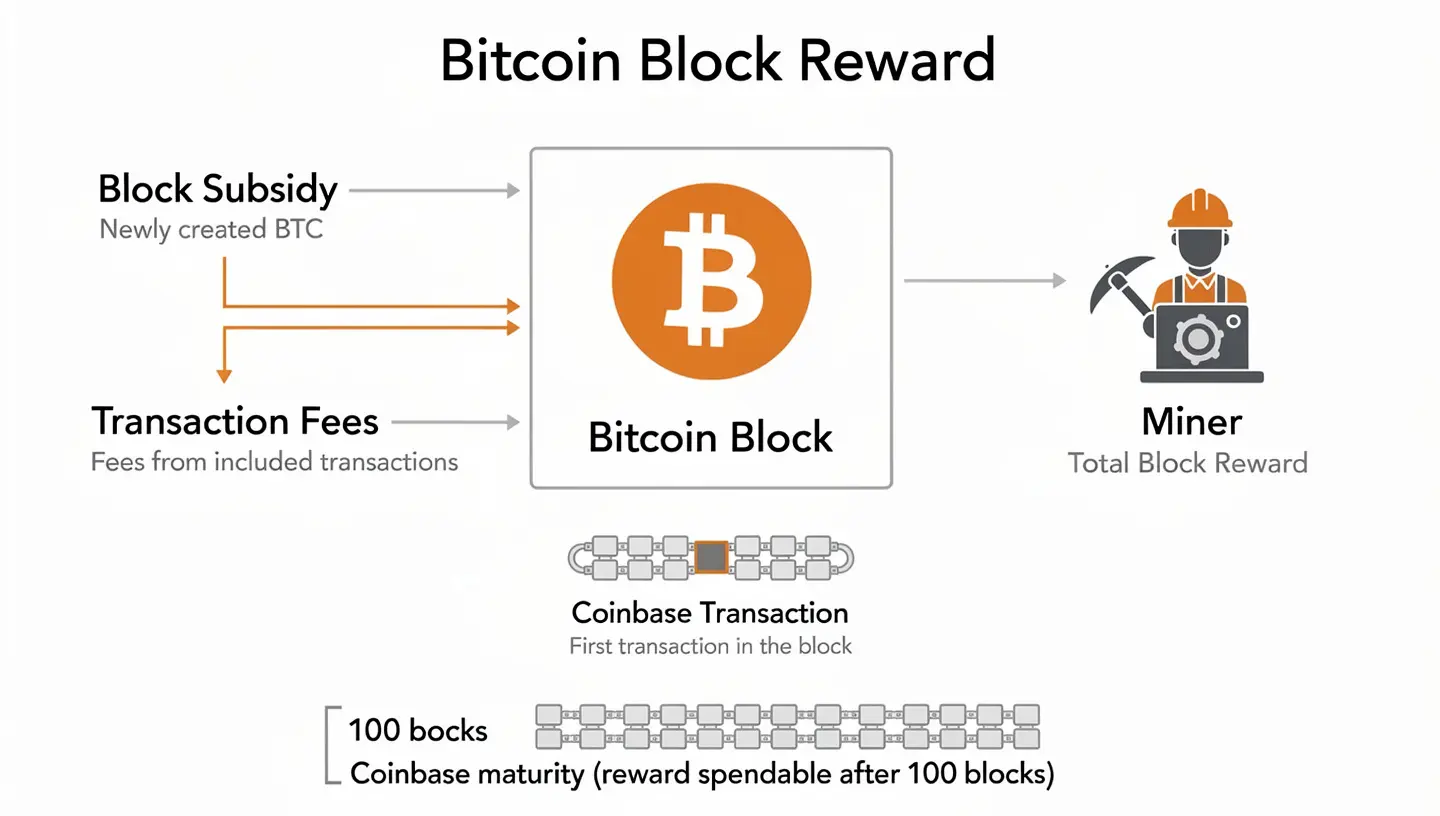
The bitcoin block reward is the payment a miner receives for successfully adding a new block of transactions to the Bitcoin blockchain. It has two parts. The first is the block subsidy: newly created bitcoin that the protocol issues directly to the miner. The second is transaction fees: small payments made by users whose transactions are included in the block. Together, these two amounts form the total reward collected by the miner for each block they mine.
New bitcoin can only enter circulation through this process. There is no treasury, no company, and no central bank issuing coins. The only mechanism is the block reward, paid out every time a miner wins the right to add the next block. This is how the Bitcoin protocol distributes new supply in a controlled and predictable way.
The payment is collected through a special first transaction inside every block, called the coinbase transaction. This is not related to the exchange of the same name. The coinbase transaction has no sender because the coins are newly created. It credits the miner’s address with both the block subsidy and all the fees from that block. A miner cannot spend this reward until the block is at least 100 blocks deep in the chain, a rule known as coinbase maturity, which gives the network time to confirm the block is valid.
Bitcoin uses proof of work to select which miner earns the reward. Miners compete by running hardware that repeatedly generates hashes until one produces a hash below the current target. The first to do so broadcasts the new block and collects the reward. The process requires real computing power and electricity, which is what makes cheating expensive and honest mining profitable.
The current bitcoin block reward: 3.125 BTC
The current bitcoin block reward is 3.125 BTC per block. At an average block time of ten minutes, the network produces roughly 144 blocks per day. That means approximately 450 BTC enters circulation each day under the current schedule, down from 900 BTC per day before the April 2024 halving.
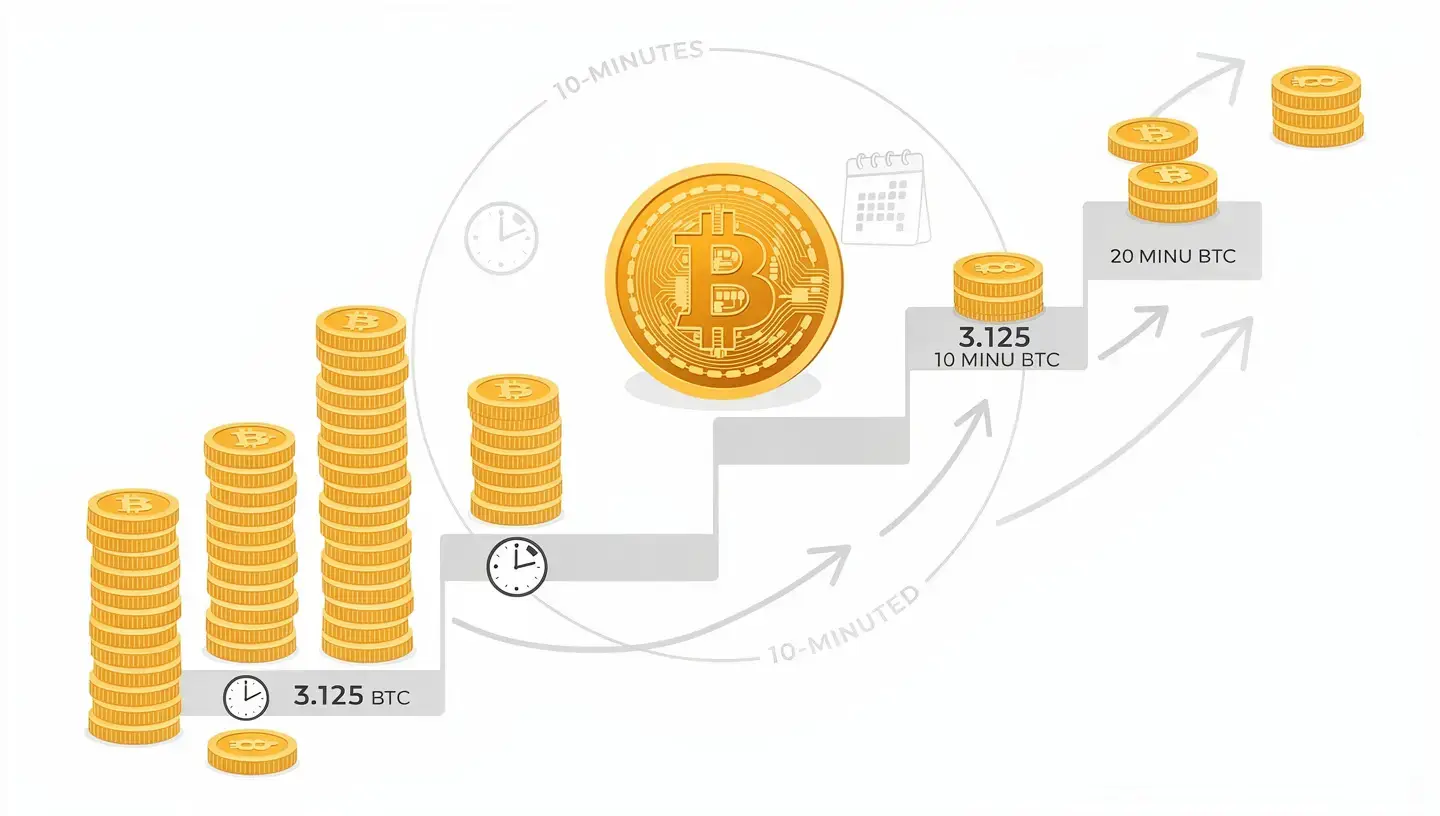
On an annual basis, the network issues around 164,000 BTC at the current rate. The actual number varies slightly because block times fluctuate around the ten-minute average, but the protocol’s difficulty adjustment keeps the pace close to that target. You can check any recent block on a block explorer like mempool.space to see the exact subsidy and fees paid to the miner for each block.
The dollar value of 3.125 BTC changes with the bitcoin price, so the reward is worth more in dollar terms when the price is higher and less when it is lower. That dynamic is one reason halvings attract attention: cutting the subsidy in half while demand remains steady tends to reduce the rate at which new supply enters the market, which historically has preceded price increases. The full context of what BTC is and how it functions is covered in the guide to what is BTC in crypto.
How did bitcoin block rewards change over time?
Bitcoin launched in January 2009 with a block subsidy of 50 BTC. That number was not chosen arbitrarily. Satoshi Nakamoto wrote the halving schedule directly into the protocol before launch, setting it to cut the reward in half every 210,000 blocks, which works out to roughly four years at a ten-minute block time. The table below shows every halving that has occurred and what comes next.
| Year | Block height | Block reward (BTC) | Event |
|---|---|---|---|
| 2009 | 0 | 50 | Genesis block, Bitcoin launch |
| 2012 | 210,000 | 25 | First halving |
| 2016 | 420,000 | 12.5 | Second halving |
| 2020 | 630,000 | 6.25 | Third halving |
| 2024 | 840,000 | 3.125 | Fourth halving (current) |
| 2028 | 1,050,000 | 1.5625 | Fifth halving (next) |
| 2032 | 1,260,000 | 0.78125 | Sixth halving |
| ~2136 | 6,300,000 | 0.00000001 | Final non-zero block reward |
| ~2140 | 6,930,000 | 0 | Last halving, reward reaches zero |
One technical detail worth noting: the total Bitcoin supply is often cited as 21 million, but the actual maximum is 20,999,999.9769 BTC. The reason is that the halving is implemented as a right bit shift in the code, which rounds down whenever the previous reward was an odd number of satoshis. The rounding is tiny, but it means the cap is fractionally below the round figure most sources quote.
Each completed halving is part of a broader history covered in detail in the guide to Bitcoin vs crypto, which explains how Bitcoin’s fixed supply distinguishes it from most other cryptocurrencies.
Why does the block reward get halved?
The halving exists to control the rate at which new bitcoin enters circulation. Bitcoin was designed as a deflationary asset with a hard cap: no more than 21 million coins can ever exist. To approach that cap gradually rather than all at once, the protocol reduces new issuance on a fixed schedule. Every 210,000 blocks, the block subsidy is cut in half, slowing the rate at which new supply enters the market.
This design was deliberate. Satoshi Nakamoto modeled it on the scarcity of precious metals. Gold becomes harder to mine over time as the easiest deposits are exhausted. Bitcoin becomes harder to produce in a different way: the reward for doing so shrinks on a predictable schedule. The idea is that rising demand combined with a falling issuance rate should support the value of the coins already in circulation.
The halving also controls inflation in a way no central bank can override. The schedule is written into the code, and changing it would require agreement from the entire network. In the history of Bitcoin, no halving has ever been delayed, skipped, or modified. The full explanation of how this works technically is in the guide to how crypto works.
How halving controls bitcoin supply
Each halving reduces the annual issuance rate relative to the total supply. Before the 2012 halving, Bitcoin had an inflation rate above 50%. By the 2024 halving, the rate had fallen below 1% annually for the first time. After the 2028 halving, it will fall below 0.5%. This progressively tightening supply is what gives Bitcoin its fixed supply characteristic over the long term, even though new coins are still being issued today.
The 210,000 blocks between each halving take approximately four years at the ten-minute target block time. The exact date of any halving becomes clearer as it approaches, because actual block times fluctuate slightly around that average. The Bitcoin network’s difficulty adjustment mechanism keeps the average close to ten minutes, but short-term variation means the precise date can shift by days or weeks from any early estimate.
What happens when all 21 million bitcoin are mined?
When the block reward reaches zero, around 2140, the protocol will stop issuing new bitcoin. Miners will no longer receive a block subsidy but will continue earning transaction fees from every block they mine. At that point, fees become the only source of miner income and the only economic incentive to keep adding blocks to the chain.
Whether transaction fees alone will be sufficient to secure the network at that scale is a long-standing question in Bitcoin research. The expectation is that if Bitcoin adoption continues to grow, the volume and value of transactions will be high enough that fees provide an adequate security budget. Halvings happening over the next 30 to 40 years will give the network time to transition gradually, with fees growing as a proportion of total miner income well before the subsidy disappears entirely. The broader context of Bitcoin’s design and what makes it different from other cryptocurrencies is covered in the guide to what is Bitcoin.
What does the block reward mean for miners?
For Bitcoin miners, the block reward is the primary source of income. When the subsidy is cut in half, miners collecting the same number of blocks per day receive half the bitcoin they did before, in subsidy terms. If the bitcoin price does not rise enough to compensate, their revenue in dollar terms falls. This makes each halving a financial stress test for the mining industry.
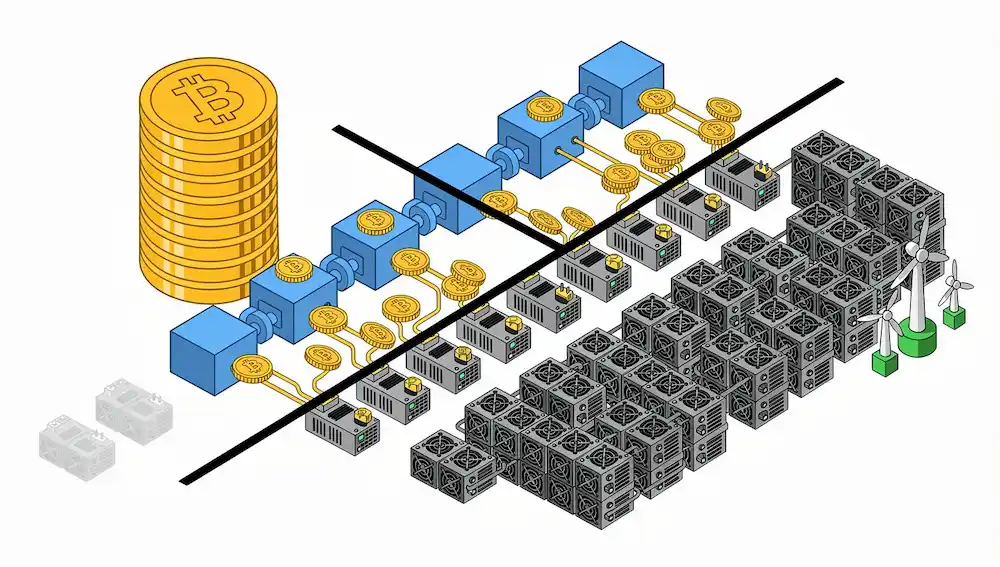
Miners prepare for halvings by upgrading to more efficient hardware, securing cheaper electricity, or building cash reserves before the event. The machines used for Bitcoin mining are called ASICs, Application-Specific Integrated Circuits, purpose-built to run the SHA-256 hashing algorithm. Older ASICs become unprofitable after a halving if the bitcoin price is not high enough to cover their electricity costs. Newer, more efficient machines extend the viable life of a mining operation.
The 2024 halving accelerated consolidation in the mining industry. Smaller operations with higher energy costs sold equipment or shut down. Larger, publicly traded mining companies with access to low-cost power and capital markets expanded their share of total hash rate. The top mining pools now control a significant portion of the blocks being added to the chain each day.
Mining difficulty adjusts automatically every 2,016 blocks to keep the block time close to ten minutes. If miners leave the network, difficulty drops, making it easier and cheaper for remaining miners to find blocks. If hash rate grows, difficulty rises, maintaining the same average pace. This self-correcting mechanism means the Bitcoin network continues producing blocks at a steady rate regardless of how many miners are participating at any given time.
Transaction fees have become a larger part of miner income over time. During periods of high network activity, fees can rival or even exceed the block subsidy for a given block. The April 2024 halving coincided with unusually high fees driven by demand for Runes, a new token standard that launched alongside the halving event. On that day, several blocks collected more in fees than the 3.125 BTC subsidy they paid out. That was a rare event at the time but may become more common as the subsidy continues to shrink. Details on how crypto works at the protocol level, including fee markets, are in the guide to what is crypto.
Block reward and bitcoin price: what history shows
Each of the three halvings before 2024 preceded a significant rise in the bitcoin price. The pattern is documented, though the sample size is small and the causes are debated. What the data shows is that reducing the rate of new supply entering the market, against a backdrop of growing or steady demand, has historically produced a supply shock that contributed to price appreciation.
- 2012 halving: Bitcoin rose roughly 9,520% in the year following the event, from about $12 to over $1,100.
- 2016 halving: Bitcoin rose roughly 3,402% over the 518 days after the halving, from around $650 to a then-record $19,700.
- 2020 halving: Bitcoin rose roughly 652% over the 335 days after the halving, reaching over $69,000 by November 2021.
The 2024 halving was unusual in that Bitcoin had already reached a new all-time high of $73,800 in March 2024, before the halving occurred. In previous cycles, the new all-time high came after the halving, not before. Whether this signals a change in how the market responds to halvings, or simply reflects the influence of spot Bitcoin ETFs approved in January 2024, is not yet clear.
Past performance does not guarantee future results. The bitcoin price depends on far more than the halving schedule alone: macroeconomic conditions, regulatory developments, institutional flows, and market sentiment all play a role. Halvings reduce new supply, but they do not control demand. Anyone treating the halving as a guaranteed price catalyst should factor in that this is a small sample size and that market conditions change with each cycle.
The next bitcoin halving: what to expect in 2028
The next bitcoin halving is expected in April 2028, when the network reaches block height 1,050,000. At that point, the protocol will automatically cut the block reward from 3.125 BTC to 1.5625 BTC per block. Daily production will drop from approximately 450 BTC to around 225 BTC.
The exact date will become clearer as it approaches. Block times fluctuate around the ten-minute average, so projections made more than a year out can be off by days or even weeks. Block explorers and halving countdown sites update their estimates in real time based on actual block production. The 2028 halving will be the fifth in Bitcoin’s history and will reduce the annual issuance rate to well below 0.5%.
Frequently asked questions
What is the current bitcoin block reward?
The current bitcoin block reward is 3.125 BTC per block. This has been the case since the fourth halving on April 20, 2024, at block height 840,000. The reward consists of a block subsidy of 3.125 BTC in newly created bitcoin, plus any transaction fees from the transactions included in that block.
How much bitcoin is mined per day?
At the current reward of 3.125 BTC per block and an average block time of ten minutes, the network produces approximately 144 blocks per day. That works out to roughly 450 BTC per day in new issuance from block subsidies. Transaction fees add a variable amount on top of that figure.
How does the block reward halving work technically?
The halving is triggered automatically by the Bitcoin code every 210,000 blocks. It is implemented as a right bit shift on the block subsidy value, which means the reward is divided by two at the protocol level. The shift rounds down if the result is not a whole number of satoshis. This is why the total supply cap is technically 20,999,999.9769 BTC rather than exactly 21 million.
Will miners still earn money after the reward goes to zero?
Yes, miners will continue earning transaction fees after the block subsidy reaches zero around 2140. At that point, fees become the only component of the block reward. The question of whether fees alone will provide sufficient incentive to keep miners securing the network is one Bitcoin researchers and developers are actively working through. The expectation is that growing adoption and higher transaction volumes will make the fee market large enough to sustain mining operations.
What is the difference between block subsidy and transaction fees?
The block subsidy is newly created bitcoin issued by the protocol to the miner. It is the component that halves every 210,000 blocks. Transaction fees are payments made by users to have their transactions included in a block. Both amounts are collected by the miner in the coinbase transaction for that block. The subsidy is predictable and fixed by the protocol; fees are variable and determined by network demand.
Why is the bitcoin block reward important for investors?
The block reward controls the rate at which new bitcoin enters circulation. As the supply of new coins slows with each halving, and if demand holds steady or grows, basic economics suggest upward pressure on price. This mechanism underpins the store of value argument for Bitcoin: a predictable and decreasing issuance rate, combined with a hard cap on total supply, produces scarcity that no central authority can override. That said, the price of bitcoin depends on many factors, and the halving alone does not determine the outcome of any given market cycle.
Sources
- Bitcoin: A Peer-to-Peer Electronic Cash System, Satoshi Nakamoto, 2008
- mempool.space, live Bitcoin block explorer with block reward and fee data